Hello and welcome to your first lesson. This course is designed to build your expertise in frontend system design, moving from the implementation-focused skills you've developed over the past two years towards the architectural thinking required for senior engineering roles.
Today, we will start by demystifying the frontend system design interview itself. We'll explore its purpose, what interviewers are truly assessing, and how it differs from the coding challenges you might be more familiar with. By the end of this lesson, you will have a clear understanding of the typical structure and expectations of these interviews, providing a solid foundation for all the topics we'll cover in this course.
The Shift from Code to Architecture
As a frontend developer, you're skilled at building user interfaces. However, as applications grow in complexity and scale, simply building components is not enough. Modern frontend roles demand architectural thinking: the ability to design robust, scalable, and maintainable systems. The system design interview is how companies evaluate this crucial skill.
Unlike algorithmic challenges that have a clear right or wrong answer, system design interviews are open-ended conversations. They usually begin with a vague prompt, such as "Design a news feed" or "Design a collaborative document editor." The goal isn't to write production-ready code in 45 minutes; it's to demonstrate how you think.
To understand what interviewers are looking for and how this round differs from a coding interview, please read the following sections from the "Frontend System Design: A Complete Interview Prep Guide".
Frontend System Design: The Complete Guide 2026
This article provides an excellent overview of the mindset and skills evaluated in a frontend system design interview.
Please read two sections. First, start with What interviewers actually evaluate. This part explains the focus on problem decomposition, trade-off analysis, and structured reasoning. Then, continue to the next section, How frontend System Design differs from coding rounds, which contrasts the open-ended, discussion-based nature of system design with the concrete pass/fail criteria of algorithmic interviews.
The key takeaway is that interviewers are evaluating your thought process. They want to see evidence of structured reasoning, trade-off awareness, and what the article calls "ownership-level thinking." This means you are expected to drive the conversation, ask clarifying questions, and justify your decisions, much like a senior engineer leading a project.
Expectations by Experience Level
The expectations for a system design interview vary significantly with experience. While a junior engineer might be asked about basic API design, a senior engineer is expected to navigate complex, large-scale distributed systems.
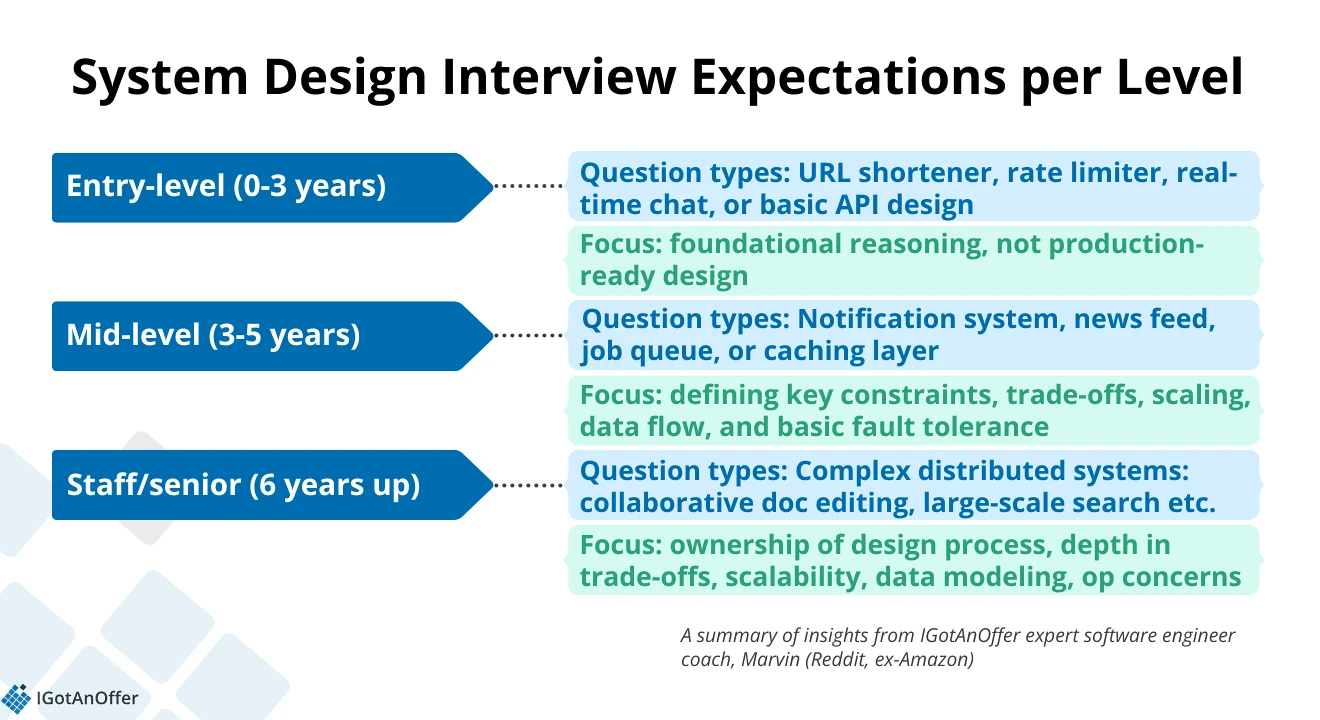
With two years of experience, you are likely positioned in the "Mid-level" category. However, since your goal is to prepare for a job switch and advance your career, we will focus on developing the skills needed to meet the "Staff/senior" expectations: demonstrating ownership of the design process, showing depth in trade-offs, and reasoning about scalability and operations.
A GitHub Gist, "Frontend System Design Interview Guide," provides a concise summary of what interviewers look for in a candidate aiming for a senior (SDE2/Senior) role.
Frontend System Design Interview Guide (RADIO Framework) · GitHub
This guide includes a very practical "cheat sheet" that summarizes key signals interviewers look for.
In the "Interview Cheat Sheet" section at the end of the document, please find and read the table under the heading What SDE2 Interviewers Look For. Pay close attention to the "Dimension" and "Signals" columns.
This table highlights the tangible skills you need to display, such as "Structured thinking," "Frontend depth," and "Tradeoff awareness." Throughout this course, we will systematically build each of these capabilities.
Structuring Your Answer: The RADIO Framework
Given the open-ended nature of the interview, having a structured approach is critical. It prevents you from rambling or diving too deep into a minor detail. A popular and effective method is the RADIO(S) framework.
This framework provides a step-by-step guide to structure your 45-60 minute interview, ensuring you cover all the important aspects of the design.

The video below gives a quick, high-level overview of this framework.
Front End System Design Fundamentals (All In One Comprehensive Guide)
Shivam Bhalla, the video's author, provides a concise introduction to the RADIO framework and what each letter stands for.
Please watch the segment from the beginning where the presenter explains each step of the framework: Requirements, Architecture, Data flow, API, and Optimizations.
The framework ensures you begin by understanding the problem before jumping to a solution. Here’s how you can vocalize this structure in an interview to guide the conversation, taken from the "Frontend System Design Interview Guide" Gist.
Frontend System Design Interview Guide (RADIO Framework) · GitHub
This section provides a script-like template for structuring your interview response.
Find the section titled How to Structure Your Interview Answer. This demonstrates how to narrate your thought process to the interviewer, setting clear expectations for the discussion.
This narrative approach is powerful because it puts you in control of the interview and shows the interviewer you have a clear, methodical plan.
Time Management
A common mistake is spending too much time on one area. The framework also helps with time allocation. Here is a suggested breakdown for a 45-minute interview.
Frontend System Design Interview Guide (RADIO Framework) · GitHub
This section provides a practical time allocation table.
Return to the "Interview Cheat Sheet" section and review the time allocation table. Notice how a significant portion of time is reserved for "Optimizations"—this is often where you demonstrate seniority.
The most important part of the interview often isn't the initial design, but the discussion of trade-offs and optimizations. This is where you connect the problem's constraints (e.g., scale, performance needs, security) to your architectural choices. Asking intelligent questions to uncover these constraints is a hallmark of a senior engineer.
The following video excerpt provides excellent examples of the types of "smart questions" you should ask during the initial requirements-gathering phase.
Frontend System Design to get to Senior Engineer
The presenter, from the channel theSeniorDev, explains that the questions you ask are just as important as the answers you give.
Watch the segment from this timestamp, which lists several insightful questions related to user traffic, device types, loading speed, and security concerns.
Asking these questions demonstrates that you are thinking about the system holistically and considering real-world operational challenges, not just the "happy path" implementation.
Conclusion
In this lesson, we've laid the groundwork for our journey into frontend system design. You now have a mental model for what a frontend system design interview entails and how to approach it.
Here are the key takeaways:
- Purpose: These interviews evaluate your ability to think architecturally, manage ambiguity, and make justified design decisions.
- Expectations: Interviewers look for structured thinking, a deep understanding of trade-offs, and a sense of ownership over the problem. Your goal is to demonstrate the qualities of a senior engineer.
- Process: The interview is a collaborative discussion. Using a framework like RADIOS helps structure your thoughts, manage time, and ensure you cover all critical aspects from requirements to optimizations.
- Seniority Signal: The quality of your questions is as important as your answers. Probing for non-functional requirements and constraints is key to demonstrating experience.
In our next lesson, we will dive deep into the first and most critical step of the RADIOS framework: gathering and clarifying functional and non-functional requirements. Mastering this phase sets the foundation for a successful design and a strong interview performance.