Hello! Welcome to our next lesson.
In our previous session, we explored Vyadhi-Pratyanikatvam, the principle of a drug acting specifically against a disease, and correlated it with the modern concept of pharmacological antagonism. Today, we shift our focus from therapies that counteract pathology to those that build vitality and promote health.
This lesson addresses the learning outcome: Differentiate between Rasayana (rejuvenation) and Vajeekarana (aphrodisiac) mechanisms using Dhatu-Agni principles. While both are considered branches of salutogenesis, their mechanisms of action at the tissue level are distinct. Understanding this distinction is key to their precise clinical application and aligns with your interest in the underlying theoretical frameworks of drug action.
1. The Foundation: Dhatu-Agni and Tissue Metabolism
Before we compare Rasayana and Vajikarana, let's briefly revisit the core principle that governs their action: the Dhatu-Agni system. You'll be familiar with this from your BAMS studies, but let's frame it as the body's sequential metabolic engine.
Ayurveda posits that the body's seven tissues (Saptadhatus) are formed in a specific sequence, each nourishing the next. This process is mediated by a specific metabolic fire, or Agni, for each tissue.
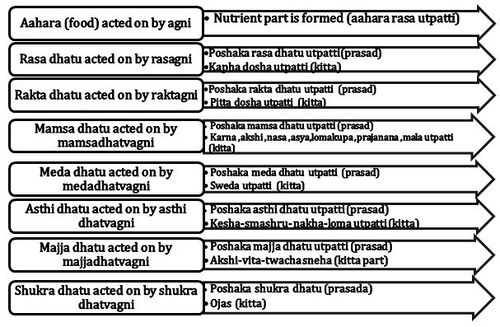
The cascade proceeds as follows:
Rasa → Rakta → Mamsa → Meda → Asthi → Majja → Shukra
The ultimate, most refined essence produced at the end of this entire metabolic process is Ojas, which represents the body's supreme vitality, resilience, and immunity. The health and quality of every Dhatu depend on the proper functioning of its corresponding Dhatvagni.
2. The Rasayana Mechanism: Systemic Rejuvenation
Rasayana literally means "the path of Rasa." It is the science of arresting aging and promoting longevity, intelligence, and immunity (Jara-Vyadhi-Nashanam). Its mechanism is not targeted at a single tissue but is designed to optimize the entire metabolic cascade.
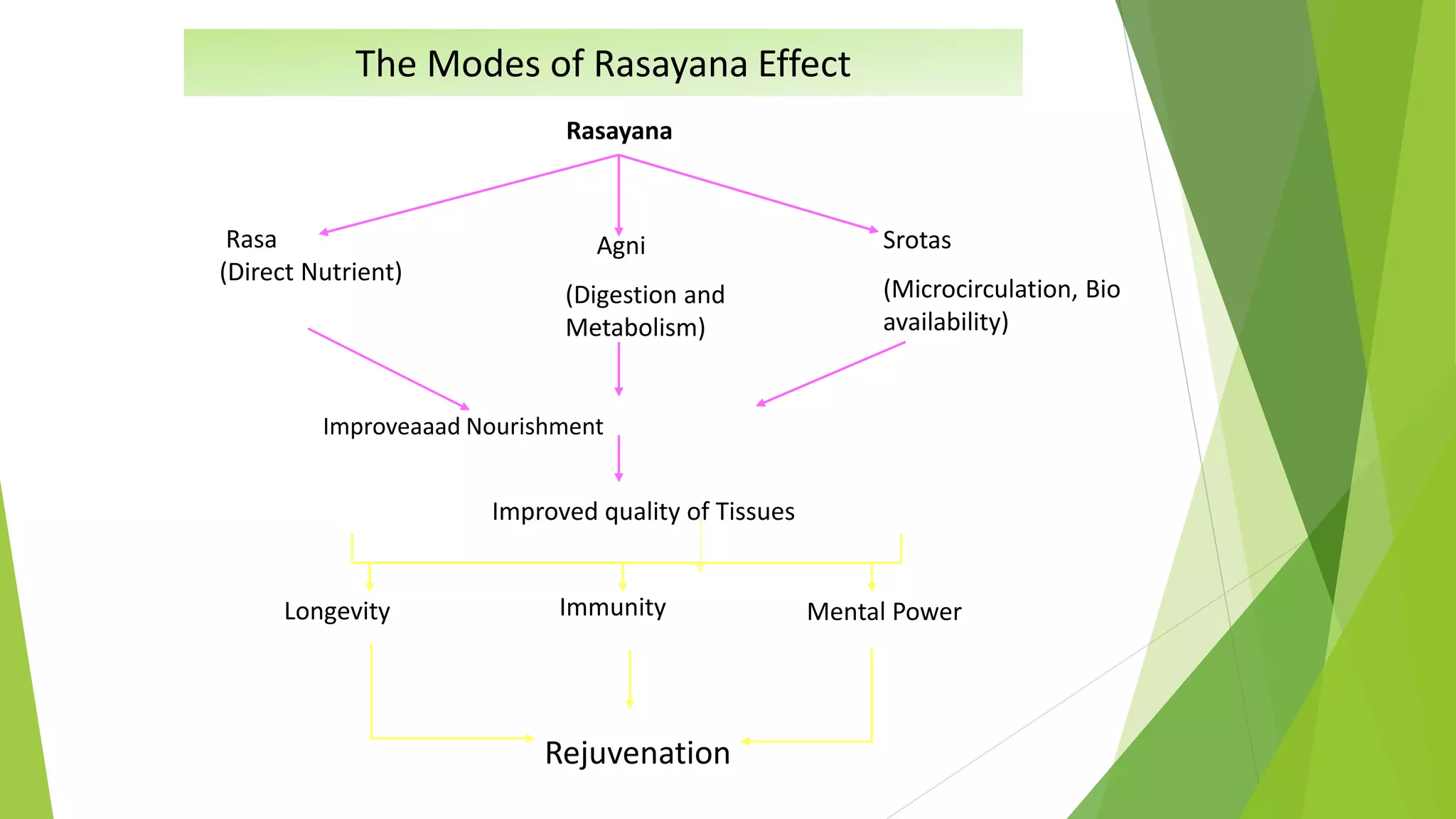
As the chart illustrates, Rasayana therapy achieves its goal primarily through three modes of action at the Dhatu-Agni level:
- Improves Rasa Quality: Rasayana dravyas are rich in nourishing properties that directly enhance the quality of the initial nutrient fluid, Rasa Dhatu. This provides superior raw material for all subsequent tissues.
- Optimizes Agni: They enhance metabolic function at both the central (Jatharagni) and tissue (Dhatvagni) levels. A well-functioning Agni ensures efficient transformation and prevents the formation of Ama (metabolic toxins).
- Clears Srotas: They ensure the micro-channels (Srotas) are clear, allowing for efficient transport of nutrients to every tissue and removal of waste products.
The effect is systemic. By improving the entire chain of nourishment from Rasa to Shukra, Rasayana therapy leads to the qualitative improvement of all seven Dhatus and the abundant production of high-quality Ojas.
3. The Vajikarana Mechanism: Focused Vitality
Vajikarana translates to "that which gives the vigor of a horse (Vaji)" and is primarily concerned with sexual potency, performance, and healthy progeny. While it promotes general health, its mechanism has a more specific focus.
To understand this, let's explore an article that discusses the broader health benefits of Vajikarana and its relationship with Rasayana.
UTILITY OF VAJIKARANA IN GENERAL HEALTH- A REVIEW
The article 'UTILITY OF VAJIKARANA IN GENERAL HEALTH- A REVIEW' provides an excellent overview. It explains the core concepts and clarifies how Vajikarana is considered a special category of Rasayana.
Please read the short paragraph under the heading 'General health benefits of selected Vajikarana drugs'. Pay special attention to the first sentence which defines the relationship between Vajikarana and Rasayana.
As the resource states, "Vajikarana is a distinctive category of Rasayana." This means it employs the same fundamental principles of nourishment but with a specialized target.
The mechanism of Vajikarana can be understood as follows:
- Prerequisite of Shodhana: Effective Vajikarana therapy, like Rasayana, begins after the body has been cleansed (Shodhana). This clears the Srotas of Ama and balances the Doshas, ensuring that the subsequent nourishing therapy can be effective.
- Targeted Nourishment of Shukra Dhatu: While Rasayana has a broad-spectrum effect on all Dhatus, Vajikarana dravyas have a potent and preferential action on the final tissue, Shukra Dhatu (reproductive tissue). Their Brimhana (bulk-promoting) and Jeevaniya (life-promoting) properties are directed specifically at nourishing and strengthening the reproductive system.
- Potentiation of Shukra Dhatvagni: These therapies act as powerful stimulants for Shukra Dhatvagni, leading to a rapid and abundant production of high-quality sperm and ovum.
- Enhancement of Ojas: By creating a surplus of superior quality Shukra Dhatu, Vajikarana indirectly leads to a significant increase in Ojas, as Ojas is the subtle essence of Shukra.
To explore this mechanism in more detail, let's return to the same article.
UTILITY OF VAJIKARANA IN GENERAL HEALTH- A REVIEW
The 'Discussion' and 'Mode of Action' sections of the article explain how Vajikarana works at the Dhatu level.
Please read from the beginning of the 'DISCUSSION' section down to the end of the 'Mode of Action' section. Focus on how the text describes the nourishment of Saptadhatu after Shodhana and the resulting formation of pure Ojas. Note the emphasis on Brimhana and Jeevaniya properties.
The key distinction is one of scope and emphasis. Rasayana is a wide-angle lens improving the entire landscape of the body. Vajikarana is a telephoto lens, focusing its power intensely on the reproductive system.
4. Comparative Analysis: Rasayana vs. Vajikarana
Let's summarize the differences based on their mechanisms of action:
| Feature | Rasayana (Rejuvenation) | Vajikarana (Aphrodisiac) |
|---|---|---|
| Primary Goal | Longevity, immunity, and prevention of aging (Jara-Vyadhi-Nashanam) | Sexual potency, stamina, and healthy progeny. |
| Scope of Action | Systemic and holistic; acts on all seven Dhatus equally. | Specialized and targeted; acts predominantly on Shukra Dhatu. |
| Effect on Dhatu-Agni | Optimizes and balances all seven Dhatvagnis. | Potently stimulates the Shukra Dhatvagni. |
| Primary Outcome | Improved quality of all tissues, enhanced immunity (Ojas). | Abundant production of high-quality Shukra Dhatu and Ojas. |
| Relationship | A broad therapy for systemic health. | A specialized branch of Rasayana for reproductive health. |
Therefore, a simple way to remember the relationship is: All Vajikarana therapies are inherently Rasayanas, but not all Rasayanas have a Vajikarana effect. For example, Guduchi is a premier Rasayana for the immune system, but it is not considered a primary Vajikarana drug. Conversely, Ashwagandha is a potent Vajikarana that also provides systemic Rasayana benefits.
Test your understanding!
An Ayurvedic herb, when studied, is found to significantly increase the quality and quantity of Majja Dhatu (marrow and nervous tissue), leading to improved cognitive function and nerve stability. It also moderately improves RBC counts (Rakta Dhatu) but has a negligible effect on sperm count (Shukra Dhatu).
Would you classify this herb's primary action as Rasayana or Vajikarana? Justify your answer using Dhatu-Agni principles.
Show answer
The herb's primary action would be classified as Rasayana, specifically a Medhya Rasayana (rejuvenator for the intellect).
Justification:
The herb's action is not targeted solely at the terminal Dhatu. Instead, it demonstrates a significant effect on an upstream tissue (Majja Dhatu) and a moderate effect on another (Rakta Dhatu). This indicates a systemic, rather than a specialized, nourishing action. It appears to be optimizing the Majja Dhatvagni and Rakta Dhatvagni without a preferential, potent effect on the Shukra Dhatvagni. Because its benefits are distributed across multiple Dhatus rather than being concentrated on Shukra, its mechanism is characteristic of a Rasayana, not a Vajikarana.
Conclusion
Today we've differentiated two of Ayurveda's most important health-promoting therapies by examining their distinct mechanisms at the tissue level.
Key Takeaways:
- Both Rasayana and Vajikarana work by nourishing the Dhatus through the optimization of Dhatu-Agni.
- Rasayana is a systemic therapy that aims to improve the quality of all seven Dhatus comprehensively, leading to longevity and immunity.
- Vajikarana is a specialized therapy that focuses its potent action primarily on the Shukra Dhatu to enhance reproductive health and virility.
- The difference lies not just in the goal (longevity vs. libido) but in the scope and target of the action within the body's metabolic pathways.
Preview of the Next Lesson:
Having explored drug actions that are specific (Vyadhi-Pratyanika), synergistic (Yogavahi), and health-promoting (Rasayana/Vajikarana), we will now turn to the factors that govern the selection of the right drug for the right situation. In our next lesson, we will learn to apply Desha-Kala-Bheshaja (place-time-drug) relationships in selecting drugs for specific disorders.