Hello! Welcome back to our journey through advanced Dravyaguna.
In our last lesson, we analyzed the deep-acting mechanisms of Samshodhana (purification) and Samshamana (palliation) at the Dhatu level. We established how these strategies either remove or pacify vitiated Doshas to restore tissue health. This raises a crucial question in pharmacology: once a drug is administered, how do we ensure it reaches the target tissue and exerts its maximum effect?
This brings us to today's learning outcome: Evaluate the concept of Yogavahi (catalytic agent) and its role in drug synergy. The principle of Yogavahi is one of Ayurveda's most sophisticated answers to enhancing drug efficacy and achieving targeted action. Understanding it is key to deciphering the logic behind complex polyherbal formulations and bridging classical pharmacology with modern concepts like pharmacokinetics and drug synergy, which directly aligns with your goal of evidence-based practice.
1. Defining Yogavahi: The Carrier and The Catalyst
The term Yogavahi is a cornerstone of Ayurvedic pharmaceutics (Bhaishajya Kalpana). It refers to a substance that, when combined with other drugs, enhances their properties and carries them to the target tissues more efficiently. This concept has a fascinating parallel in modern pharmacology: the "bioenhancer."
To begin, let's establish a clear definition by drawing from both classical and contemporary interpretations.
Concepts of Yogavahi Dravyas in Ayurveda
This article, 'Concepts of Yogavahi Dravyas in Ayurveda', provides an excellent introduction. It defines the term and connects it to the modern concept of bioenhancers.
Please read the 'INTRODUCTION' and the section titled 'YOGVAHI'. Focus on how the authors define a Yogavahi substance and the dual roles it plays as a 'carrier' and a 'catalyst'.
As the article clarifies, a Yogavahi substance possesses a unique ability. It acts as a vehicle to transport the active principles of the main drug to the site of action, often enhancing its absorption and bioavailability. Critically, it does this while also augmenting the drug's therapeutic action, a synergistic effect central to Ayurvedic formulations.
This dual action can be summarized as:
- Carrier (Vahana): It facilitates the delivery of a drug to a specific tissue or organ system.
- Catalyst (Prabhava): It enhances the potency and efficacy of the co-administered drug, often allowing for a lower dose of the primary drug to be used.
This principle explains why so many Ayurvedic formulations are not single herbs but complex mixtures. The inclusion of a Yogavahi ingredient is a deliberate pharmacological strategy to maximize therapeutic outcomes.
2. The Pantheon of Yogavahis: Key Examples and Mechanisms
Ayurvedic texts identify several substances renowned for their Yogavahi properties. Let's explore the most prominent examples, examining both their classical rationale and the modern scientific understanding of their mechanisms.
a) Pippali (Piper longum) and Maricha (Piper nigrum)
Perhaps the most famous and well-researched Yogavahis, Pippali and Maricha are key components of the famous Trikatu formulation. Their bioenhancing effect is primarily attributed to the alkaloid piperine.
An appraisal of the bioavailability enhancers in Ayurveda ...
To understand the modern scientific basis of Yogavahi action, we'll turn to a research paper from the National Center for Biotechnology Information (NCBI). It details the scientifically validated mechanisms of piperine.
Please read the section 'Yogavahi' and the following section 'Recent scientific evidences for bio-enhancing effect of Pippali (piperine)'. Focus on the proposed mechanisms of action listed, such as the inhibition of specific enzymes.
As the paper details, piperine's bioenhancing effect is not a vague concept; it has specific, measurable mechanisms:
- Inhibition of Metabolic Enzymes: Piperine inhibits key enzymes in the liver and intestinal wall, such as cytochrome P450 (specifically CYP3A4) and P-glycoprotein (P-gp). These enzymes are responsible for the "first-pass metabolism" that breaks down many drugs before they can enter systemic circulation. By inhibiting them, piperine allows more of the primary drug to be absorbed intact.
- Enhanced Absorption: Piperine can increase blood flow to the gastrointestinal tract and may alter the fluidity of the intestinal cell membrane, making it more permeable to other drug molecules.
- Inhibition of Glucuronidation: This is another key metabolic pathway that deactivates drugs by making them water-soluble for excretion. Piperine inhibits this process, prolonging the drug's active life in the body.
In essence, piperine runs interference for the primary drug, protecting it from the body's metabolic defenses and ensuring more of it reaches its target.
b) Madhu (Honey)
Acharya Sushruta famously declared honey to be 'Param Yogavahi'—the supreme catalytic agent.
Classical Rationale:
As noted in the first article we read ("Concepts of Yogavahi Dravyas in Ayurveda"), honey's efficacy comes from its Sukshma (subtle, penetrating) Guna. This allows it to penetrate the deepest tissues (Dhatus) and micro-channels (Srotas), carrying the medicinal properties of the herbs mixed with it. Its heating potency (Ushna Virya), despite its sweet taste, makes it particularly effective for carrying drugs intended to pacify Kapha dosha.
Modern Perspective:
Honey is a complex mixture of enzymes, organic acids, and simple sugars (fructose and glucose). The simple sugars provide a rapid energy source and can facilitate the transport of other molecules across cell membranes through specific transporters.
c) Ghrita (Medicated Ghee)
Ghrita is another premier Yogavahi, especially for herbs targeting the nervous system and for delivering fat-soluble active compounds.
Classical Rationale:
The lipophilic (fat-loving) nature of ghee allows it to easily cross the lipid-based cell membranes and even the blood-brain barrier. Charaka states that ghee has the unique ability (Prabhava) to absorb the properties of the herbs processed with it (Samskarasya Anuvartana) without losing its own inherent nourishing qualities.
Modern Perspective:
This aligns perfectly with modern pharmacokinetics. Many active plant compounds (like saponins in Brahmi or withanolides in Ashwagandha) are fat-soluble. Processing these herbs into a medicated ghrita creates a lipid-based delivery system that dramatically enhances their absorption and distribution to lipid-rich tissues like the brain.
d) Parada (Purified Mercury) and other Metals/Minerals
The use of Parada in Rasa Shastra is fundamentally linked to its supreme Yogavahi property. When properly purified and processed into Bhasmas (e.g., Rasa Sindura), it is believed to potentiate the accompanying herbs exponentially.
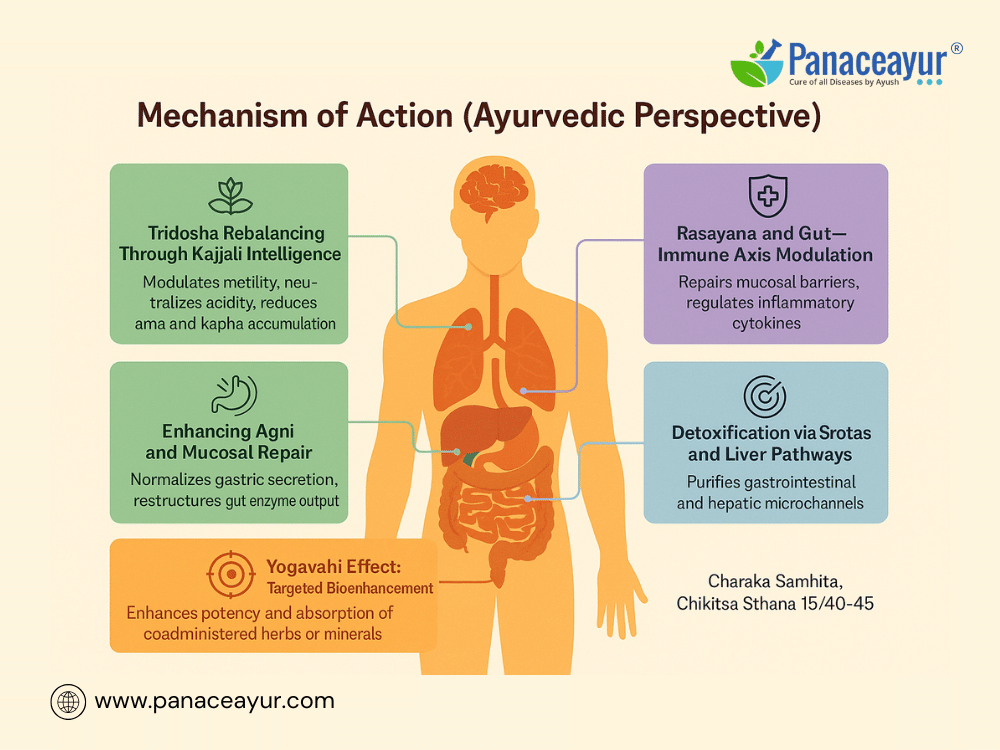
The modern analogue here could be nanoparticles. The intricate processing of Bhasmas creates micro-fine particles that have a vast surface area and unique absorption characteristics, allowing for targeted delivery and enhanced cellular uptake.
Test your understanding!
A patient with a Vata-dominant neurological condition requires a therapeutic formula containing the herb Ashwagandha. The key active compounds in Ashwagandha (withanolides) are known to be lipophilic (fat-soluble). You have two primary Yogavahi substances to choose from as a vehicle (Anupana): Madhu (honey) or Ghrita (ghee).
Which one would you choose and why? Justify your answer based on the principles of Yogavahi and modern pharmacokinetics.
Show answer
The ideal choice would be Ghrita.
Justification:
- Pharmacokinetic Matching: Since the active compounds (withanolides) are lipophilic, they will dissolve readily in Ghrita, a lipid medium. This enhances their absorption through the gut wall and facilitates their transport across the blood-brain barrier, which is also lipid-based, to target the nervous system. Honey (Madhu), being primarily water-based, would be a poor solvent and vehicle for these compounds.
- Guna-Karma Alignment: The patient has a Vata-dominant condition. Ghrita has Snigdha (unctuous) and Guru (heavy) qualities, which are excellent for pacifying the Ruksha (dry) and Laghu (light) qualities of vitiated Vata. Honey, with its Ushna Virya, might not be the primary choice for pacifying Vata unless specific Kapha involvement is also present.
3. Visualizing Synergy: A Modern Research Example
The ultimate role of a Yogavahi is to create synergy, where the combined effect is greater than the sum of the parts (1 + 1 > 2). Modern science provides powerful tools to visualize and validate this ancient concept.
A classic example is the combination of Curcumin (from Haridra / Turmeric) and Piperine (from Pippali / Black Pepper). Curcumin has potent anti-inflammatory and neuroprotective properties but suffers from extremely poor bioavailability. Piperine is the solution.

This image perfectly demonstrates the bridge between classical wisdom and modern validation:
- The Problem: Curcumin's low bioavailability limits its clinical use.
- The Ayurvedic Solution: Combine it with a Yogavahi, Pippali (piperine).
- The Modern Proof: Researchers use methods like in vitro assays and cell line studies to quantify the "synergy quotient." Studies have shown that piperine can increase the bioavailability of curcumin by up to 2000%. This is a direct, measurable validation of the Yogavahi principle.
Conclusion
Today we have evaluated the profound concept of Yogavahi. Far from being a vague idea, it is a precise pharmacological principle used to enhance drug delivery, potency, and synergy.
Key Takeaways:
- Yogavahi substances act as both carriers and catalysts, a concept mirrored by modern "bioenhancers."
- Key examples like Pippali, Madhu, and Ghrita have distinct properties that make them suitable for different types of drugs and target tissues.
- The mechanisms of action for Yogavahis like piperine are now well-understood scientifically, involving the inhibition of metabolic enzymes (e.g., CYP3A4, P-gp) and enhanced absorption.
- The principle of Yogavahi is a cornerstone of Ayurvedic polyherbal formulations, designed to achieve synergy and maximize therapeutic effects, as demonstrated by the well-researched combination of curcumin and piperine.
Preview of the Next Lesson:
We've seen how a Yogavahi can make a drug work better. But what about drugs that are chosen for their direct opposition to a disease's nature? In our next lesson, we will investigate this by exploring the concept of Vyadhi-Pratyanikatvam and correlating it with the modern pharmacological principle of antagonism.