Hello! Welcome back to our module on functional digestive disorders.
In our previous lesson, we established that Agnimandya (impaired digestive fire) is the Ayurvedic equivalent of functional dyspepsia and the root cause of Ama (metabolic toxins). We explored how Deepana-Pachana therapies, using formulations like Trikatu and Chitrakadi Vati, work to restore digestive health.
Today, we'll follow this pathological process downstream. When Agnimandya becomes chronic, its dysfunction extends beyond the stomach and begins to impair the small intestine's ability to absorb and process nutrients. This leads to a complex condition known as Grahani Roga. Your learning outcome for this lesson is to correlate the clinical presentations of Irritable Bowel Syndrome (IBS) with the classical Samprapti of Grahani Roga.
This lesson is crucial because IBS is one of the most common gastrointestinal disorders seen in clinical practice today. Understanding its deep correlation with Grahani provides a powerful diagnostic and therapeutic framework that goes far beyond simple symptomatic management.
1. Understanding Grahani: Anatomy and Pathogenesis (Samprapti)
The term Grahani refers to both an anatomical site and a disease state.
-
Anatomical Site: Classically, Grahani is described as the "sixth Kala," situated above the Pakvashaya (colon) and below the Amashaya (stomach). It is the primary seat of Jatharagni (digestive fire). Functionally and anatomically, this corresponds to the duodenum and small intestine, where the most critical digestive and absorptive processes occur. Its very name comes from the root Grah, meaning "to hold" or "to grasp," highlighting its function of retaining food for digestion.
-
Disease State (Grahani Roga): When this organ becomes dysfunctional due to weakened Agni, it leads to the disease Grahani Roga. The pathogenesis, or Samprapti, follows a clear sequence which begins with the concepts we discussed in the last lesson.
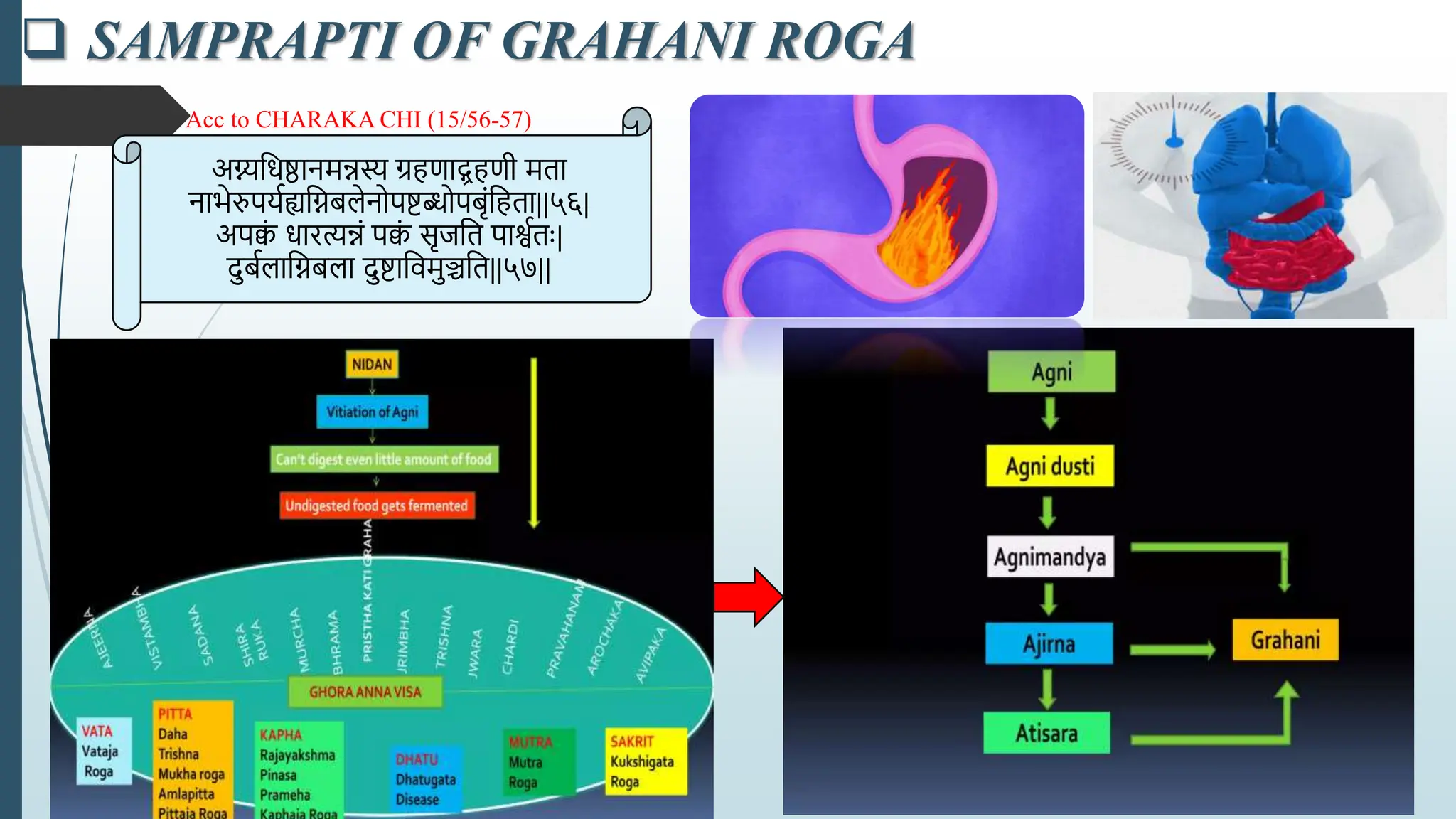
The sequence is as follows:
- Nidana Sevana: Consumption of unwholesome food, irregular eating habits, suppression of natural urges, and psychological stress.
- Agni Dusti: These factors vitiate the Jatharagni, leading to Mandagni (hypofunction of Agni).
- Ama Formation: With a weak digestive fire, food is not properly digested, leading to the formation of Ama.
- Grahani Vitiation: This Ama and the vitiated Doshas directly damage the functional integrity of the Grahani organ, impairing its ability to hold, digest, and separate nutrients (Sara) from waste (Kitta).
- Symptom Manifestation: The dysfunctional Grahani then expels food prematurely, leading to the hallmark symptom: Muhurbaddha Muhurdrava Mala Pravritti—the passage of stool that alternates between being formed/constipated and loose/diarrheal.
To delve deeper into this pathogenic process, please review the following text.
Grahani: An Ayurvedic and Integrative Medical Review ... - ijrpr
The paper 'Grahani: An Ayurvedic and Integrative Medical Review' provides an excellent overview of the pathogenesis.
Please read section 3.0 Pathophysiology of Grahani Roga. Focus on the descriptions of Nidana (etiological factors), the Samprapti (pathogenesis) cascade, and the Purvarupa/Rupa (premonitory and cardinal symptoms). This will solidify your understanding of how Grahani Roga develops.
2. Clinical Classifications: Grahani Roga and Irritable Bowel Syndrome
The beauty of the Ayurvedic system lies in its ability to classify a single disease into different types based on the predominant Dosha, which allows for highly personalized treatment. This is where the correlation with IBS becomes strikingly clear.
First, let's watch a short video where a practitioner describes the clinical presentation of the different types of Grahani.
Ayurvedic management of irritable bowel Syndrome |Compiled|
The video 'Ayurvedic management of irritable bowel Syndrome' provides a practical clinical perspective on Grahani Roga and its different types.
Watch the following segments: Introduction (00:00 - 02:02): This sets the stage by comparing Grahani to IBS. Kaphaja Grahani (05:24 - 09:23): Note the description of stools with mucus and a feeling of incomplete evacuation. Pittaja Grahani (13:41 - 16:02): Focus on the symptoms of burning sensation and loose, yellowish stools. Vataja Grahani (18:40 - 24:32): Pay attention to the erratic bowel habits, pain, bloating, and associated anxiety.
Now, let's formalize this by correlating these classical types with the modern subtypes of IBS, which are classified by the Rome IV criteria based on stool patterns.
| IBS Subtype (Rome IV Criteria) | Description |
|---|---|
| IBS-C | Irritable Bowel Syndrome with Constipation |
| IBS-D | Irritable Bowel Syndrome with Diarrhea |
| IBS-M | Irritable Bowel Syndrome with Mixed bowel habits |
| IBS-U | Irritable Bowel Syndrome, Unclassified |
The following reading provides a detailed, side-by-side correlation.
Grahani: An Ayurvedic and Integrative Medical Review ... - ijrpr
This section of the 'Grahani: An Ayurvedic and Integrative Medical Review' paper is the cornerstone of today's lesson. It directly maps the Dosha-based Grahani types to the modern IBS subtypes.
Please read section 4.0 Clinical Classification and Correlation with Modern Disorders very carefully. Pay special attention to subsections 4.1 (Dosha-Based Classification) and 4.2 (Correlation with Irritable Bowel Syndrome). The table at the end of this section provides a superb summary of the correlations.
To summarize the key correlations:
- Vataja Grahani: Characterized by erratic bowel function (Muhurbaddha Muhurdrava), abdominal pain, significant bloating (Adhmana), and anxiety. This aligns almost perfectly with IBS-M (Mixed type) and can also present as IBS-C (Constipation-predominant).
- Pittaja Grahani: Presents with loose, watery stools (Drava mala), a burning sensation (Daha), and inflammation. This strongly correlates with IBS-D (Diarrhea-predominant). In severe cases with bleeding, it can even reflect aspects of Inflammatory Bowel Disease (IBD) like ulcerative colitis.
- Kaphaja Grahani: Dominated by the passage of bulky, sticky stools with mucus (Sa-ama Purisha), nausea, and a feeling of heaviness. This can be linked to IBS-U (Unclassified) or presentations of IBS where mucus is the most prominent feature.
3. A Deeper Correlation: The Neuro-Enteric Connection
The correlation between Grahani and IBS goes deeper than just symptom-matching. Your BAMS background and interest in mechanisms will appreciate this next level of analysis, which connects Ayurvedic physiology to modern neurophysiology.
Ayurveda has always acknowledged the profound impact of the mind on the gut through the concept of Manasa Nidana (psychological causes) like stress and grief. This is the ancient articulation of the gut-brain axis, a central concept in the modern understanding of IBS.
Furthermore, the function of the gut is governed by Vata Dosha, specifically its subtypes Samana Vata and Vyana Vata.
- Samana Vata governs secretions and local movements, helping to hold and process food.
- Vyana Vata governs the large-scale peristaltic movements that propel contents through the GI tract.
Modern physiology describes a parallel system: the Enteric Nervous System (ENS), often called the "second brain," which has two main plexuses:
- Meissner's (Submucosal) Plexus: Controls local secretions, absorption, and muscle movements.
- Auerbach's (Myenteric) Plexus: Controls the overall motility and peristaltic reflexes of the gut.
The functional correlation is clear:
- Samana Vata functions are analogous to the Meissner's Plexus.
- Vyana Vata functions are analogous to the Auerbach's Plexus.
Therefore, the Vata derangement described in Grahani Samprapti is not just a vague concept; it can be understood as a dysregulation of the Enteric Nervous System, which is a core pathophysiological finding in IBS.
The following resource beautifully elucidates this connection.
an-inquisitive-insight-into-the-pathophysiology-and- ...
This paper, 'An Inquisitive Insight into the Pathophysiology and Management of Grahani Roga', provides a brilliant analysis connecting Vata subtypes to the enteric nervous system.
Please read the sections titled 'Physiology of Samana and Vyana vata' and 'Pathophysiology of Samana and Vyana vata'. Focus on how the authors simulate the functions of these Vata subtypes with the Meissner's and Auerbach's plexuses and how their vitiation leads to the core symptoms of Grahani/IBS.
Test your understanding!
A 30-year-old software engineer presents with a 6-month history of digestive issues that began after a high-stress project at work. They report recurrent abdominal cramping and significant bloating. Their main complaint is an unpredictable bowel pattern: for 2-3 days, they will have hard, difficult-to-pass stools, followed by 2-3 days of frequent, loose, and urgent bowel movements. They also report feeling anxious and having trouble sleeping.
Based on this clinical presentation:
- What is the most likely Ayurvedic diagnosis (specify the type of Grahani)?
- What is the corresponding modern diagnosis according to the Rome IV criteria?
- Briefly explain the Samprapti, linking the psychological stress, Agni, and the specific Dosha involved.
Show answer
- Ayurvedic Diagnosis: Vataja Grahani. The key indicators are the alternating constipation and diarrhea (Muhurbaddha Muhurdrava), abdominal cramping/pain (Shula), bloating (Adhmana), and the associated psychological symptoms of anxiety and insomnia, all of which are classic signs of Vata vitiation.
- Modern Diagnosis: IBS-M (Mixed bowel habits). The defining feature is the recurrent pattern of both constipation and diarrhea.
- Samprapti Explanation: The Manasa Nidana (psychological cause) of high stress directly vitiated Vata Dosha and suppressed the Jatharagni (Mandagni). This impaired digestive fire led to Ama formation. The vitiated Vata, particularly its Samana and Vyana aspects, dysregulated the enteric nervous system, causing the erratic motility of the Grahani (small intestine). This results in the alternating pattern of over-absorption (leading to hard, dry stool) and under-absorption with rapid transit (leading to loose stool).
Conclusion
Today, we have established a robust correlation between a classical Ayurvedic disease and a common modern diagnosis. This is not just an academic exercise; it provides a clinically sophisticated lens through which to view and manage functional bowel disorders.
Key Takeaways:
- Grahani Roga is the classical Ayurvedic counterpart to Irritable Bowel Syndrome (IBS).
- The pathogenesis (Samprapti) originates from Agnimandya, leading to Ama formation and subsequent dysfunction of the Grahani organ (small intestine).
- The Dosha-based classifications of Grahani align remarkably well with the modern subtypes of IBS:
- Vataja Grahani ↔ IBS-M / IBS-C
- Pittaja Grahani ↔ IBS-D
- Kaphaja Grahani ↔ Mucus-predominant IBS
- The Ayurvedic understanding of Vata vitiation in Grahani provides a deep physiological explanation for the dysmotility and visceral hypersensitivity seen in IBS, correlating with the modern concept of the gut-brain axis and the enteric nervous system.
Preview of the Next Lesson:
Having now learned to diagnose the different types of Grahani/IBS, the next logical step is treatment. In our next lesson, we will focus on the therapeutic principles, where you will learn to select appropriate Deepana, Pachana, and Grahi Dravyas for different Dosha-dominant Grahani presentations.