Hello and welcome back to our module on advanced integrative practice.
In our last lesson, we focused on ensuring safety from an internal perspective by analyzing how a patient's unique constitution (Prakriti) and current imbalance (Vikriti) influence their response to a given Dravya. We saw how tailoring treatment to this internal environment is a cornerstone of personalized Ayurvedic medicine.
Today, we shift our focus to external safety. In a world where many patients use both Ayurvedic and allopathic medicines, understanding the potential for interactions is no longer optional—it's a core competency for any responsible integrative practitioner. Your learning outcome for this lesson is to analyze potential herb-drug interactions between common Ayurvedic and allopathic medicines. We will move beyond simple lists of what not to mix, and delve into the mechanisms of why these interactions occur, empowering you to think critically in a clinical setting.
1. Understanding the Mechanisms of Herb-Drug Interactions (HDIs)
Before we look at specific examples, it's crucial to understand the two primary ways herbs and drugs can interact. Most interactions fall into one of two categories: Pharmacokinetic or Pharmacodynamic.

To explore these mechanisms in more detail, we'll turn to a high-quality review article that breaks down the science of HDIs.
Understanding the relevance of herb–drug interaction studies ...
The paper 'Understanding the relevance of herb–drug interaction studies' provides a deep dive into the scientific basis of HDIs. It is essential for grasping the 'why' behind these interactions.
Please read the sections titled 'Mechanisms of HDIs', 'Pharmacokinetic HDIs' (including its subsections on Absorption, Distribution, Metabolism, and Elimination), and 'Pharmacodynamic HDIs'. As you read, focus on understanding: The fundamental difference between pharmacokinetic (PK) and pharmacodynamic (PD) interactions. In PK interactions, pay special attention to the role of Cytochrome P450 (CYP) enzymes in metabolism. Note the difference between enzyme induction (which can reduce a drug's effect) and inhibition (which can increase a drug's effect and toxicity). Also in PK interactions, grasp the concept of transporters like P-glycoprotein (P-gp) and their role in drug elimination. In PD interactions, focus on the concepts of synergism/addition (effects are combined) and antagonism (effects are opposed).
Let's summarize the key points from the reading.
A. Pharmacokinetic (PK) Interactions: "What the body does to the drug"
These interactions occur when an herb alters the Absorption, Distribution, Metabolism, or Excretion (ADME) of an allopathic drug.
- Absorption: An herb might change how much of a drug is absorbed. For example, a bulk-forming laxative herb like Psyllium (Isabgol) can speed up intestinal transit, reducing the time available for another drug to be absorbed.
- Distribution: Some drugs travel in the bloodstream bound to proteins. An herb could potentially displace a drug from these proteins, increasing the amount of "free" (active) drug in circulation. This is particularly dangerous for drugs with a narrow therapeutic window, like Warfarin.
- Metabolism: This is the most common and clinically significant mechanism. The liver uses a family of enzymes called Cytochrome P450 (CYP450) to break down most drugs and foreign substances.
- Enzyme Inhibition: Some herbal constituents can block a specific CYP enzyme. If a drug is metabolized by that enzyme, it won't be broken down as quickly. Its levels in the blood will rise, potentially leading to toxicity. A classic example is Piperine from Pippali, which inhibits CYP3A4, increasing the levels of many drugs.
- Enzyme Induction: Other herbs can "induce" or ramp up the production of a CYP enzyme. This makes the enzyme more efficient, so it breaks down a co-administered drug much faster. The drug's blood levels will drop, leading to a loss of efficacy. The most famous example is St. John's Wort.
- Excretion: This process, often involving the kidneys and gut, can be influenced by transport proteins. P-glycoprotein (P-gp) is an efflux pump that pushes drugs out of cells and into the gut or urine for elimination. If an herb inhibits P-gp, it can reduce the elimination of a drug, causing its levels to rise.
B. Pharmacodynamic (PD) Interactions: "What the drug does to the body"
These interactions happen when an herb and a drug have similar or opposing effects at the target site (e.g., a receptor).
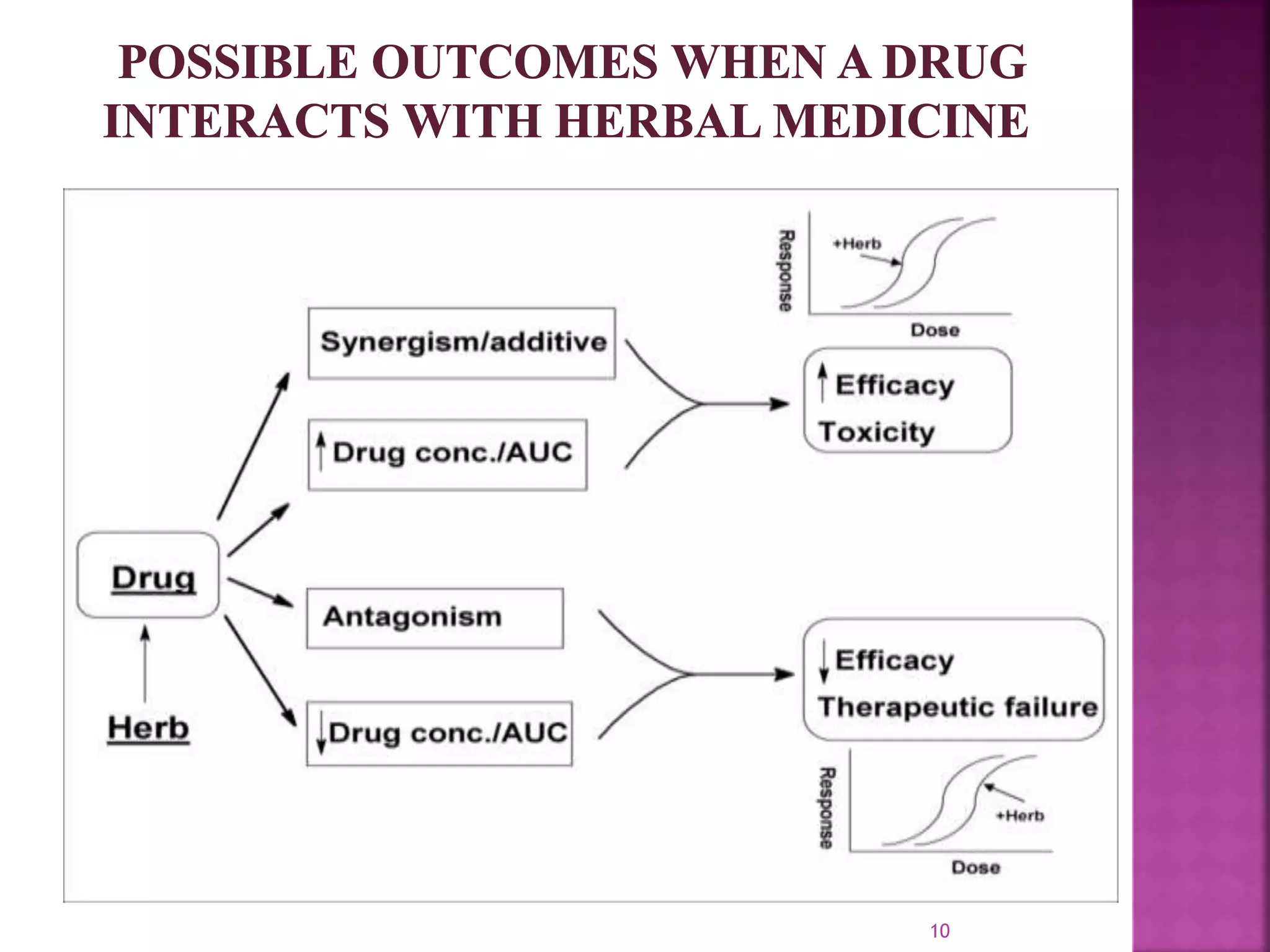
- Synergistic/Additive Effect: The herb and drug have similar effects, and their combined action is additive (1+1=2) or synergistic (1+1>2).
- Example: A patient taking a sedative drug like lorazepam (a benzodiazepine) also takes Ashwagandha, which has mild sedative properties. The combination can lead to excessive drowsiness or CNS depression.
- Antagonistic Effect: The herb and drug have opposing effects, which can cancel each other out.
- Example: A patient is on antihypertensive medication to lower blood pressure. If they take an herb known to raise blood pressure, like Licorice (Yashtimadhu) in high doses, it could counteract the effect of their medication.
2. Common Ayurvedic Herb-Drug Interactions
Now that we have the theoretical framework, let's explore some of the most clinically relevant interactions you are likely to encounter. Given your interest in metabolic, digestive, and neurological disorders, we will focus on herbs used in these areas.
Drug interactions between Ayurvedic and Allopathic ...
The review paper 'Drug interactions between Ayurvedic and Allopathic ...' provides a practical list of known and potential interactions for several key Ayurvedic herbs. We will use it as a reference guide.
Please read Section 3, which starts with 'Drug interactions involving Guggulu'. This section provides a concise summary of interactions for herbs like Guggulu, Rasona, Ashwagandha, Sunti, Yashtimadhu, and Piperine. Refer to this as we discuss the examples below.
Here is a summary of some critical interactions, categorized by herb:
| Ayurvedic Herb | Allopathic Drug Class | Potential Interaction & Mechanism (PK/PD) | Clinical Relevance |
|---|---|---|---|
| Guggulu (Commiphora mukul) | Anticoagulants (e.g., Warfarin) | Increased bleeding risk. Guggulu has anti-platelet activity. (PD - Additive) | High. Essential to monitor INR closely. |
| Statins (e.g., Atorvastatin) | Potentiated cholesterol-lowering effect. (PD - Synergistic) | Moderate. May allow for lower statin dose but needs monitoring. | |
| Antihypertensives (e.g., Propranolol, Diltiazem) | Decreased bioavailability of the drug. The mechanism is likely alteration of absorption or metabolism. (PK) | High. Can lead to uncontrolled hypertension. | |
| Ashwagandha (Withania somnifera) | Sedatives (e.g., Benzodiazepines, Barbiturates) | Increased drowsiness and sedation. Ashwagandha has sedative properties. (PD - Additive) | Moderate to High. Risk of excessive CNS depression. |
| Immunosuppressants | May oppose the effect of the drug. Ashwagandha can stimulate the immune system (e.g., increase neutrophils). (PD - Antagonistic) | High. Critical for transplant patients. | |
| Thyroid Medications (e.g., Levothyroxine) | May alter thyroid hormone levels. Animal studies suggest it can increase T3/T4. (PD - Additive) | Moderate. Requires monitoring of thyroid function tests. |
For a more detailed look at Ashwagandha, a very popular herb, let's watch a short video from a pharmacist's perspective.
Ashwagandha Drug Interactions: What's Real vs. What You've Heard
The video 'Ashwagandha Drug Interactions: What's Real vs. What You've Heard' provides a practical, evidence-based summary of key interactions for this important Medhya Rasayana.
Watch the segment from 00:59 to 03:21. The speaker discusses interactions with Phenobarbital (a barbiturate), Digoxin, Immunosuppressants, and Benzodiazepines. Notice how he differentiates between different levels of evidence.
| Ayurvedic Herb | Allopathic Drug Class | Potential Interaction & Mechanism (PK/PD) | Clinical Relevance |
|---|---|---|---|
| Licorice (Yashtimadhu) | Diuretics (Thiazide, Loop) | Increased potassium loss (Hypokalemia). Glycyrrhizin has a mineralocorticoid effect. (PD - Additive) | High. Can lead to cardiac arrhythmias. |
| Antihypertensives | May increase blood pressure, counteracting the drug's effect. (PD - Antagonistic) | High. Can lead to treatment failure. | |
| Garlic (Rasona), Ginger (Sunti) | Anticoagulants (e.g., Warfarin), Anti-platelets (e.g., Aspirin) | Increased bleeding risk. These herbs have anti-platelet effects. (PD - Additive) | High. Important for patients on blood thinners. |
| Piperine (from Pippali) | Various drugs (Phenytoin, Propranolol, Theophylline) | Increased drug concentrations and risk of toxicity. Piperine inhibits CYP3A4 and P-gp. (PK - Metabolism/Excretion Inhibition) | High. A classic example of a "bio-enhancer" that is actually an HDI. |
Test your understanding!
A 60-year-old patient with a history of deep vein thrombosis is stable on his prescription Warfarin (an anticoagulant). He comes to you seeking Ayurvedic treatment for osteoarthritis and high cholesterol. You consider prescribing a classical formulation containing Guggulu and Ginger (Sunti).
- Identify the two potential herb-drug interactions in this scenario.
- For each interaction, state the mechanism (PK or PD) and the potential clinical outcome.
- How would this analysis influence your treatment plan?
Show answer
-
Interactions:
- Warfarin + Guggulu
- Warfarin + Ginger (Sunti)
-
Mechanism and Outcome:
- Warfarin + Guggulu: This is a pharmacodynamic (PD) interaction. Both Warfarin (by inhibiting vitamin K-dependent clotting factors) and Guggulu (by inhibiting platelet aggregation) reduce the body's ability to form clots. Their effects are additive. The clinical outcome is a significantly increased risk of bleeding.
- Warfarin + Ginger: This is also a pharmacodynamic (PD) interaction. Ginger, like Guggulu, has anti-platelet effects. This adds to Warfarin's anticoagulant action, leading to an increased risk of bleeding.
-
Influence on Treatment Plan: The risk of a major bleeding event is very high. Simply prescribing this combination would be unsafe. You have a few options:
- Avoid: Do not use Guggulu or Ginger. Select alternative Vata-shamaka and lipid-lowering herbs that do not have anti-platelet or anticoagulant properties (e.g., certain other resins or herbs, but each must be checked).
- Co-manage with the Allopathic Doctor: The safest approach. Inform the patient's primary physician or cardiologist about the proposed Ayurvedic treatment. They may need to monitor the patient's INR (a measure of blood clotting) much more frequently if these herbs are started, and potentially adjust the Warfarin dose.
- Prioritize Safety: Given the seriousness of the potential interaction, the most prudent action is to avoid herbs with known anti-platelet effects in a patient on Warfarin unless there is close collaboration with the prescribing physician.
3. A Practical Guide for the Integrative Clinician
Knowing about these interactions is the first step. The next is integrating this knowledge into your practice to ensure patient safety.
- Take a Meticulous History: Always ask for a complete list of all medications, including prescription drugs, over-the-counter medicines, and other supplements. Be specific: "Are you taking any medication for blood pressure? Blood sugar? Blood thinners?"
- Educate Your Patients: Many patients do not consider herbal products to be "medicines" and may not volunteer this information to their allopathic doctor. Explain to them that natural does not mean inert, and that for their safety, all healthcare providers need to know everything they are taking.
- Use Reliable Resources: When in doubt, look it up. Use professional resources like medical databases (e.g., Natural Medicines Database, Micromedex) or review articles to check for potential interactions.
- Practice Pharmacovigilance: If you suspect an adverse event or interaction has occurred, document it and report it through the appropriate channels, such as the Pharmacovigilance Programme for ASU & H Drugs in India. This contributes to our collective knowledge base.
Conclusion
Today we have explored the critical topic of herb-drug interactions, moving from the fundamental mechanisms to practical clinical examples. You have learned how to analyze these interactions based on their pharmacokinetic and pharmacodynamic profiles, a skill essential for safe and effective integrative care.
Key Takeaways:
- Herb-drug interactions are real and can have significant clinical consequences.
- They are broadly classified into Pharmacokinetic (affecting ADME, often via CYP enzymes) and Pharmacodynamic (affecting the drug's target site) interactions.
- Common Ayurvedic herbs like Guggulu, Ashwagandha, and Licorice have well-documented interactions with important drug classes like anticoagulants, sedatives, and antihypertensives.
- The role of an integrative practitioner includes meticulous history-taking, patient education, and a commitment to pharmacovigilance to mitigate these risks.
Preview of the Next Lesson:
Building on today's lesson on interactions with external substances, we will next explore how to manage safety in the context of the patient's internal disease state. Our next lesson will be on evaluating contraindications for commonly used Ayurvedic drugs in patients with comorbidities (e.g., hypertension, renal disease). This will further refine your ability to design safe and personalized treatment plans for complex patients.