Hello and welcome back.
In our previous lesson, we explored the critical role of context in Ayurvedic therapeutics by examining the Desha-Kala-Bheshaja framework. We saw how the efficacy of a drug is tied to place, time, and its intrinsic properties. Today, we begin to build the bridge between these classical principles and modern scientific understanding, fulfilling a core goal of your advanced studies.
This lesson addresses the learning outcome: Identify major phytochemical classes (alkaloids, glycosides, terpenes) in key classical Dravyas. We will move from the functional properties of a drug (Karma) to its material basis. Understanding these chemical constituents is the first step in correlating Ayurvedic pharmacodynamics with modern phytochemistry and pharmacology, which is essential for evidence-based practice and research, especially in your areas of interest like metabolic and digestive disorders.
1. From Secondary Metabolites to Bioactive Principles
Plants produce a vast array of chemical compounds. These are often categorized into two groups:
- Primary Metabolites: These are essential for the plant's life, growth, and reproduction. They include carbohydrates, proteins, and lipids.
- Secondary Metabolites: These are not directly involved in primary life functions but play a crucial role in the plant's defense, adaptation, and interaction with its environment.
When we talk about the active components of medicinal plants, we are almost always referring to these secondary metabolites, which are also known as phytochemicals. These are the compounds that give a Dravya its therapeutic power.
To begin, let's get acquainted with the main categories of these phytochemicals.
A Comparative study of Rasaand Phytochemicals of ...
The paper 'A Comparative study of Rasa and Phytochemicals' provides a clear, introductory overview of the most common classes of phytochemicals found in medicinal plants.
Please read the section titled 'Phytochemicals', starting from 'Phytochemicals also called as phytonutrients...' and ending just before 'Ayurvedic concept of Rasa(Taste)'. This will introduce you to the definitions of alkaloids, glycosides, terpenoids, and other important classes.
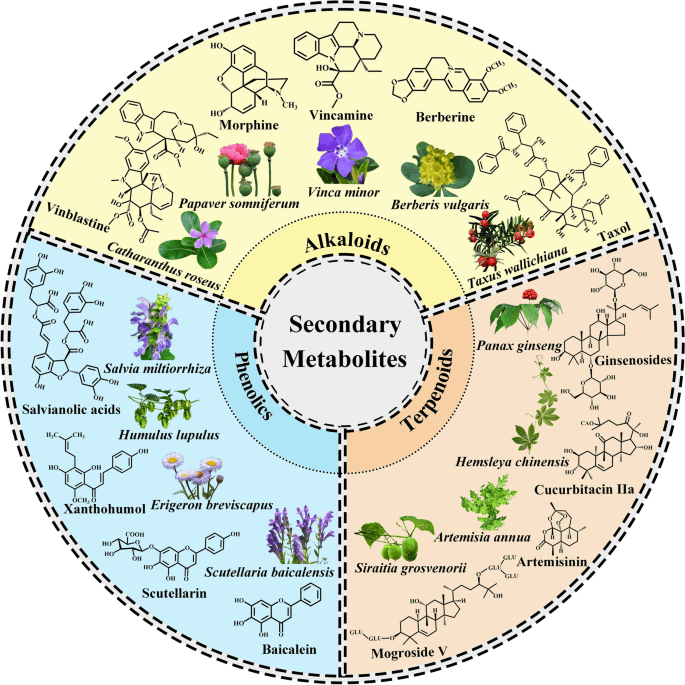
The reading introduced you to several key classes. For this lesson, we will focus on the three mentioned in our learning outcome—Alkaloids, Terpenoids, and Glycosides—as they represent some of the largest and most pharmacologically significant groups. We will also touch upon Phenolics, as they are ubiquitous and highly important.
2. The Major Phytochemical Classes in Classical Dravyas
Let's explore each class, defining its characteristics and identifying its presence in well-known Ayurvedic herbs.
A. Alkaloids
As you read, alkaloids are naturally occurring organic compounds that contain at least one nitrogen atom. This makes them chemically basic (alkaline-like), hence the name. They often have potent and diverse physiological effects.
- Key Characteristics: Nitrogen-containing, basic, often bitter-tasting, and typically exhibit significant pharmacological activity.
- Classical Dravya Examples:
- Guduchi (Tinospora cordifolia): Famous for its Rasayana and Jwarahara (antipyretic) properties, it contains alkaloids like berberine. Berberine is extensively researched for its anti-diabetic and anti-inflammatory effects, making it highly relevant to metabolic disorders.
- Sarpagandha (Rauwolfia serpentina): Traditionally used for its calming effects, its primary alkaloid, reserpine, was one of the first modern drugs developed for hypertension.
- Vatsanabha (Aconitum ferox): A highly potent and potentially toxic herb, its strong effects are due to alkaloids like aconitine. This highlights that the potency of alkaloids requires careful use and dosage (Shodhana is often required).
B. Terpenoids (or Terpenes)
This is an exceptionally large and structurally diverse class of phytochemicals built from a five-carbon building block called an isoprene unit.
- Key Characteristics: Built from isoprene units, they are classified by the number of units they contain (e.g., monoterpenoids with 2 units, diterpenoids with 4, triterpenoids with 6). They are responsible for the aromas, flavours, and colours of many plants.

- Classical Dravya Examples:
- Ashwagandha (Withania somnifera): Its primary active constituents are withanolides (e.g., Withaferin A), which are a type of triterpenoid. These are responsible for its celebrated Balya (strengthening) and adaptogenic effects.
- Brahmi (Bacopa monnieri): A premier Medhya Rasayana (nootropic), its memory-enhancing properties are attributed to bacosides, which are classified as triterpenoid saponins.
- Guggulu (Commiphora wightii): Known for its Medohara (fat-reducing) and anti-inflammatory actions, its effects are largely due to guggulsterones, which are plant steroids (a class of triterpenoids).
C. Glycosides
Glycosides are compounds in which a sugar molecule (the glycone) is bonded to a non-sugar molecule (the aglycone or genin). The aglycone can be an alkaloid, a terpenoid, or a phenolic compound, and it is this part that primarily determines the molecule's pharmacological activity.
- Key Characteristics: Composed of a sugar and a non-sugar part. The sugar component often improves solubility and bioavailability. This is a very broad category defined by a chemical linkage rather than a single type of core structure.
- Classical Dravya Examples:
- Shatavari (Asparagus racemosus): This renowned female reproductive tonic contains steroidal saponin glycosides called shatavarins. The aglycone is a steroid (a triterpenoid), and the glycone is the sugar attached to it.
- Arjuna (Terminalia arjuna): Used as a Hridya (cardioprotective) tonic, it contains several glycosides, including arjunosides and arjunetin.
- Digitalis purpurea (Foxglove): While not a classical Ayurvedic herb, it's the classic example. Its cardiac glycosides, like digoxin, are used in modern medicine for heart failure and illustrate the powerful effects of this class. The principles are the same for Ayurvedic glycoside-containing plants.
Test your understanding!
A patient with cognitive complaints is prescribed Brahmi (Bacopa monnieri). Modern research confirms its efficacy is due to a specific group of phytochemicals. Based on what we've just discussed, what is the primary class of these compounds, and what broader category do they belong to?
Show answer
The primary active compounds are bacosides. These are a type of saponin glycoside, and their core structure (aglycone) is a triterpenoid. So, they fit into both the glycoside and terpenoid categories, which is very common.
3. Integrating Knowledge: From Herb to Chemical Class
Now that we have defined the major classes, let's solidify the connection between key classical Dravyas and their phytochemical profiles. This integrated view is fundamental to your goal of blending Ayurvedic and modern knowledge.
The following resource provides excellent, specific examples of bioactive constituents in prominent Rasayana herbs.
WORLD JOURNAL OF PHARMACEUTICAL RESEARCH
The article 'Integrating Ayurveda and Phytochemistry' lists the specific, named phytochemicals for several major Rasayana dravyas. This will help you move from general classes to concrete examples.
Please read the section 'Phytochemistry of Rasayana Dravyas'. Focus on the six listed herbs: Amalaki, Guduchi, Ashwagandha, Shatavari, Brahmi, and Haritaki. For each, note the major phytoconstituents mentioned.
Let's summarize this information, focusing on the herbs most relevant to your interests in metabolic, digestive, and neurological health.
| Dravya (Herb) | Classical Use (Brief) | Major Phytochemical Class(es) | Specific Bioactive Compound(s) |
|---|---|---|---|
| Guduchi | Rasayana, Jwarahara, Anti-diabetic | Alkaloids, Terpenoids | Berberine, Tinosporide, Cordifolioside |
| Ashwagandha | Rasayana, Balya, Vata-hara | Terpenoids (Steroidal Lactones) | Withanolides (e.g., Withaferin A) |
| Brahmi | Medhya Rasayana (Nootropic) | Terpenoids (Triterpenoid Saponins) | Bacosides A & B |
| Amalaki | Rasayana, Tridoshahara, Anti-diabetic | Phenolics (Tannins), Vitamin C | Gallic Acid, Ellagic Acid, Emblicanins |
| Haritaki | Rasayana, Anulomana (Laxative) | Phenolics (Tannins) | Chebulagic Acid, Chebulinic Acid |
This table clearly connects the Dravya you know from your BAMS studies to the specific chemical families and compounds that modern science has identified as being responsible for their actions. For instance, the Rasayana and anti-diabetic effect of Guduchi can be scientifically explained by the metabolic-regulating properties of the alkaloid berberine.
Conclusion
In this lesson, we have taken the first crucial step in bridging classical Dravyaguna with modern phytochemistry. You learned to identify the major classes of secondary metabolites—alkaloids, terpenoids, and glycosides—that function as the active principles in medicinal plants.
Key Takeaways:
- Phytochemicals are the active constituents of Dravyas, primarily classified as secondary metabolites.
- Alkaloids are nitrogen-containing compounds, often potent and bitter, exemplified by berberine in Guduchi.
- Terpenoids are a vast class built from isoprene units, including withanolides in Ashwagandha and bacosides in Brahmi.
- Glycosides consist of a sugar and a non-sugar part, where the non-sugar aglycone determines the activity. Shatavarins in Shatavari are a key example.
- By identifying these classes in classical herbs, we create an evidence-based link between a plant's traditional use and its scientifically validated mechanisms of action.
Preview of the Next Lesson:
Now that you can identify these chemical classes, our next lesson will explore a fascinating correlation: Correlate Rasa (taste) with dominant phytochemical constituents in representative medicinal plants. We will investigate questions like, "Why do so many alkaloid-rich plants taste bitter (Tikta)?" and "What is the chemical basis for the sweet (Madhura) taste of herbs like Yashtimadhu?" This will add another layer to your integrated understanding of Dravyaguna.