Hello! Welcome back to your course on building a modern accounting website with Astro.
In our last lesson, we established the core difference between the React SPA model you're familiar with and Astro's server-first, Multi-Page App (MPA) approach. We saw that Astro's "Islands Architecture" minimizes client-side JavaScript, leading to faster websites.
Today, we'll zoom in on the specific rendering strategy that makes this possible: Static Site Generation (SSG). This lesson will cover the benefits of SSG for content-heavy websites like the one you're planning to build. Understanding these advantages is key to appreciating why Astro is such a powerful tool for your goal of creating a high-performance, SEO-optimized, and maintainable site.
Let's get started.
What Exactly is Static Site Generation (SSG)?
From your experience with React, you're used to Client-Side Rendering (CSR), where the browser downloads JavaScript and builds the page on the user's device. Static Site Generation turns this on its head.
With SSG, every page of your website is generated into a complete HTML file at build time—that is, when you run a command like astro build in your terminal. This process happens once, on a development or build server, before any user ever visits your site.
The result is a folder full of static assets (HTML, CSS, and minimal JavaScript) that are ready to be served.
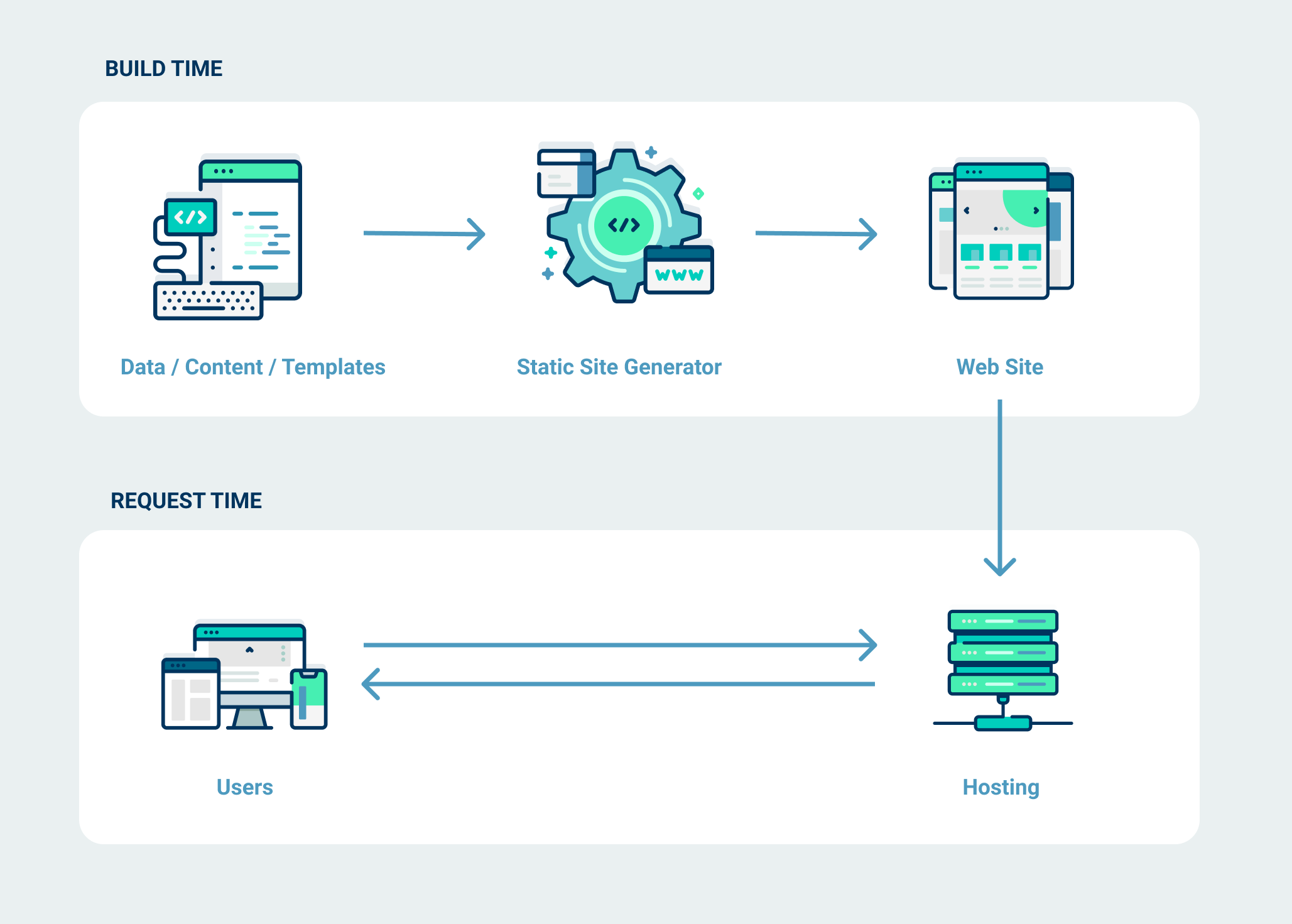
To better understand how SSG fits into the broader landscape of web rendering, let's watch a clear explanation of the main strategies.
The video "WTF Do These Even Mean" from Web Dev Simplified provides an excellent breakdown of the different rendering acronyms. It clearly defines the steps in a site's lifecycle, which will help you understand where SSG does its work.
Please watch two segments: From 01:05 to 01:58 to understand the three core phases: build, server, and client. From 06:24 to 08:40 to see a detailed explanation of SSG. Pay close attention to how it shifts the workload almost entirely to the 'build' phase.
As the video explained, the key idea is to do the work upfront. Instead of generating a page for every visitor (like with Server-Side Rendering) or making the visitor's browser do the work (like with CSR), SSG pre-builds everything.
Let's quickly recap the main rendering strategies to solidify your understanding:
| Strategy | When is the HTML page built? | Where is the work done? |
|---|---|---|
| Client-Side Rendering (CSR) | On-demand, in the user's browser | Client |
| Server-Side Rendering (SSR) | On-demand, for each request | Server |
| Static Site Generation (SSG) | Ahead of time, during the build | Build Server |
The Four Major Benefits of SSG
For a content-focused website like an accounting firm's, where providing information, building trust, and attracting clients through search engines are primary goals, SSG offers four compelling advantages.
1. Blazing-Fast Performance
This is the most immediate benefit. Because the HTML pages are pre-built, a user's request is incredibly simple for a server to handle. There's no database to query or templates to process. The server just finds the requested file and sends it.
These static files are also perfectly suited for deployment on a Content Delivery Network (CDN). A CDN is a global network of servers that caches your files in locations physically closer to your users. When a user in London visits your site, they receive the files from a server in Europe, not one in North America, drastically reducing latency.
The combination of pre-built files and CDN distribution results in near-instant load times. This directly improves user experience and positively impacts your Core Web Vitals, which are key metrics Google uses to measure page performance.
The following article offers a great overview of the benefits of SSG, particularly its performance gains.
Why Static Site Generators Are the Future of Web Development
The article "Why Static Site Generators Are the Future of Web Development" from JekyllPad provides a clear comparison between static and dynamic sites, highlighting the core advantages.
Please read the sections "Static vs Dynamic Websites: A Quick Comparison" and the list of benefits that follows it. Focus on how the table contrasts SSG with traditional dynamic sites on metrics like performance, security, and cost.
2. Superior Search Engine Optimization (SEO)
Your goal to build an SEO-optimized site is directly supported by SSG. Search engine crawlers (like Googlebot) work best when they can quickly and easily understand the content of a page.
- SPAs (CSR): Crawlers receive a nearly empty HTML file and must execute JavaScript to see the content. This is slow, and sometimes the crawler gives up before the content is fully rendered, leading to poor indexing.
- SSGs: Crawlers receive a complete, content-rich HTML file instantly. The site's structure, text, and links are all present and easy to parse.
This "crawler-friendliness" means your pages are indexed faster and more accurately, giving you a significant advantage in search rankings.
This next resource is a case study that demonstrates the powerful impact of switching from a JavaScript-heavy approach to SSG.
Why Static Site Generation Beats SPAs for SEO
The article "Why Static Site Generation Beats SPAs for SEO" provides a compelling real-world example and a clear explanation of why SSG is the superior choice for SEO-critical sites.
Read the sections "Understanding the Three Approaches," "Why SSG is the Clear Winner," and "The Results Speak for Themselves." Pay close attention to the comparison table and the dramatic SEO improvements documented after the switch.
3. Rock-Solid Security
Since an SSG-powered site consists of only static files, there is no live database connection and no server-side code running to process user requests. This dramatically reduces the "attack surface." Common web vulnerabilities like SQL injection or server-side code exploits are simply not possible because the systems they target don't exist in the request-time environment. This "security by subtraction" makes for a much safer and more robust website.
4. Effortless Scalability and Lower Costs
Serving static files is extremely resource-efficient. A static site can handle huge traffic spikes—perhaps from a blog post going viral or a successful marketing campaign—without performance degradation. Dynamic sites, in contrast, would require scaling up expensive server and database resources to handle the same load.
This efficiency also translates to lower hosting costs. Many modern hosting platforms (like Vercel and Netlify, which we'll cover later) offer generous free tiers for hosting static sites.
This image provides a great visual summary of how the different rendering strategies stack up across these important metrics.

Test your understanding!
You are advising a client on their web strategy. They have two distinct needs:
- A public-facing marketing website with a blog, service pages, and case studies. The primary goal is to attract new customers via Google searches.
- An internal, password-protected dashboard for their employees to manage complex project data in real-time.
Based on what you've learned, which rendering strategy (CSR, SSR, or SSG) would you recommend for each project, and why?
Show answer
-
Marketing Website: SSG is the ideal choice. Its superior performance and SEO friendliness are critical for attracting and retaining new customers through search. The content is relatively static and doesn't require real-time updates, making it a perfect fit for the pre-building model of SSG.
-
Internal Dashboard: CSR (the model used in many React SPAs) is a much better fit here. SEO is irrelevant since the dashboard is private. The interface needs to be highly interactive and handle complex, real-time data. An SPA can provide the rich, app-like experience required, and the initial load time is less critical for a logged-in user who will spend a significant amount of time in the application.
Conclusion: Why SSG is Right for Your Project
Today we've explored the significant benefits of Static Site Generation for content-heavy websites. For your goal of building a modern accounting website, this approach is a perfect match.
Let's summarize the key takeaways:
- SSG creates websites that are incredibly fast because all pages are pre-built as static HTML files and can be served from a CDN.
- It's fantastic for SEO, as search engine crawlers can instantly read the complete content of every page.
- The architecture is highly secure and scalable, with a minimal attack surface and the ability to handle large amounts of traffic with ease and low cost.
- The main trade-off is build time, which can increase for sites with thousands of pages, but for most projects, the benefits far outweigh this consideration.
You now have a solid understanding of both what Astro does (from the last lesson) and why its default strategy is so effective. This sets a strong foundation for the practical work ahead.
Up Next: We'll move from theory to practice. In the next lesson, you will set up your first Astro project and get familiar with its default folder structure. It's time to start building