In our previous lesson, we established the competitive landscape for the boudoir photoshoot competition. We distinguished between the necessary background conditions that all serious competitors must meet and the active causal factors that ultimately determine the winner. We saw how judging criteria, whether implicit or explicit in a scorecard, focus on attributes that create impact, originality, and memorability.
Today, we will build directly on that foundation. Our objective is to take the first of our two main causal claims for Event 2 and transform it into a formal, testable proposition. Specifically, this lesson will guide you through how to state Hypothesis 1 (body type advantage) in precise, testable terms, specifying the physical attributes and their competitive advantage.
As a statistician and researcher, you are intimately familiar with the challenge of translating abstract concepts into measurable variables. This process, which we will focus on today, is known as operationalization. It is the crucial step that moves us from a vague idea—"she won because she had a great body"—to a scientific hypothesis that can be rigorously evaluated with evidence.
From Abstract Concept to Measurable Hypothesis
The core of our first hypothesis is the concept of a "body type advantage." In its current form, this is too subjective to be useful for causal analysis. What one person considers an "advantageous" body type, another may not. To make this concept analytically rigorous, we must operationalize it by breaking it down into observable and measurable components.
The following video provides an excellent overview of this process, explaining why we measure the attributes of an object (in this case, the contestant) rather than the object itself, and how abstract concepts can be broken down into observable characteristics.
Operational Definition and Measurement of Variables with Examples - Research Methodology
This video from the "Research With Fawad" channel explains the fundamentals of operationalization.
Please watch the following segments: The introduction, which explains why proper measurement is necessary for valid results. The explanation of measuring characteristics of objects, not the objects themselves. This is key to our task of defining the contestant's specific physical attributes. The discussion on operationalizing abstract concepts by reducing them to observable behaviors or characteristics. Pay close attention to the example of breaking down "effective leadership" into its component parts.
As the video explains, the goal is to reduce an abstract notion to a set of concrete, observable indicators. We will follow a systematic, three-step process to operationalize our "body type advantage" concept.
The 3-Step Operationalization Process
A clear framework for operationalization can be found in research methodology literature. We will use the structure laid out in the following guide.
Operationalization | A Guide with Examples, Pros & Cons - Scribbr
This guide from Scribbr provides a clear, step-by-step method for operationalization.
Please read the introductory sections, focusing on the definition of operationalization and the three main steps involved: the three steps. The examples provided, such as operationalizing 'social anxiety' or 'creativity', illustrate the kind of specificity we are aiming for.
Following this guide, we will proceed step-by-step.
Step 1: Identify the Main Concept
Our main concept is the Body Type Advantage.
Step 2: Choose Variables to Represent the Concept
We need to break "Body Type Advantage" into its constituent parts. Based on the case description—"toned body yet big breasts"—we can identify two primary variables and a third interaction variable:
- Muscular Definition: The degree of visible muscle tone.
- Breast Volume: The size of the contestant's bust.
- Physique Combination: The co-occurrence of high muscular definition and large breast volume.
Step 3: Select Indicators for Each Variable
This is the most critical step. We must define what observable evidence would allow us to measure these variables. Here, we can draw on the specific standards used in physique competitions, as they provide a detailed vocabulary for describing the very attributes we are interested in. While our case is a boudoir competition, the aesthetic criteria for a toned physique share significant overlap.
Bikini Judging Criteria – In-Depth | Five Starr Physique
This article from Five Starr Physique provides an in-depth look at the judging criteria for the "Bikini" category in physique competitions. It offers precise language for the indicators we need.
Read through the sections discussing the official guidelines, muscular development, and conditioning. Pay close attention to the specific descriptions, such as "full round glutes," "roundness in the delts," "conditioned core," and the crucial distinction between desirable "separation" and undesirable "striations." Finally, note the emphasis on how only what is visible on stage is judged.
Using this domain-specific knowledge, we can now define concrete indicators for our variables:
-
Variable 1: Muscular Definition
- Indicator (a): Visible abdominal muscle definition, but without the "deeply etched" look associated with bodybuilding.
- Indicator (b): Clear "separation" visible between major muscle groups (e.g., quadriceps and hamstrings; glutes and hamstrings).
- Indicator (c): Absence of "striations" (visible muscle fibers), which would be considered "excessively muscular" for this aesthetic.
- Indicator (d): Presence of rounded deltoids (shoulders), contributing to an "hourglass" upper body shape.
-
Variable 2: Breast Volume
- Indicator (a): A bust-to-waist ratio visibly greater than the average of other finalists in the competition.
- Indicator (b): The need for lingerie designs (a nod to your own design experience) that provide significant support, unlike the styles typically worn by smaller-busted competitors.
-
Variable 3: Physique Combination
- Indicator (a): The simultaneous presence of indicators for high muscular definition (implying low body fat) and indicators for large breast volume. This combination is physiologically uncommon and thus visually distinctive.
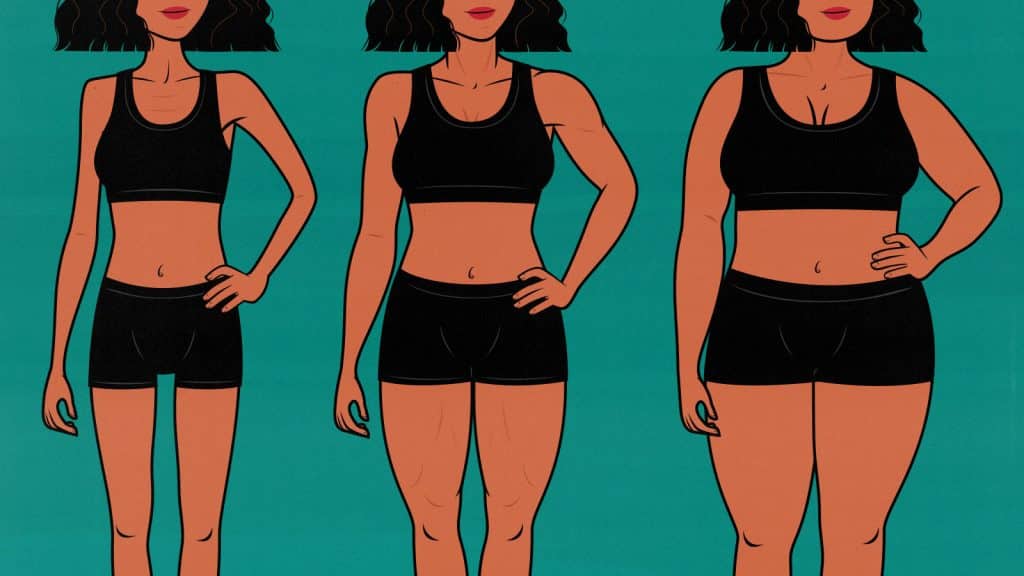
The image below illustrates three common female body types. Our contestant's hypothesized advantage lies in possessing a rare combination of the traits seen in the middle figure (muscular tone and definition) and the right-hand figure (fuller bust and hips).
Formulating the Precise Hypothesis
With our concept fully operationalized, we can now state Hypothesis 1 in a precise and testable form. It's not just a statement of fact, but a causal claim that links the attribute to the outcome via the judging criteria we identified in the last lesson.
Hypothesis 1 (Body Type Advantage): The contestant's victory was caused in part by a significant and visually unique 'body type advantage.' This advantage is defined by the rare combination of two specific physical attributes: (1) a high degree of muscular definition, indicated by a conditioned core and clear muscle group separation without striations, and (2) a large natural breast volume, visibly greater than the competition's average. This combination produced a physique that was simultaneously toned and curvaceous, creating a high-impact, memorable visual that distinguished her from other finalists and scored favorably on the competition's active judging criteria of 'Impact/Impression,' 'Originality,' and 'Fitness & Style.'
This formulation is:
- Precise: It specifies exactly what is meant by "body type advantage."
- Testable: It points directly to the evidence we would need to find to confirm or deny it (photos showing muscle separation, comparative analysis of competitor physiques, judges' notes).
- Causal: It links the attribute (the body type) to the outcome (the win) through a specific mechanism (scoring highly on key judging criteria).
Conclusion
In this lesson, we have moved from a general notion to a specific, analytically sound hypothesis. By applying the principles of operationalization, we have deconstructed the abstract concept of a "body type advantage" into a set of concrete, observable, and measurable indicators.
Key Takeaways:
- Formulating a testable hypothesis requires operationalization: the process of turning abstract concepts into measurable variables and indicators.
- Hypothesis 1 (Body Type Advantage) is defined by the rare co-occurrence of high muscular definition (tone, separation) and large breast volume.
- This specific combination is hypothesized to have conferred a competitive advantage by creating a unique, high-impact visual that resonated with established judging criteria for photographic competitions.
We have now formally stated our first hypothesis for Event 2. In the next lesson, we will apply the same rigorous process to our second proposed cause: the powerful effect of her attire and its contrast with her known persona.