Introduction
In our last lesson, we wove together our two primary hypotheses—'body type' and 'attire/persona contrast'—into a synergistic causal model. We proposed that the contestant's victory resulted not from a simple sum of these factors, but from a powerful interaction where each amplified the effect of the other. While this creates a compelling narrative, a robust causal analysis demands that we don't fall in love with our own theory. We must actively try to falsify it by pitting it against its strongest competitors.
This lesson is dedicated to that essential task. Our goal is to decompose the most plausible rival hypothesis for the boudoir competition win, break it down into a testable step-by-step mechanism, and identify the specific 'evidence fingerprints' we would need to find if it were true. As a statistician, you can think of this as specifying and operationalizing an alternative model to guard against spurious findings and omitted variable bias. This process sets the stage for a "three-cornered fight" where our primary theory, a rival theory, and the empirical evidence are all brought into the ring together.
The Logic of Rival Explanations
Before we build our rival hypothesis, let's clarify why this is so critical in causal analysis. When we observe a correlation between a proposed cause and an outcome , we must consider the possibility that a third variable, , is responsible for the relationship. This is a familiar problem in both qualitative and quantitative research.
The image below illustrates three common ways a third variable can complicate a causal story.
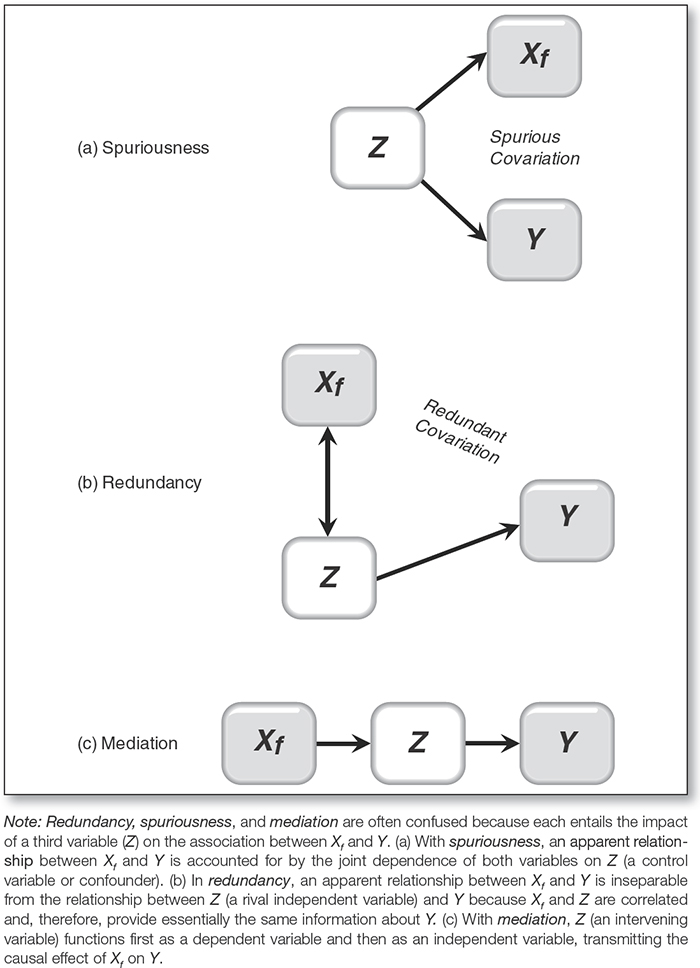
In our analysis of the boudoir competition, our primary theory posits a direct and interactive causal link from 'body type' and 'attire contrast' () to the 'win' (). A rival hypothesis suggests that another factor, let's call it 'Posing Skill' (), is the true cause.
- If 'Posing Skill' () is the real cause of the win () and also, for instance, gave the contestant the confidence to choose provocative attire (), then our 'attire contrast' hypothesis could be a spurious covariation, as shown in diagram (a).
- If 'Posing Skill' () is simply highly correlated with an excellent physique () and both contribute to the win, we might have a case of redundancy, as in diagram (b), where it's difficult to separate their effects.
Our task is to build a case for the rival hypothesis that is so clear and testable that we can then use evidence to determine whether our primary model holds up or whether the relationship is better explained by the rival.
Identifying and Decomposing the Rival Hypothesis
In Module 3, we generated several rival hypotheses, including superior posing skill, professional coaching, and the quality of the lingerie design. For this exercise, we will focus on what is arguably the most direct and plausible rival:
H_R1 (Rival Hypothesis 1): The contestant won due to her superior posing skill, which was of a professional calibre that distinguished her from all other competitors and was the decisive factor for the judges.
To make this hypothesis testable, we must decompose it into a causal mechanism—a chain of cause and effect linking the skill to the outcome.
The Causal Mechanism for H_R1 (Superior Posing Skill):
- Possession of Skill: The contestant possesses an objectively superior and technically advanced posing ability compared to her rivals. This skill is not just "good"; it is quantifiably better (e.g., greater range of poses, better understanding of angles, more compelling emotional expression).
- Demonstration of Skill: This superior skill is clearly and consistently demonstrated during the judged performance phase of the competition.
- Perception and Valuation: The judges, as experts, perceive this technical superiority and explicitly value it as a key criterion for winning.
- Translation to Scores: This high valuation is directly reflected in high scores on specific, relevant judging criteria (e.g., 'Technique', 'Artistry', 'Professionalism').
- Decisive Impact: The cumulative points awarded specifically for posing skill are substantial enough to be the primary and decisive factor in her victory, outweighing other attributes like physique or attire.
This step-by-step mechanism provides a clear, falsifiable model. If any of these links is broken, the entire rival explanation is weakened or fails completely.
Operationalizing H_R1: Evidence Fingerprints
Now we must identify the specific, observable "evidence fingerprints" that each step of this mechanism should have left behind. To do this systematically, we will use the four formal process-tracing tests. These tests help us classify evidence based on whether it is necessary (a "hoop" the theory must pass) or sufficient (a "smoking gun" that confirms it) for our inference.
To familiarize yourself with these concepts, please watch the following video and review the accompanying text.
This segment from the video "Process Tracing Methodology" by the channel Studying Politics & International Relations provides a clear explanation of the four types of empirical tests.
Watch the segment explaining the four types of tests. Pay attention to how "certainty" (necessity) and "uniqueness" (sufficiency) are used to define hoop tests, smoking-gun tests, straw-in-the-wind tests, and doubly-decisive tests.
With that framework in mind, let's specify the evidence fingerprints for each part of our rival mechanism, H_R1.
Fingerprints for Mechanism Step 1: Possession of Skill
- Straw-in-the-Wind: Evidence of formal training in dance, gymnastics, or professional modeling. This increases the plausibility that she possesses the skill but doesn't prove it was superior or used in the competition.
- Straw-in-the-Wind: Testimonials from photographers or coaches who worked with her before the competition, attesting to her exceptional posing ability.
Fingerprints for Mechanism Step 2: Demonstration of Skill
- Hoop Test: Analysis of the competition photos and videos must show technically proficient and varied posing. If the evidence shows her poses were simple, awkward, or repetitive, H_R1 fails this necessary test and can be eliminated. The skill must be visibly present.
- Straw-in-the-Wind: A side-by-side comparison with photos of other contestants reveals her poses to be visibly more complex, graceful, or emotionally resonant.
Fingerprints for Mechanism Step 3: Perception and Valuation
- Smoking Gun: An interview quote from a judge stating, "Her posing technique was what sealed the deal. It was on a completely different level from everyone else." This type of evidence is sufficient to strongly support this part of the mechanism.
- Straw-in-the-Wind: General comments from judges about the importance of "professionalism" or "technique" in their decision-making.
Fingerprints for Mechanism Step 4: Translation to Scores
- Hoop Test: The official scorecards must include a criterion related to posing, technique, or artistry, and she must have received top marks in that category from a majority of judges. If no such criterion exists, or she scored poorly on it, this crucial link in the mechanism is broken.
- Smoking Gun: A judge's scorecard with an appended note: "+5 extra points for flawless posing technique."
Fingerprints for Mechanism Step 5: Decisive Impact
- Doubly Decisive Test (Very rare, but the ultimate prize): A transcript of the judges' deliberation revealing a statement like: "I wasn't convinced by her look, but her technical posing skill was so far beyond the rest that it single-handedly earned her the win." This evidence would simultaneously confirm H_R1 while falsifying our primary hypotheses (H1 and H2).
- Hoop Test: The point differential attributable to the 'posing' score must be large enough to account for her victory margin. If she won by 10 points, but only gained a 2-point advantage from posing scores, this hypothesis fails a necessary test for being the decisive cause.
The Strategy of Elimination
Our primary goal when testing a rival hypothesis is not necessarily to prove it, but to see if we can disprove it. The most efficient way to do this is to focus on the hoop tests. If a hypothesis fails even one necessary test, it can be confidently eliminated, allowing us to increase our confidence in the surviving explanations. This "method of elimination" is a cornerstone of process tracing.
The following reading explains this logic using the famous Sherlock Holmes story of "Silver Blaze."
[PDF] Understanding Process Tracing - Political Science at UC Berkeley
This excerpt from the paper "Understanding Process Tracing" demonstrates how eliminating suspects (rival hypotheses) through hoop tests can be as powerful as finding a smoking gun for the main suspect.
Please read the sections on Doubly Decisive Tests and review Table 6, Building a Doubly Decisive Test. Focus on how the definite exoneration of two suspects via hoop tests leaves the third as the only remaining possibility, thereby strengthening the case against it.
Just as Holmes eliminated suspects who couldn't have committed the crime, our goal in the next stage of analysis will be to see if H_R1 fails any of its crucial hoop tests (e.g., was her posing actually skillful? Did the judges actually have a way to score it?).
Conclusion
In this lesson, we have moved from building our primary theory to rigorously preparing to challenge it. By treating a rival explanation with the same analytical seriousness as our own, we ensure our final conclusion is robust and has survived a trial by fire.
Here are the key takeaways:
- Rival Hypotheses are Essential: Testing against plausible rivals is crucial for avoiding spurious conclusions and strengthening causal inference.
- Decomposition is Key: A vague rival hypothesis is untestable. We must break it down into a precise, step-by-step causal mechanism.
- Fingerprints Guide the Search: For each step in the rival mechanism, we must define the specific evidence fingerprints we would expect to find if it were true.
- Hoop Tests are for Elimination: When evaluating rivals, our most powerful tool is often the hoop test. A single failed hoop test can allow us to discard an entire explanatory path.
We have now fully operationalized both our primary, synergistic hypothesis and a strong rival. All the conceptual work is complete. In the next module, we will begin the process of adjudication. We will construct an evidence matrix to formally map the collected facts against these competing explanations and apply the process-tracing tests to see which theory provides the most compelling account of the contestant's victory.