Introduction
In our last session, we synthesized our analytical work on Event 1 into a coherent causal narrative. We wove together the two key mechanisms—the wife's unmet sexual needs (H1) and the husband's deep trust in his best friend (H2)—to explain the 5-year stability of the couple's cuckold/hotwife dynamic. This gave us a compelling story about how the outcome came to be.
Today, we take the final and crucial step in our analysis of Event 1: refining this narrative to reflect the true strength of our findings. Your learning outcome is to finalize the Event 1 narrative by distinguishing claims supported by strong vs. weak evidence and stating remaining uncertainties. This process adds a layer of intellectual honesty, transforming a confident draft into a rigorous and defensible causal account. For a statistician accustomed to confidence intervals and p-values, this is the qualitative equivalent: qualifying our conclusions based on the quality of the data.
From Claims to Confident Claims: The Hierarchy of Evidence
At the heart of our task is a simple principle: not all evidence is created equal. An offhand remark in an interview does not carry the same weight as a dated communication log that corroborates a key event. To visualize this, consider the "Melnyk Hierarchy of Evidence," a model used in clinical decision-making.
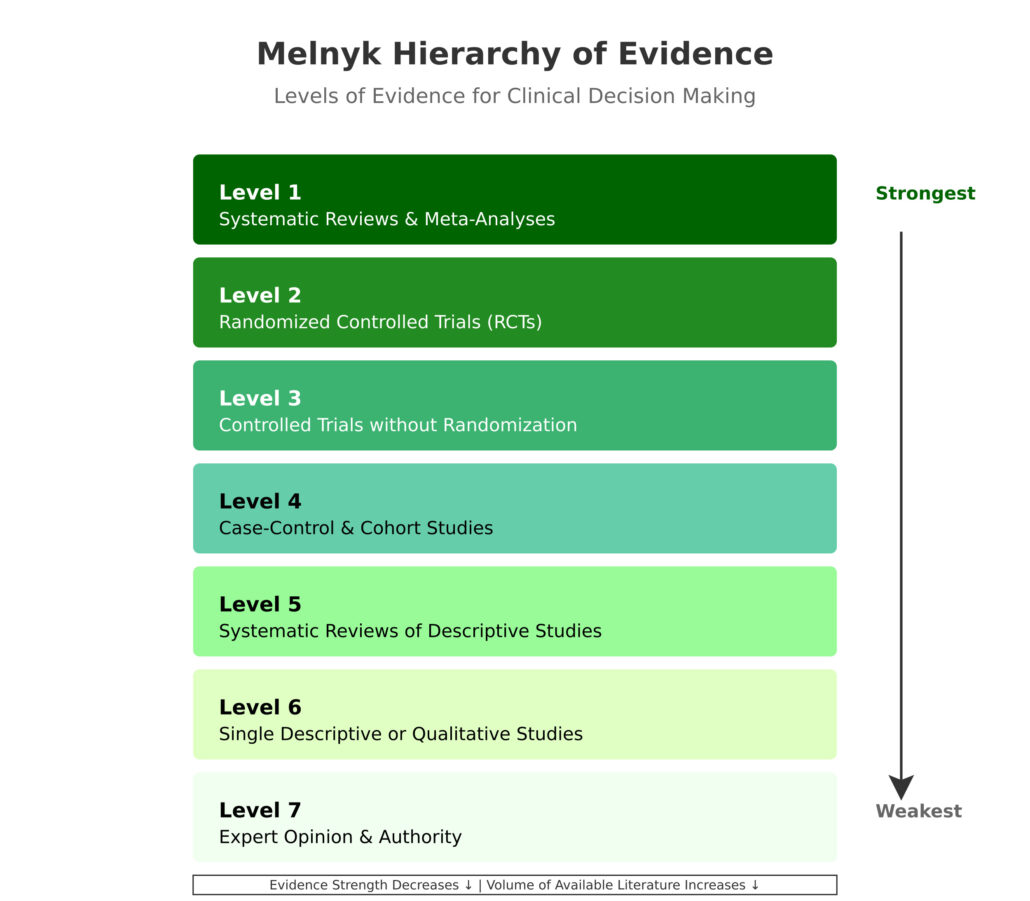
In our single-case study, we can think of "smoking gun" evidence (which we've called "love-to-find" evidence) as being higher up this pyramid, while a single, uncorroborated interview account might be lower down. Our goal today is to assess where each component of our narrative sits in this hierarchy and to reflect that in our final written account.
A Framework for Qualifying Evidence
To do this systematically, we can draw on established concepts from process-tracing methodology. These provide a language and logic for evaluating the probative value of our evidence.
[PDF] Process-Tracing Methods in Program Evaluation
This World Bank Group report provides a practical framework for assessing qualitative evidence. It formalizes the intuitions behind weighing different pieces of information.
First, please review the section on "Operationalization of Expected Observables." Focus on the definitions in Box 2.1, which clearly define "Need-to-find" and "Love-to-find" evidence. These correspond to the hoop and smoking-gun tests we've discussed. Next, turn to Table 2.1 which presents a linguistic scale for expressing confidence, from "almost certainly" to "almost certainly not." This gives us the precise vocabulary we need to qualify our claims in the final narrative.
The distinction between "absence of evidence" and "evidence of absence" is also critical for identifying uncertainties. The following reading explains this and the "weakest link" principle in causal chains.
[PDF] Process tracing with Bayesian updating
This paper applies concepts from Bayesian reasoning to process tracing, offering a sharp analytical lens for our task.
Please read the section that begins "This approach encourages us to interrogate...". Focus on the discussion of how the overall strength of a claim is limited by its weakest component and the critical distinction between absence of evidence and evidence of absence.
To summarize this framework:
- "Love-to-find" evidence provides strong confirmation, making a claim highly probable.
- The overall confidence in a causal chain is only as strong as its weakest link.
- "Absence of evidence" (we didn't find it) is not "evidence of absence" (we looked for it where it should be, and it wasn't there). The latter is disconfirmatory, while the former simply signals an area of uncertainty.
Applying the Framework: Refining the Event 1 Narrative
Let's critically re-examine the draft narrative from our previous lesson, assigning confidence levels to each major causal claim using the linguistic scale from "Process-Tracing Methods in Program Evaluation".
| Causal Claim | Evidence Type (Hypothetical) | Confidence Assessment |
|---|---|---|
| 1. Initial Conditions: The marriage was stable and loving, and the husband-bull friendship was strong. | Consistent testimony from all three parties; artifacts from before the arrangement (photos, shared history anecdotes). | Almost Certainly: Strong, multi-source evidence for the baseline state. |
| 2. Driving Cause (H1): The wife had significant, unmet sexual needs creating tension. | Wife's direct testimony; husband's corroborating testimony; (Love-to-find) communication logs expressing frustration. | Almost Certainly: Direct, corroborated testimony supported by contemporaneous evidence. |
| 3. Enabling Cause (H2): The husband's deep trust in his friend made the solution viable. | Husband's direct testimony; (Need-to-find) evidence of a long-standing, positive friendship. Absence of evidence of rivalry. | Almost Certainly: Direct testimony combined with passing a "need-to-find" test. |
| 4. Counterfactual Resilience: The arrangement would have failed with a stranger. | Husband's explicit and emphatic statements in interviews. | Very Probably: Strong testimony, but inherently a claim about a hypothetical. |
| 5. Causal Interaction: A positive feedback loop sustained the dynamic for 5 years. | Tracing the evolution of satisfaction and trust over the 5-year chronology based on interview accounts of specific moments. | Very Probably: A strong inference, but its strength is limited by the weakest link (the memory of specific events). |
Stating Uncertainties and Boundaries
A rigorous analysis is transparent about its limits. Based on our review, we can identify a few areas of remaining uncertainty.
-
Retrospective Bias: Our narrative relies heavily on interviews conducted after the fact. While the accounts are consistent, we must acknowledge the possibility that participants have, consciously or not, smoothed out the story over time to make it more coherent. This is a general uncertainty that applies to the whole narrative.
-
Absence of Evidence on "Pre-existing Openness": One of our rival hypotheses was that the couple was already ideologically open to non-monogamy. While we found strong evidence for H1 and H2 as the active causes, we did not find "evidence of absence" for this rival hypothesis. It's possible it was a background condition. This is a classic "absence of evidence" scenario.
-
Boundary of the Analysis: Our causal question focuses on what sustained the dynamic for the couple. The bull's full motivations—why he agreed and continued—are a related but distinct question. Our analysis offers limited insight into his internal causal process beyond his friendship with the husband.
Finalized Causal Narrative: Event 1
By integrating these assessments and uncertainties, we can now produce the finalized version of the narrative. The changes are highlighted to show how we've embedded our confidence levels and limitations.
Final Causal Narrative: Event 1
It is almost certain that the establishment and 5-year sustainment of a successful cuckold/hotwife dynamic for this mid-40s Indian couple is explained by the powerful interaction of two central causes: the wife’s unmet sexual needs created a powerful motivation for change, while the husband’s deep-seated trust in the chosen partner—his best friend—made that change acceptable and stable.
The story does not begin with a crisis, but with what is almost certainly two strong, independent relationships: a loving and committed marriage, and a profound, long-standing friendship between the husband and another man. These formed the stable background conditions. However, evidence from all parties makes it almost certain that a significant tension emerged within the marriage. The wife developed sexual needs and desires for a level of intensity and variety that were not being met. This (H1: Unmet Needs mechanism) became the primary driving force for seeking a non-traditional solution; the status quo was no longer sufficient for her fulfillment.
The couple confronted this challenge and made the critical decision to explore an open relationship. At this juncture, the second causal factor became paramount. It is very probable that the abstract idea of an open relationship was made concrete and viable only through the (H2: Best Friend Trust mechanism). The husband’s testimony strongly suggests that inviting a stranger into the marriage would have presented an intolerable emotional threat. His best friend, however, was a known entity with whom he shared years of trust. This pre-existing bond acted as a powerful enabling condition, dramatically lowering the perceived risk and making the husband's consent possible. The friend was not a rival, but a trusted collaborator.
It is very probable that the interaction and synergy between these two factors created a positive feedback loop key to the outcome's 5-year stability. The trust (H2) provided a safe emotional container for the wife's needs to be met by the bull (H1). The successful fulfillment of these needs, in turn, led to the wife's increased happiness, which reinforced the stability of the primary marriage. This cycle cemented the dynamic's success and allowed it to endure crises that might otherwise have ended it.
The resulting 5-year stable and mutually satisfying dynamic was therefore not an accident, but the direct product of this specific causal pathway: a problem (unmet needs) found a unique and acceptable solution (the trusted best friend), creating a reinforcing cycle that promoted long-term stability.
Analytical Uncertainties and Boundaries:
This conclusion is based on evidence with high internal validity, primarily consistent, multi-source testimony corroborated by available artifacts. However, two limitations should be noted. First, the evidence is largely retrospective and thus susceptible to recall and rationalization biases, though its consistency mitigates this concern. Second, while the analysis confidently identifies the primary causal drivers, it cannot definitively rule out the influence of a pre-existing ideological openness to non-monogamy as a contributing background condition. The focus of this analysis has been on the couple's dynamic; a full causal account of the bull's motivations remains a boundary of this investigation.
Conclusion
Today we have completed the final step in producing a robust causal account for Event 1. By moving beyond a simple draft to a qualified narrative, we have embraced the principles of rigorous analytical work.
Here are your key takeaways from this lesson:
- A finalized causal narrative must be transparent about the strength of the evidence supporting each of its claims.
- Frameworks like "love-to-find/need-to-find" evidence and linguistic confidence scales provide a systematic way to assess and communicate the probative value of qualitative data.
- Explicitly stating uncertainties, evidentiary gaps, and analytical boundaries is not a weakness, but a core feature of a strong, honest, and defensible causal explanation.
We have now brought the analysis of Event 1 to its conclusion. In our next lesson, we will return to the boudoir competition, applying the narrative construction techniques we've practiced to draft the core causal story for Event 2.