Introduction
In our last session, we dissected the couple's five-year narrative to pinpoint four critical junctures—pivotal moments where the relationship's path was not predetermined and could have veered in entirely new directions. We identified the initial disclosure of unhappiness, the selection of the best friend as a partner, the resolution of the first jealousy crisis, and the adaptation of their rules.
Today, we will build directly upon that work. Our goal is to move from simply identifying these forks in the road to meticulously documenting the choices made at each one, alongside the plausible alternatives that were available but not taken. This isn't merely a cataloging exercise. From your background in operations research and causal analysis, you'll recognize this as the process of mapping a decision tree. By articulating the alternative paths, we are creating the necessary empirical foundation for the counterfactual reasoning we will employ later to rigorously assess the causal necessity of our primary hypotheses.
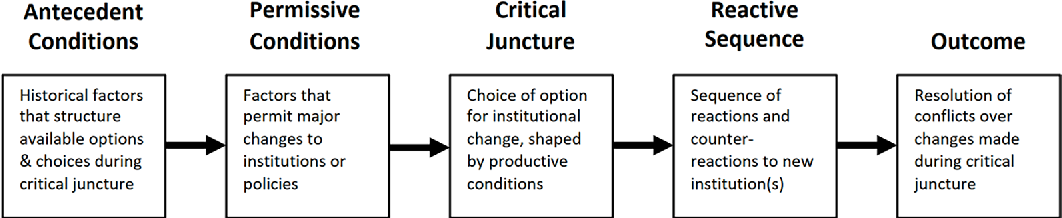
The flowchart below illustrates the broader causal process. In our last lesson, we located the "Critical Juncture" box. Today, we delve inside that box to understand the specific "Choice of option" that set the subsequent "Reactive Sequence" in motion.
The Logic of Documenting Plausible Alternatives
At the heart of causal analysis in single-event studies is the principle of contingency. To argue that a choice was causal, we must demonstrate that other choices were possible and that they would have led to different outcomes. The challenge lies in defining what constitutes a "possible" or "plausible" alternative. We are not interested in flights of fancy, but in genuine, viable options that were available to the actors at the time.
To formalize this, we will draw again on the theoretical work on critical junctures and counterfactuals.
[PDF] The STudy of CriTiCal JunCTureS Theory, narrative, and ...
This paper by Capoccia and Kelemen provides the methodological rationale for our task today. It explains why analyzing choices requires us to consider what could have happened.
Please read Section IV, "Methods," focusing on the first two subsections, "Counterfactual Analysis" and "Theory-Guided Narrative." Pay close attention to the statement that analyzing contingency requires researchers to analyze "what happened in the context of what could have happened," and how this necessitates reconstructing not only actual decisions but also plausible alternatives. Also, note the importance of the "minimal-rewrite rule," which constrains us to consider only those alternatives that were genuinely available and considered, or at least logically possible, within the immediate context.
The reading emphasizes that our alternatives must be historically consistent and theoretically plausible. This helps us distinguish between useful analytical tools and what one scholar calls "exuberant" or overly speculative counterfactuals. The following reading provides a practical framework for thinking about this distinction.
Students' use of counterfactuals for evaluating historical ...
While this paper is about history education, its analytical framework is highly relevant. It provides clear criteria for what makes an alternative "plausible" and "context-sensitive."
Please read the following two sections: "Plausibility": Find this subsection and read from its beginning. The key concept here is the distinction between "restrained" counterfactuals (useful for analysis) and "exuberant" ones. A restrained alternative involves changing a single antecedent while keeping other conditions fixed. "Context sensitivity": Read this subsection, starting from its beginning. This introduces the idea that a plausible alternative must be specific and consistent with what we know about the actors and their situation. Vague statements like "they could have done something different" are not useful; specific statements like "they could have sought therapy" are.
From these readings, we can establish our procedure. For each of the four junctures, we will:
- State the choice that was made.
- List the "restrained" and "context-sensitive" alternatives that were not taken.
- These alternatives represent the counterfactual scenarios against which we will later test our causal claims.
Documenting Choices and Alternatives in Event 1
Let's now apply this framework to the four critical junctures we identified in the couple's five-year journey.
Juncture 1: The "Unfulfilled" Conversation
-
The Moment: After a period of low intimacy, the wife initiates a conversation, stating she feels "unfulfilled" and wants to explore sexually.
-
The Choice Made: To engage in a frank, vulnerable, and collaborative dialogue about her dissatisfaction and desires.
-
Plausible Alternatives Not Taken:
- Continued Suppression: The wife could have chosen to remain silent about her feelings. This is a highly plausible alternative, representing the path of least immediate resistance and conflict avoidance. The result would likely have been continued marital stasis, growing resentment, or emotional distancing.
- Unilateral Action (Covert Affair): The wife could have decided to seek fulfillment outside the marriage without her husband's knowledge or consent. This is plausible as it is a common, though high-risk, strategy individuals use to address unmet needs.
- Demand/Ultimatum: Instead of a collaborative opening, the wife could have presented her needs as a non-negotiable demand or an ultimatum (e.g., "we need to open our marriage, or I'm leaving"). This is a plausible, albeit more confrontational, alternative.
Juncture 2: The Proposal of the Best Friend
-
The Moment: The husband, having considered the wife's desire to explore non-monogamy, rejects the idea of a stranger and counter-proposes his own best friend.
-
The Choice Made: To structure the non-monogamous arrangement around a pre-existing, high-trust relationship (the husband-bull friendship).
-
Plausible Alternatives Not Taken:
- Anonymous/Casual Partner: The couple could have proceeded with the wife's initial suggestion of seeking an anonymous or casual partner through dating apps or social events. This is highly plausible as it was explicitly discussed and is a common model for open relationships.
- Couple-Centric Non-Monogamy (Swinging): They could have chosen to explore together at clubs or parties, a different form of consensual non-monogamy that keeps the couple as the primary unit of exploration. This is a plausible alternative within the broader landscape of non-monogamous options.
- Seeking Professional Help (Therapy): Instead of opening the marriage, they could have decided the wife's dissatisfaction was a problem to be solved within the dyad, perhaps with the help of a sex or marriage therapist. This represents a standard, conventional path for addressing such issues.
- Husband's Veto: The husband could have used his prerogative to veto the entire idea of non-monogamy. This was a highly plausible alternative that would have triggered a different kind of marital crisis, forcing them to either accept the status quo or confront potential separation.
Juncture 3: The First Jealousy Crisis & Its Resolution
-
The Moment: Following the first sexual encounter, the husband experiences intense jealousy. The bull, sensing this, proactively calls the husband to provide reassurance and reaffirm their friendship.
-
The Choice Made (by the bull): To actively manage the husband's emotional state and prioritize the friendship over the new sexual dynamic.
-
Plausible Alternatives Not Taken:
- Husband Retracts Consent: Overwhelmed by jealousy, the husband could have declared the experiment a failure and withdrawn his consent. This is perhaps the most likely alternative outcome in such situations and would have terminated the arrangement.
- Bull Becomes Defensive or Avoidant: The bull, feeling awkward or blamed for his friend's pain, could have withdrawn or acted defensively. This plausible human reaction would have likely been interpreted by the husband as a confirmation of his fears, rupturing both the friendship and the arrangement.
- Wife Prioritizes Husband's Comfort: The wife, witnessing her husband's distress, could have chosen to end her involvement with the bull to alleviate her husband's pain, sacrificing her own fulfillment for the immediate stability of the marriage.
Juncture 4: The Rule Violation & Adaptation
-
The Moment: A spontaneous encounter violates a pre-agreed rule. The three parties meet to discuss the violation.
-
The Choice Made: To collaboratively amend the rulebook, replacing the rigid rule with a more flexible one involving a "check-in text."
-
Plausible Alternatives Not Taken:
- Punitive Response/Termination: The husband could have interpreted the violation as a fundamental betrayal of trust and ended the arrangement. This is a plausible alternative, especially in the early, fragile stages of such a dynamic.
- Strict Reaffirmation of the Original Rule: They could have decided the answer was more rigidity, doubling down on the "no spontaneity" rule. This is plausible but might have made the arrangement feel overly restrictive and less sustainable in the long run.
- Ignoring the Violation (Rule Decay): The parties, wishing to avoid conflict, could have simply ignored the fact that a rule was broken. This is a plausible conflict-avoidant strategy that would have set a precedent that rules were not binding, likely leading to future erosion of trust and boundaries.
Conclusion
In this lesson, we have moved beyond simply naming the critical junctures to analyzing their internal logic. By systematically documenting the choices made and the plausible alternatives not taken, we have created a structured map of the decision points that constructed the final outcome. This is a critical step that transforms a narrative into a set of analyzable causal propositions.
The key takeaways from this session are:
- Analyzing a critical juncture means understanding "what happened in the context of what could have happened."
- Plausible alternatives must be "restrained" (based on a minimal rewrite of history) and "context-sensitive" (specific and realistic for the actors involved).
- For each of the four junctures, we have documented the choice made and a specific set of viable alternatives, creating the raw material for counterfactual analysis.
In our next lesson, we will use the phased chronology and this new map of choices and alternatives to trace the evolution of our core explanatory concepts: the wife's sexual satisfaction and the husband-bull trust. We will examine how each documented choice propelled these factors along the specific trajectory that led to the stable, five-year outcome.