Introduction
Welcome to the final lesson in our module on Currency Exchange Rates. In our previous lesson, we explored the theoretical underpinnings of exchange rate movements, focusing on Purchasing Power Parity (PPP) and the International Fisher Effect (IFE). We learned how long-term exchange rates are linked to inflation and interest rate differentials.
Today, we will address the practical consequences of these currency fluctuations. This lesson is designed to help you master the learning outcome: Analyze the impact of exchange rate movements on international trade and capital flows.
We will investigate how a currency's appreciation or depreciation affects a country's balance of trade (its exports and imports) and its corresponding capital flows. We will explore two key economic frameworks used for this analysis: the elasticities approach and the absorption approach. Understanding these models is crucial for interpreting the real-world economic effects of currency changes and is a highly testable area in the CFA exam.
1. The Fundamental Link: Trade, Savings, and Capital Flows
Before we analyze how exchange rates cause changes, we must first understand a fundamental accounting identity in international economics: a country's trade balance and its capital flows are two sides of the same coin.
A country with a trade deficit (imports > exports) is spending more than it produces. To finance this, it must borrow from the rest of the world or sell assets to foreigners. This results in a capital account surplus (a net inflow of capital). Conversely, a country with a trade surplus (exports > imports) produces more than it spends and uses the excess to invest abroad, resulting in a capital account deficit (a net outflow of capital).
To understand this from a more fundamental macroeconomic perspective, let's watch the first part of the following video.
Level 1 CFA Economics: Currency Exchange Rates-Lecture 6
This video from IFT provides a clear, CFA-focused explanation of the relationship between the trade balance and capital flows, and then derives the key equation linking trade to domestic savings and investment.
Watch from the beginning to 05:36. Focus on: The core idea that a trade deficit must be balanced by a capital surplus. The derivation of the macroeconomic identity starting from the equality of income and expenditure.
As the video demonstrates, this relationship can be expressed with a crucial formula that you must remember:
Where:
- is the trade balance (Exports - Imports).
- is the private sector balance (Private Savings - Investment).
- is the government fiscal balance (Taxes - Government Spending).
This equation shows that a country's trade balance is not an isolated phenomenon. It is inextricably linked to the saving and spending decisions of its private sector and its government. A trade surplus () means a country saves more than it invests domestically, and the excess savings are lent abroad. A trade deficit () means a country invests more than it saves, financing the shortfall with foreign capital.
With this foundation, we can now explore the two main approaches to analyzing how an exchange rate change affects the trade balance.
2. The Elasticities Approach
The elasticities approach is a microeconomic framework that focuses on how exchange rate movements affect the trade balance by changing the relative prices of domestic and foreign goods. The key question it answers is: if our currency gets cheaper (depreciates), will our trade balance improve? The answer depends on how sensitive the quantity of our exports and imports is to price changes—in other words, it depends on their price elasticities of demand.
The Marshall-Lerner Condition
The central concept in this approach is the Marshall-Lerner condition. It provides the mathematical condition that must be met for a currency depreciation to lead to an improvement in the trade balance.
The condition is met if the following inequality holds true:
Let's break this down:
- and are the weights (shares) of exports and imports in total trade.
- is the price elasticity of demand for exports.
- is the price elasticity of demand for imports.
Intuition:
- When the domestic currency depreciates, foreigners see our exports as cheaper. The term captures the positive effect on the trade balance as the quantity of our exports increases.
- At the same time, we see imports as more expensive. The impact on our import bill is twofold: we pay a higher price, but we buy a lower quantity. The term captures this net effect. If import demand is elastic (), the quantity we buy falls by more than the price rises, so our import spending decreases, helping the trade balance. If it's inelastic (), we spend more on imports, hurting the trade balance.
The Marshall-Lerner condition simply sums these effects. If the result is positive, the depreciation improves the trade balance.
This concept is best understood through a numerical example.
Level 1 CFA Economics: Currency Exchange Rates-Lecture 6
The next segment of the IFT video provides an excellent, step-by-step calculation showing how to apply the Marshall-Lerner condition.
Watch from 06:06 to 17:51. Follow the Italy/US example closely. Pay attention to how the depreciation affects the value of exports and the value of imports separately before calculating the net impact on the trade balance.
For an alternative, text-based walkthrough of a similar example, you can refer to the following reading.
Exchange Rates and Trade Balance: The Elasticities Approach
This article from IFT World provides a written summary of the elasticities approach and a detailed numerical example, which is great for reinforcing your understanding.
Read sections 10 and the 'Example' within it. This covers the same ground as the video but allows you to review the calculations at your own pace.
The J-Curve Effect
Even when the Marshall-Lerner condition holds, the trade balance doesn't improve overnight. In the short run, it often gets worse before it gets better. This pattern is known as the J-curve effect.
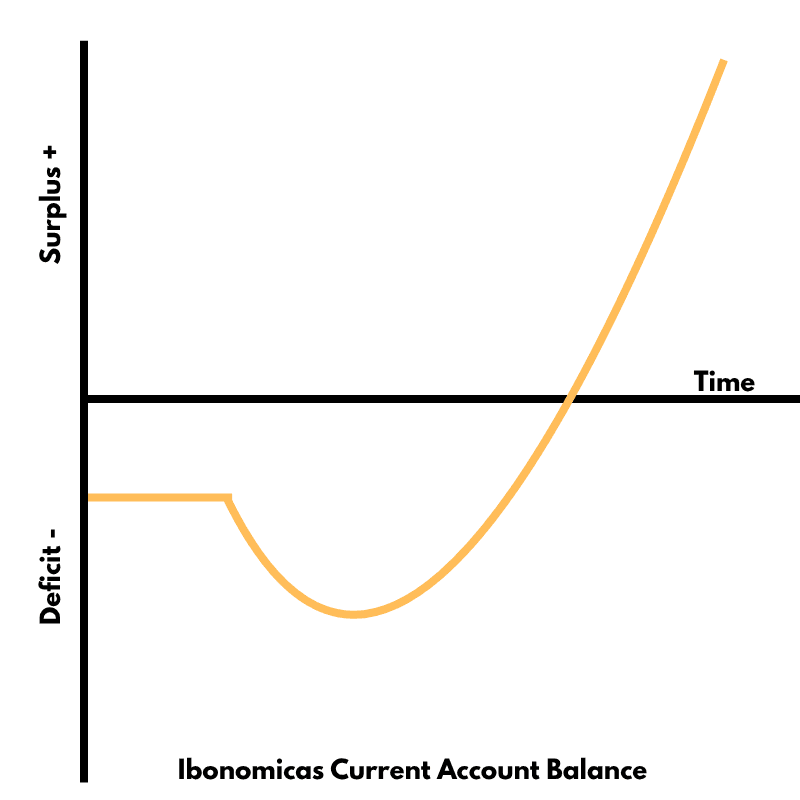
Why does this happen?
- Contract Inelasticity: In the very short term, many import/export orders are based on existing contracts. The quantities are fixed, but the prices change immediately. After a depreciation, a country pays more for its contracted imports, worsening the trade balance.
- Recognition and Decision Lags: It takes time for consumers and businesses to recognize the price changes and adjust their purchasing behavior.
- Long-term vs. Short-term Elasticity: Demand tends to be more inelastic in the short term. Over time, as consumers find substitutes and producers adjust supply chains, demand becomes more elastic, and the Marshall-Lerner condition is more likely to hold.
Level 1 CFA Economics: Currency Exchange Rates-Lecture 6
Let's return to the IFT video for a concise explanation of the J-curve effect.
Watch from 22:15 to 24:22. The video provides a clear summary of why the trade balance might worsen in the short run.
3. The Absorption Approach
The absorption approach shifts the focus from microeconomic elasticities to a macroeconomic perspective. It looks at the trade balance through the lens of national income and expenditure. The term absorption refers to total domestic spending by consumers, businesses, and the government ().
From our earlier equation, we know , where Y is national income. Therefore:
This approach argues that for a currency depreciation to improve the trade balance, a country's national income must rise relative to its domestic absorption. In other words, the country must produce more than it spends, or equivalently, save more relative to its investment.
The effect of a depreciation depends on the state of the economy.
- If the economy has excess capacity (unemployment): A depreciation can switch spending from foreign goods to domestic goods. This stimulates domestic production, raising national income (). Since people tend to save a portion of any new income, income rises more than absorption, and the trade balance improves.
- If the economy is at full employment: National income () cannot easily increase. Therefore, for the trade balance to improve, domestic absorption must decrease. A depreciation can cause this via a wealth effect. The weaker currency reduces the real purchasing power of domestic assets, making people feel poorer. In response, they may reduce their spending and increase their savings, thus lowering absorption and improving the trade balance.
Level 1 CFA Economics: Currency Exchange Rates-Lecture 6
The final segment of the IFT video explains this absorption approach and the crucial distinction between an economy with excess capacity and one at full employment.
Watch from 24:22 to 28:36. Focus on the core idea that to improve the trade balance, income must rise relative to expenditure, and understand the different mechanisms at play depending on the level of employment.
Conclusion
In this lesson, we analyzed the impact of exchange rate movements on trade and capital flows, completing our study of currency exchange rates.
Key Takeaways:
- A country's trade balance () and capital account balance are mirror images. A trade deficit must be financed by a net capital inflow (a capital account surplus).
- The trade balance is fundamentally linked to domestic economic activity via the equation: .
- The Elasticities Approach posits that a currency depreciation improves the trade balance if the Marshall-Lerner condition holds, meaning that the demand for exports and imports is sufficiently price-elastic.
- The J-Curve Effect describes the phenomenon where the trade balance may initially worsen after a depreciation before it improves, due to lags and short-term inelasticities.
- The Absorption Approach provides a macroeconomic view, stating that to improve the trade balance, national income must increase relative to domestic absorption (spending). The mechanism depends on whether the economy is at full employment or has spare capacity.
Preview of the Next Module:
This lesson concludes our module on Currency Exchange Rates. We now have a comprehensive understanding of how currencies are quoted, traded, and how they impact the global economy. In our next module, "Measuring the Macroeconomy," we will pivot to the foundational metrics that describe a country's economic health, beginning with the most important of all: Gross Domestic Product (GDP).