Introduction
Hello! Welcome back to our course on CFA Level 1 Economics.
In our last lesson, we focused on Gross Domestic Product. We learned how to distinguish between nominal GDP (valued at current prices) and real GDP (valued at constant base-year prices). This led us to our first measure of inflation, the GDP deflator, which captures the overall price level of all goods and services produced within an economy.
Today, we'll explore the most widely cited measure of inflation: the Consumer Price Index (CPI). This lesson is designed to meet the learning outcome of defining the CPI and, crucially, distinguishing it from the GDP deflator. We will:
- Define the CPI and understand its purpose.
- Walk through the step-by-step process of calculating it.
- Directly compare the CPI and the GDP deflator, highlighting their key differences in scope and construction.
Understanding both indices is essential for analyzing economic data, a core skill for the CFA exam.
1. The Consumer Price Index (CPI)
The GDP deflator gives us a broad view of price changes across the entire economy. However, as consumers, we are often more concerned with how price changes affect our personal cost of living. This is where the Consumer Price Index comes in.
The Consumer Price Index (CPI) is a measure of the average change over time in the prices paid by urban consumers for a fixed "market basket" of consumer goods and services. In short, it aims to track the cost of living for a typical household.
To understand what the CPI is and how it's calculated, let's watch a video that breaks it down into clear, manageable steps.
Chapter 24: Measuring the Cost of Living
This video from DrAzevedoEcon provides an excellent introduction to the CPI and a detailed walkthrough of the calculation process. It's a great way to build the concept from the ground up.
Watch the video from the beginning to the 09:07 mark. Pay close attention to: The definition of the CPI and the 'basket of goods'. The five steps for calculating the CPI: Fix the basket Find the prices Compute the cost of the basket Choose a base year and calculate the index Calculate the inflation rate
As the video explained, the process is systematic. Let's summarize the key formulas:
-
Calculate the Cost of the Basket: For each year, you multiply the fixed quantities of goods in the basket by their prices in that year and sum the totals.
-
Calculate the CPI: The CPI for any given year is the cost of the basket in that year divided by the cost of the basket in the base year, multiplied by 100.
Note: By definition, the CPI in the base year is always 100. -
Calculate the Inflation Rate: The inflation rate is the percentage change in the CPI from one period to the next.
Calculation in Practice
Now let's apply these formulas. The best way to solidify this process is to work through a numerical example, just as you'll be expected to do on the exam.
Chapter 24: Measuring the Cost of Living
Let's continue with the same video, which now provides a clear, step-by-step calculation using a simple basket of hot dogs and hamburgers.
Watch the segment from 09:07 to 19:36. Follow along carefully as the presenter: Calculates the cost of the fixed basket in three different years. Uses these costs to calculate the CPI for each year, with 2001 as the base year. Calculates the inflation rate between years using the CPI values.
This example highlights a key feature of the CPI calculation: the quantities of goods in the basket (4 hot dogs, 2 hamburgers) remain constant. Only the prices change from year to year.
2. Distinguishing CPI from the GDP Deflator
You now know how to calculate two different price indices: the GDP deflator and the CPI. While they both measure inflation, they do so in different ways and can sometimes tell slightly different stories. For the CFA exam, you must be able to clearly distinguish between them.
The core difference lies in what goods and services are included in the basket.
Let's watch a final segment from the same video, which directly compares the two indices.
Chapter 24: Measuring the Cost of Living
This short segment concisely explains the key distinctions between the CPI and the GDP deflator.
Watch from 31:50 to 34:51. Focus on the two main differences discussed: the types of goods included (domestically produced vs. consumed) and the nature of the basket (fixed vs. variable).
To summarize and reinforce these crucial distinctions, here is a table that lays them out side-by-side.
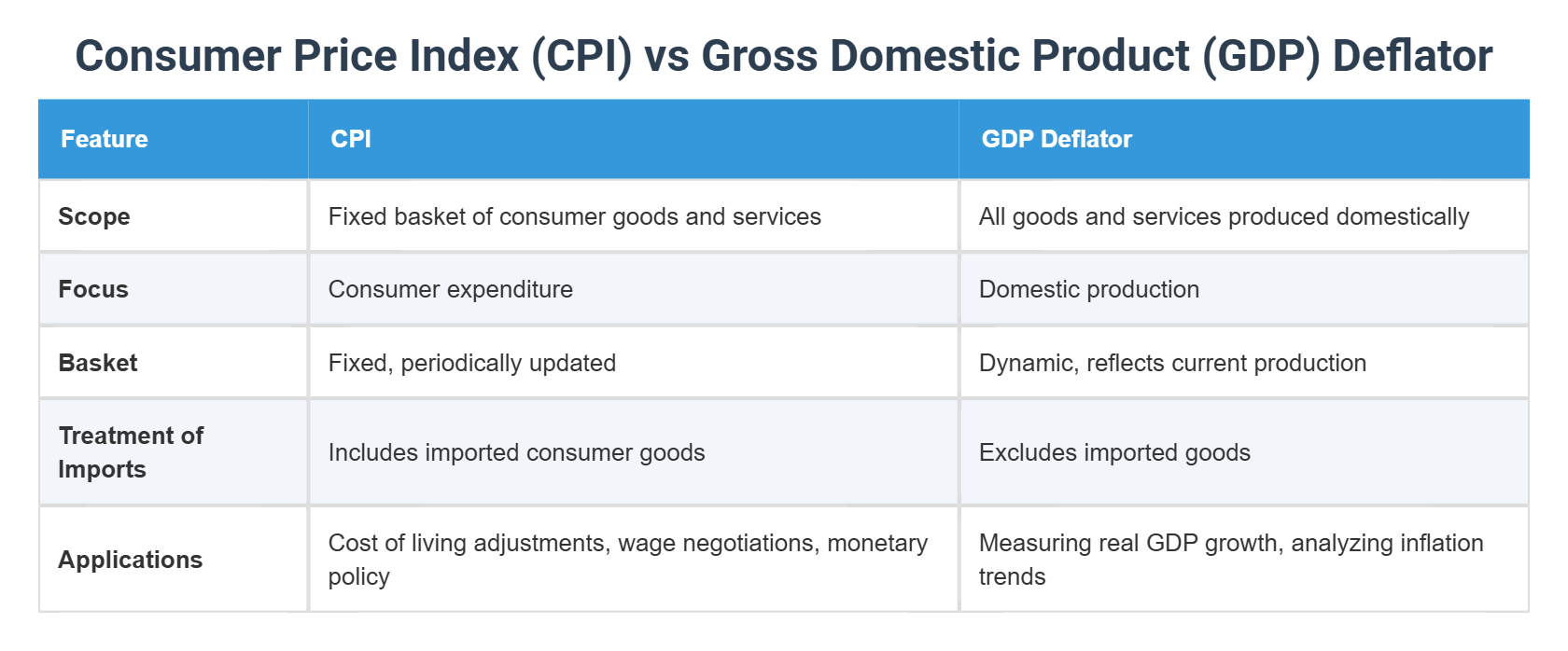
Let's break down the three main points of comparison from this table:
-
Basket Composition (Scope):
- CPI: Tracks a fixed basket of goods and services purchased by a typical consumer. This basket includes everyday items like food, housing, transportation, and clothing.
- GDP Deflator: Reflects the prices of all final goods and services produced domestically in the current year. The "basket" is not fixed; it changes automatically as the composition of the country's output changes.
-
Treatment of Imports:
- CPI: Includes the prices of imported goods that consumers buy (e.g., a Japanese television or a German car purchased in the US).
- GDP Deflator: Excludes the prices of all imports, as it only measures prices of domestically produced goods.
-
Capital and Government Goods:
- CPI: Excludes goods not directly purchased by consumers, such as industrial machinery (capital goods) or military hardware (government goods).
- GDP Deflator: Includes the prices of capital goods and goods purchased by the government, as they are part of domestic production (the 'I' and 'G' in GDP).
Quick Conceptual Check
Imagine the price of foreign-made oil increases significantly. Which index would be more affected, and why?
Answer
The **CPI** would be more affected. This is because gasoline, which is derived from oil, is a significant component of the typical consumer's spending basket. Since much of the oil may be imported, the GDP deflator would not capture this price increase to the same extent, if at all (depending on how much is domestically produced vs. imported).Biases in the CPI
Because the CPI uses a fixed basket, it has some well-known limitations or "biases" that can cause it to slightly overstate the true rate of inflation. These are important to know.
- Substitution Bias: When the price of one good rises faster than others, consumers tend to substitute towards cheaper alternatives (e.g., buying chicken instead of beef). The fixed CPI basket doesn't account for this, so it assumes people keep buying the more expensive good, overstating the increase in their cost of living. The GDP deflator is less prone to this as its basket updates each period.
- Introduction of New Goods: New inventions (like smartphones) increase the value and choice our money can buy, effectively making us better off. The fixed CPI basket is slow to incorporate new goods, so it misses this improvement in purchasing power.
- Unmeasurable Quality Change: Products often improve over time (e.g., a new laptop is much more powerful than one from five years ago). The CPI has difficulty separating price increases due to quality improvements from pure inflation.
Conclusion
In this lesson, we moved from the broad measure of economy-wide prices (GDP deflator) to the more consumer-focused measure (CPI). Understanding both gives you a more complete toolkit for analyzing inflation.
Key Takeaways:
- The Consumer Price Index (CPI) measures the cost of a fixed basket of goods and services purchased by a typical consumer.
- The CPI is calculated by dividing the cost of the basket in the current year by its cost in a base year and multiplying by 100.
- The key differences between the CPI and the GDP deflator are:
- Basket: CPI uses a fixed consumer basket; the GDP deflator uses a changing basket of all domestically produced goods.
- Imports: CPI includes imports; the GDP deflator excludes them.
- Scope: The GDP deflator includes prices of investment and government goods, while the CPI does not.
Preview of the Next Lesson:
We have now covered how to measure an economy's output (GDP) and its price level (GDP deflator and CPI). The third critical macroeconomic variable is unemployment. In our next lesson, we will define unemployment, learn how it's measured, and distinguish between its different types: frictional, structural, and cyclical.