Hello. Last lesson connected a header-sensitive sentiment prediction to a proposed internal route: swapping an activation changed the prediction in the expected direction. That result leaves a practical question unresolved. If you suppress the implicated activation to reduce reliance on the header, what else stops working?
This lesson develops a test for that collateral cost. You will compare shortcut sensitivity with performance on tasks where the same internal representation may carry useful information, then use controls to distinguish a genuine trade-off from indiscriminate damage caused by the intervention.
A shortcut feature need not be a shortcut-only feature
Suppose a sentiment classifier sees a review under either of two source headers. The review’s sentiment label stays fixed, but header A tends to raise the positive-sentiment score. A candidate activation direction carries part of that effect. It is tempting to remove the direction and call the shortcut fixed.
The difficulty is that a direction is not a neatly isolated variable called “source bias.” It can carry several signals, or a downstream computation can use information in it for more than one purpose. The model might also need the header when explicitly asked to identify the source. Even on a review without a meaningful header, the same direction might help convey sentiment-bearing text. Suppression could therefore reduce an unwanted cue effect and impair a legitimate prediction.
A two-dimensional toy model makes the distinction precise. Let be evidence from the review and be a header-associated signal. Imagine that an internal state and the model’s fixed sentiment readout are
The first coordinate is associated with the header, but it also carries review evidence. Removing that coordinate eliminates the header’s influence on ; it also eliminates the readout’s access to . The second coordinate still contains , but the unmodified downstream readout does not use it. Information remaining somewhere in a representation is not the same as an intact model being able to use it after an intervention.
The schematic below illustrates the related idea of amnesic probing: change a representation to suppress information about a property, then measure both whether that property remains readable and what happens to the model’s task.
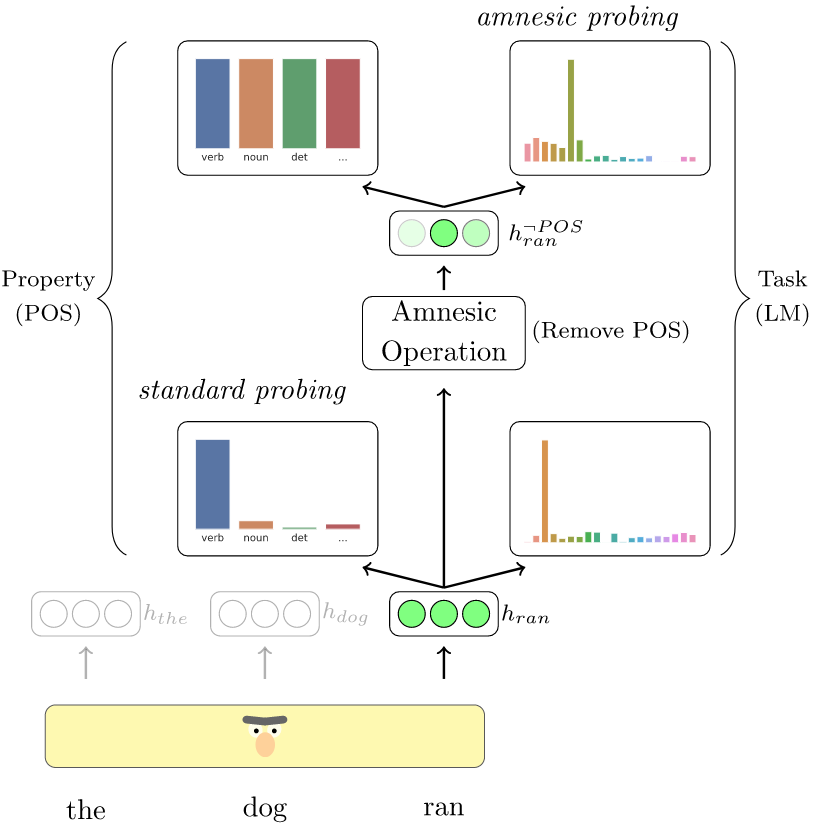
Read the original study for its distinction between decodable information and used information, its intervention controls, and an example of task effects varying across word classes.
Behavioral Explanation with Amnesic Counterfactuals
Read Elazar and colleagues’ paper to see why feature suppression needs both a behavioral test and checks for collateral information loss.
In “1 Introduction” (p. 160), begin at the discussion of probe accuracy and read the probe limitation. Continue through the introduction’s proposal to remove information and measure the effect on prediction. In “2.3 Controls” (p. 162), read the random-direction control. Then, under “Control over Selectivity,” read the restoration test. Focus on what each control can and cannot rule out. In “6 Specific Labels and Word Prediction” (p. 166), find the “Fine-Grained Analysis” paragraph after Table 4. Read the category comparison, stopping before “Removal of Specific Labels.” Notice why an average task effect can hide which legitimate predictions are harmed.
The paper’s part-of-speech example is not a shortcut-mitigation experiment. Its transferable lesson is methodological: removing readable information is an intervention on a model, not a surgical guarantee about what else remains intact.
Define both sides of the trade-off before intervening
Keep the held-out, matched review pairs from the previous lesson. Let and contain the same review and differ only in the source header. Continue using the positive-minus-negative logit score . If A is the header predicted to raise that score, define the mean shortcut sensitivity for model condition as
Here denotes the original model and the model with the intervention applied during inference. A lower positive than is evidence that the intervention reduces the measured header effect. Inspect paired effects as well as their mean: an average near zero could conceal large effects in opposite directions. Retain the original model’s accuracy and loss, too; header insensitivity achieved by making every score nearly constant is not a useful mitigation.
Now specify legitimate behavior that could use the same representation. Two complementary evaluations serve different purposes:
- Review-evidence sentiment: Use held-out reviews under a neutral or standardized header. The gold label comes from the review. Record accuracy and cross-entropy loss, and examine results separately for positive and negative reviews. This tests whether suppression damages the behavior you meant to preserve.
- Legitimate source use: If the model supports a source-identification task, ask it to identify A or B from the header in held-out examples. Source identity is relevant evidence for this task. Record correct-source accuracy and a correct-versus-incorrect source logit margin. This test is meaningful only if the unmodified model performs the task and the proposed site participates in its computation; a sentiment-only classifier cannot be expected to answer a new source-identification task.
The first evaluation catches loss of useful review information, whether through a shared signal or general disruption. The second deliberately checks a setting in which header information has a valid use. Neither should be silently substituted for the other. In particular, losing source-identification ability does not automatically mean sentiment accuracy has fallen.
For a legitimate test set with loss , report the paired degradation
A positive means the intervened model is worse. Keep accuracy alongside loss: accuracy may remain unchanged even as margins on correct predictions deteriorate. Report and across a range of suppression strengths, not just at the setting with the largest header-effect reduction. That gives a behavioral trade-off curve rather than a single success claim.
Make “suppress the feature” an exact intervention
The feature must have a defined site and operation. Suppose the proposed header-associated feature is a unit direction at a specified layer and classification position, with reference activation mean . One possible intervention is
where leaves the activation unchanged and removes its centered component along . Cache or compute the original activation, apply the change with a hook at the pre-specified site, and let the model recompute downstream activations. Apply the same rule to shortcut and legitimate test inputs.
If the candidate is a sparse-autoencoder (SAE) latent rather than a direction, a targeted test has a different form. With original latent activation and decoder vector , subtract its contribution:
This keeps the original SAE reconstruction residual in place; replacing with an entire modified reconstruction would introduce reconstruction error as an additional intervention. Even this targeted subtraction does not guarantee that the latent has only one semantic role.
Choose the site, strength values, and any threshold for calling a result useful on development data. On separately held-out reviews, first verify that the intervention affects the proposed signal: for example, test whether a fresh header readout trained and evaluated with proper splits still recovers header identity from the intervened activations. Then measure and the legitimate-task outcomes. A failed readout supports a limited claim about that readout’s accessible information; a successful new readout shows that the attempted erasure was incomplete. Neither result replaces the behavioral measurements.
A simple worked result illustrates why all columns matter. These numbers are hypothetical, not results from either reading:
| Condition | Mean header effect | Review-only sentiment accuracy | Source-ID accuracy |
|---|---|---|---|
| Original | 1.2 | 91% | 98% |
| Moderate suppression | 0.5 | 89% | 82% |
| Strong suppression | 0.1 | 71% | 53% |
The strong intervention nearly removes the measured header shift, but it also substantially harms both legitimate evaluations. The moderate intervention offers a different trade-off. Whether either is acceptable is a decision about the application, not something a feature label or a probe score decides.
Separate shared utility from intervention damage
A performance drop after suppression has at least two explanations. The feature may genuinely support legitimate computation, or the operation may have disturbed other information and pushed activations into a regime the downstream model handles poorly. Test those explanations rather than assuming the first.
Compare your targeted intervention with random directions matched for the amount of representation removed, using several random draws. Also check the actual activation-change norm: equal numbers of removed directions do not ensure equal perturbation sizes. A sham hook that returns the original activation checks for implementation errors. Report how legitimate performance changes by class and input type, not just in aggregate.
A follow-up study of amnesic probing is useful here because it compares removal methods and shows why an intervention’s apparent behavioral effect depends on its precision.
[PDF] Improving Causal Interventions in Amnesic Probing with Mean ...
Read this Findings of ACL study for a comparison of information-removal methods and the controls used before attributing task damage to a targeted property.
In “2.2 INLP, MP and LEACE” (pp. 12982–12983), start with the paragraph explaining why imprecise removal makes an effect hard to interpret. Read the method comparison, stopping before “3 Experiments and Results.” Focus on why removing more directions is not necessarily a better causal test. Then go to “3 Experiments and Results,” Step 2, “What is the impact on model behaviour?” (pp. 12983–12984). Starting immediately after Table 1, read the information control. Inspect Table 2 and the paragraphs immediately following it, through the sentence explaining that comparable random projection with MP or LEACE hardly affects results. Compare targeted and random removals within the same method, rather than treating any drop from the original model as proof of targeted information use.
A restoration check can provide further evidence. The original amnesic-probing study supplies the removed property explicitly to a modified downstream system and asks whether performance can be recovered. Recovery is consistent with that property accounting for some damage; failure to recover raises concern about other information being lost. But this is a newly trained or adapted downstream system, not evidence that the original, fixed model could avoid the cost of suppression unaided.
There are limits even after good controls. A direction can mix header and review information, as in the toy model. A matched random direction may not intersect equally important information. Downstream components may compensate for a removed signal on some inputs but not others. For that reason, the most defensible conclusion is conditional: at this site, under this operation and test distribution, reducing the header effect incurs this measured cost to legitimate behavior. It is stronger than a visualization-based claim, but narrower than “we removed only the shortcut.”
Takeaway
To test a proposed shortcut fix, measure both the nuisance-cue effect and behavior that ought to survive—and include a task where the cue itself is legitimately relevant when the model supports one. Pre-specify the intervention, use held-out matched inputs, compare against sham and perturbation-matched controls, and inspect the trade-off across strengths and subgroups. A successful suppression is not established by a quieter feature or a smaller header effect alone.
The next lesson extends this caution across training: as representations change between checkpoints, a fixed interpretability signal may stop measuring the mechanism it was originally chosen to track.