Hello! Welcome to the fifth lesson in our B1 grammar journey.
In the last two lessons, we established a foundational concept: Greek verbs have two aspects, imperfective (for ongoing/repeated actions) and perfective (for single/completed actions), and we learned how to form the two different verb stems that correspond to them.
Today, we'll connect the "how" with the "why." Our learning outcome is to select the correct verb aspect (perfective vs. imperfective) based on contextual meaning. We will move beyond mechanics and into the art of expressing precise meaning. By the end of this lesson, you'll be able to analyze a situation and choose the aspect that best communicates your intent, whether you're describing a past habit, a future plan, or a simple wish.
1. Aspect: The Lens Through Which You View an Action
Before we dive into examples, let's solidify the core distinction. Think of verbal aspect as the lens on a camera:
- Imperfective Aspect: This is your "wide-angle" or "panning" lens. It focuses on the process, duration, or repetition of an action. It's used for habits, ongoing activities, and background descriptions. The action is seen from the inside, as it unfolds.
- Perfective Aspect: This is your "snapshot" lens. It captures an action as a single, complete event. It doesn't care about the internal duration; it presents the action as a whole. It's used for one-off events and actions in a sequence.
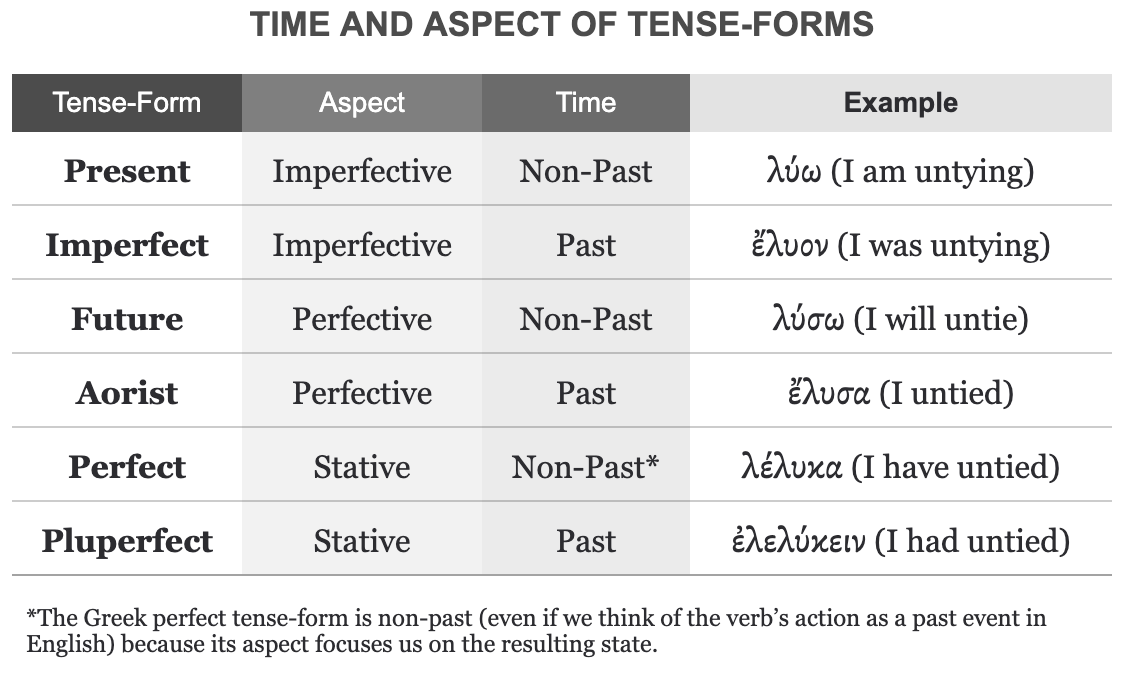
This fundamental distinction applies across different tenses and moods. The following chart provides an excellent visual overview of how tense-forms relate to time and aspect. Notice how the Imperfect and Aorist are both in the "Past," but fall under "Imperfective" and "Perfective" aspect, respectively.
2. The Classic Showdown: Aorist (Perfective) vs. Imperfect (Imperfective)
The clearest place to see aspect at work is in the past, when distinguishing between the Aorist (Αόριστος), formed from the perfective stem, and the Imperfect (Παρατατικός), formed from the imperfective stem.
The following reading provides concrete examples that make this distinction clear.
simple past & past continuous - aoristos vs paratatikos - Omilo
The article 'simple past & past continuous' from Omilo offers excellent side-by-side comparisons that highlight when to use the Aorist versus the Imperfect. This will help you identify the contextual clues that signal which aspect to use.
Please read the section titled 'When to use Aoristos or Paratatikos?'. Pay close attention to the three example pairs and the time expressions used in each sentence (like 'σήμερα', 'κάθε μέρα', 'πέρυσι', 'για 1 ώρα'). These are the contextual clues we are focusing on.
As you saw in the article, the choice of tense is often guided by specific adverbs and phrases. Let's summarize the most common signals:
Use the Imperfective Aspect (Παρατατικός) for:
- Habitual or repeated actions: "When I was a child, I used to..."
- Signal words:
κάθε μέρα/χρόνο(every day/year),πάντα(always),συχνά(often),συνήθως(usually). - Example:
Όταν ήμουν στην Ελλάδα, **κολυμπούσα** κάθε μέρα.(When I was in Greece, I swam every day.)
- Signal words:
- Ongoing actions in the past (background): "While I was reading, the phone rang."
- Signal words:
ενώ(while),καθώς(as). - Example:
Ενώ **έβλεπα** τηλεόραση, κάποιος χτύπησε την πόρτα.(While I was watching TV, someone knocked on the door.)
- Signal words:
- Descriptions of states or situations:
- Example:
Το σπίτι **ήταν** μεγάλο και **είχε** ωραία θέα.(The house was big and had a nice view.)
- Example:
- Actions with an explicit duration:
- Example from the article:
...**πλήρωναν** λογαριασμούς... για 1 ώρα.(...they were paying bills... for 1 hour.)
- Example from the article:
Use the Perfective Aspect (Αόριστος) for:
- Single, completed actions in the past: "Yesterday, I finished work."
- Signal words:
χθες(yesterday),πέρυσι(last year),προχθές(the day before yesterday), specific dates. - Example:
Χθες **είδα** μια πολύ καλή ταινία.(Yesterday I saw a very good movie.)
- Signal words:
- A sequence of completed actions: "He got up, got dressed, and left."
- Example:
**Σηκώθηκε**, **ντύθηκε** και **έφυγε**.(He got up, got dressed, and left.)
- Example:
- Sudden events:
- Signal word:
ξαφνικά(suddenly). - Example:
Ξαφνικά **άκουσα** έναν θόρυβο.(Suddenly I heard a noise.)
- Signal word:
Test your understanding! (Past Tense)
For each sentence, would you use the Imperfective (Παρατατικός) or Perfective (Αόριστος) form of the verb in parentheses?
- Πέρυσι _______ (πηγαίνω) διακοπές στη Σαντορίνη. (Last year I went on holiday to Santorini.)
- Κάθε καλοκαίρι _______ (πηγαίνω) στο χωριό μου. (Every summer I used to go to my village.)
Show answer
- πήγα (Perfective/Αόριστος). The action happened once, last year (
πέρυσι). - πήγαινα (Imperfective/Παρατατικός). The action was repeated every summer (
Κάθε καλοκαίρι).
3. Aspect in the Future and Subjunctive
The same logic applies to other moods and tenses, even though we are no longer talking about the past. The choice still depends on whether you view the action as a process or a single event.
3.1 Future Tense
-
Continuous Future (
θα+ Imperfective stem): Describes an action that will be in progress or happening habitually in the future.Από αύριο, **θα διαβάζω** δύο ώρες κάθε απόγευμα.(Starting tomorrow, I will be studying for two hours every afternoon.) - A future habit.Αύριο τέτοια ώρα, **θα ταξιδεύω** για τη Ρώμη.(Tomorrow at this time, I will be traveling to Rome.) - An action in progress at a specific future point.
-
Simple Future (
θα+ Perfective stem): Describes a single, complete action that will happen in the future.Αύριο **θα διαβάσω** αυτό το κεφάλαιο.(Tomorrow I will read this chapter.) - A single, defined task.**Θα σου τηλεφωνήσω** όταν φτάσω.(I will call you when I arrive.) - A single event.
3.2 Subjunctive Mood (after να, ας, για να, etc.)
The subjunctive is where this distinction becomes very powerful for expressing nuance.
-
Imperfective Subjunctive (
να+ Imperfective stem): Refers to the process or a repeated action.Μου αρέσει **να ακούω** μουσική όταν δουλεύω.(I like to listen to music when I work.) - A general preference/habit.Πρέπει **να προσέχεις** περισσότερο.(You must be more careful.) - General, ongoing advice.
-
Perfective Subjunctive (
να+ Perfective stem): Refers to a specific, one-time action.Θέλω **να ακούσω** αυτό το τραγούδι.(I want to listen to this song.) - A specific, single act.Πρέπει **να φύγεις** αμέσως.(You must leave immediately.) - A single, immediate command.
Summary and Key Takeaways
Choosing the correct aspect is a core skill for fluency in Greek. It moves beyond simple tense and adds a layer of meaning that is integral to the language.
- Core Principle: The choice depends on how you view the action. Is it a process/habit (imperfective) or a single, whole event (perfective)?
- Imperfective Aspect: Use for habits, repeated actions, descriptions, and ongoing background events. Think
πάντα,κάθε μέρα,ενώ. - Perfective Aspect: Use for single, completed actions and sequential events. Think
χθες,μια φορά,ξαφνικά. - Universal Logic: This distinction applies not just to the past (Imperfect vs. Aorist), but also to the future (Continuous vs. Simple) and the subjunctive mood, allowing for subtle and precise communication.
In our next lesson, we will put this all into practice by analyzing the use of perfective and imperfective aspect in a short text. This will challenge you to see how an author uses aspect to build a narrative, distinguishing between background description and plot-advancing events.