Guten Tag! Welcome to your sixth lesson.
In our last lesson, you learned how to use essential courtesy phrases like bitte, danke, and Entschuldigung. These words are the social glue of daily conversation. Today, we'll build another crucial foundation: numbers. From telling the time and understanding prices to sharing a phone number, knowing how to count is a skill you will use every single day.
This lesson will teach you how to count from 0 to 100 in German. We'll break it down into simple, logical patterns that will make it much easier to learn than you might think.
1. The Foundation: Numbers 0 to 12
The first step is to learn the numbers from 0 to 12. These numbers have unique names and don't follow a specific pattern, so they need to be memorized. They are the essential building blocks for all other numbers.
To start, let's hear how they are pronounced.
Numbers in German 0-100 | Zahlen | German for beginners | Learn German
Please watch this first part of the video 'Numbers in German 0-100' from the 'Learn German' channel. It carefully pronounces each number from 0 to 12.
Watch from the beginning of the number section at 00:53 until 03:44. Repeat each number after the speaker to practice your pronunciation.
Now, let's review these numbers in writing. The following reading provides a clear list and some helpful pronunciation guides.
German Numbers: Learn How to Count from 0-100 Now!
Please read the first section of the article 'German Numbers: Learn How to Count from 0-100 Now!'. This provides a written list of the numbers 0-12, which you just heard.
Read the section titled 'The Foundation: German Numbers 0-12'. Pay close attention to the spelling of each number.
Here is the list for your reference:
- 0 - null
- 1 - eins
- 2 - zwei (Remember the 'ts' sound for 'z')
- 3 - drei
- 4 - vier
- 5 - fünf
- 6 - sechs
- 7 - sieben
- 8 - acht
- 9 - neun
- 10 - zehn
- 11 - elf
- 12 - zwölf
2. The Teens: Numbers 13 to 19
Once you know the numbers up to 12, the teens (from 13 to 19) become much easier because they follow a clear pattern. You simply combine the single-digit number with the word for ten, zehn.
Pattern: [Unit Number] + zehn
For example:
- drei (3) + zehn (10) = dreizehn (13)
- vier (4) + zehn (10) = vierzehn (14)
There are two small exceptions to watch out for:
- sechzehn (16): The 's' from sechs is dropped.
- siebzehn (17): The '-en' from sieben is dropped.
This is done to make the pronunciation smoother. The video and reading below explain this pattern and its exceptions.
Numbers in German 0-100 | Zahlen | German for beginners | Learn German
Continuing with the 'Learn German' video, this next part covers the numbers from 13 to 20, clearly explaining the 'zehn' pattern.
Watch from 03:44 to 07:09. Notice how the numbers are constructed and listen carefully to the pronunciation of the exceptions, 'sechzehn' and 'siebzehn'.
For a written explanation of this same pattern, the article you looked at earlier is very helpful.
German Numbers: Learn How to Count from 0-100 Now!
The article 'German Numbers: Learn How to Count from 0-100 Now!' also explains this 'teen pattern' very clearly.
Read the section 'German Numbers 13-19: The Teen Pattern'. This will reinforce what you just saw in the video.
3. The Big Step: Numbers 20 to 100
This is where German numbers become quite different from English. Let's first learn the tens (20, 30, 40, etc.).
The Tens (20, 30, 40...)
Most tens are formed by taking the base number (e.g., vier for 40) and adding the suffix -zig.
- vier + zig = vierzig (40)
- fünf + zig = fünfzig (50)
Key exceptions to note:
- 20 is zwanzig
- 30 is dreißig (It ends in -ßig, not -zig. The "ß" is pronounced like a sharp 's'.)
- 60 is sechzig (The 's' from sechs is dropped.)
- 70 is siebzig (The 'en' from sieben is dropped.)
- 100 is (ein)hundert
The "Backward" Rule for Numbers 21-99
This is the most important rule to learn. For numbers between the tens (like 21, 43, 78), German says the unit number first, then "and" (und), then the ten.
Pattern: [Unit Number] + und + [Ten]
Let's take 21 as an example:
- It's literally "one and twenty".
- ein (one) + und (and) + zwanzig (twenty) = einundzwanzig
- Note: When eins is used in a compound number like this, the final 's' is dropped, so it becomes ein.
Another example, 37:
- "seven and thirty"
- sieben + und + dreißig = siebenunddreißig
All these compound numbers are written as one single word. This might feel strange at first, but with practice, it becomes automatic. The next video explains this rule using real-life examples.
Counting in German from 1 - 100 | Super Easy German 178
The presenters in this 'Easy German' video do a fantastic job of explaining this 'backward' counting system in a very clear and practical way.
Please watch from 03:56 to 05:32. They give many examples like 'siebenunddreißig' (37) that make the rule easy to understand. Listen to how they say the numbers naturally.
To see this system broken down step-by-step, the following reading is very useful.
German Numbers: Learn How to Count from 0-100 Now!
Let's go back to our main article. It explains the structure of the tens and the 'unit + und + ten' rule with many written examples for you to study.
Read the section 'German Numbers 20-99: Understanding the Decade Pattern'. This covers both the tens (20, 30, etc.) and the compound numbers (21, 35, etc.).
Test your understanding!
Using the [Unit] + und + [Ten] rule, how would you write the following numbers in German?
- 42 (two and forty)
- 65 (five and sixty)
- 98 (eight and ninety)
Show answer
- zweiundvierzig (zwei + und + vierzig)
- fünfundsechzig (fünf + und + sechzig)
- achtundneunzig (acht + und + neunzig)
Summary and Reference
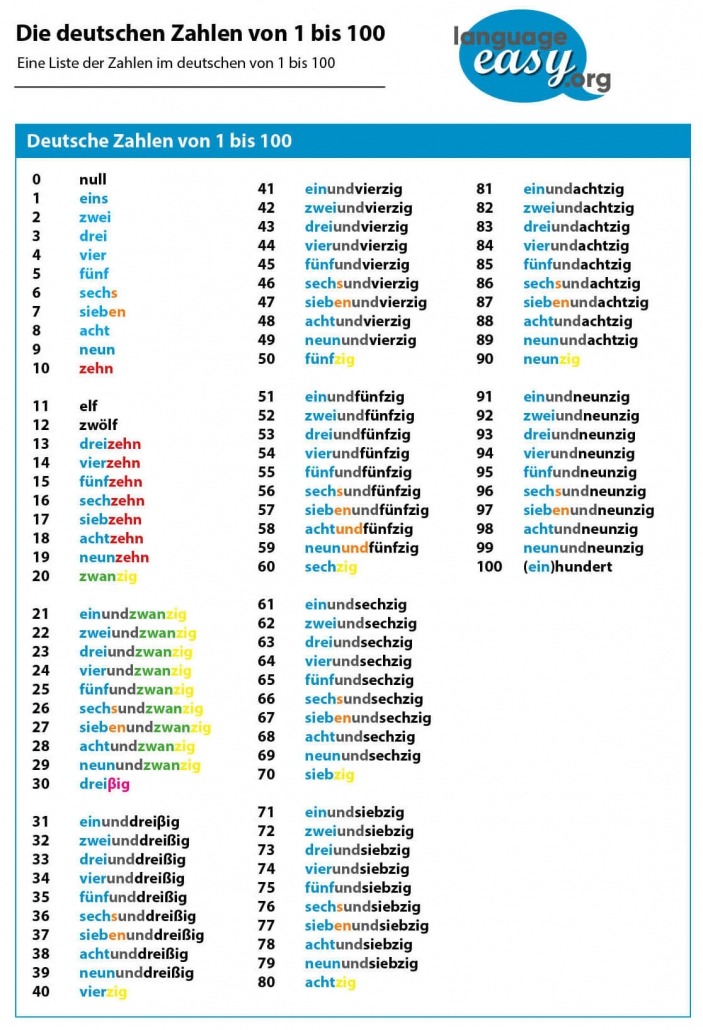
You have now learned all the rules needed to count to 100! Here is a handy chart that lists all the numbers. You can use it as a reference to practice and review.
Conclusion
Ausgezeichnet! (Excellent!) You've covered a lot of ground today. Understanding and using numbers is a massive step towards fluency.
Here are the key takeaways:
- Numbers 0-12 are unique and must be memorized.
- Numbers 13-19 follow the pattern: Unit + zehn.
- The tens (20, 30, 40...) mostly end in -zig.
- Numbers 21-99 follow the "backward" rule: Unit + und + Ten (e.g., einundzwanzig).
In our next lesson, we will learn how to ask and answer basic personal information questions using words like Wer? (Who?), Wie? (How?), Woher? (From where?), and Wo? (Where?). You'll see how knowing numbers is immediately useful, for example, when someone asks "Wie alt sind Sie?" (How old are you?).
Bis bald! (See you soon!)