Hello. Welcome to our next lesson.
In our previous session, we deconstructed the experience of numbness and dissociation, reframing it as a protective shutdown mechanism—the mind's intelligent response to overwhelming stress. Today, we build on that by exploring a closely related feeling, one captured poignantly in your source material by phrases like, “No one actually understands how lonely I feel” (#2) and “I feel like I’m drowning and no one even notices” (#13).
This lesson addresses the learning outcome: to write a passage that distinguishes between the psychological experience of alienation and the physical state of being alone.
Our goal is to dissect this crucial distinction. Many people use "lonely" and "alone" interchangeably, but as your work aims to show, they are worlds apart. One can be perfectly content while alone, yet feel profoundly, painfully lonely in a room full of people. Articulating this paradox is fundamental to your book's mission of making readers feel seen in their most isolating experiences.
1. The Core Distinction: Aloneness vs. Alienation
First, let's establish a clear vocabulary. The terms isolation, loneliness, alienation, and solitude are often conflated, but they describe distinct states.
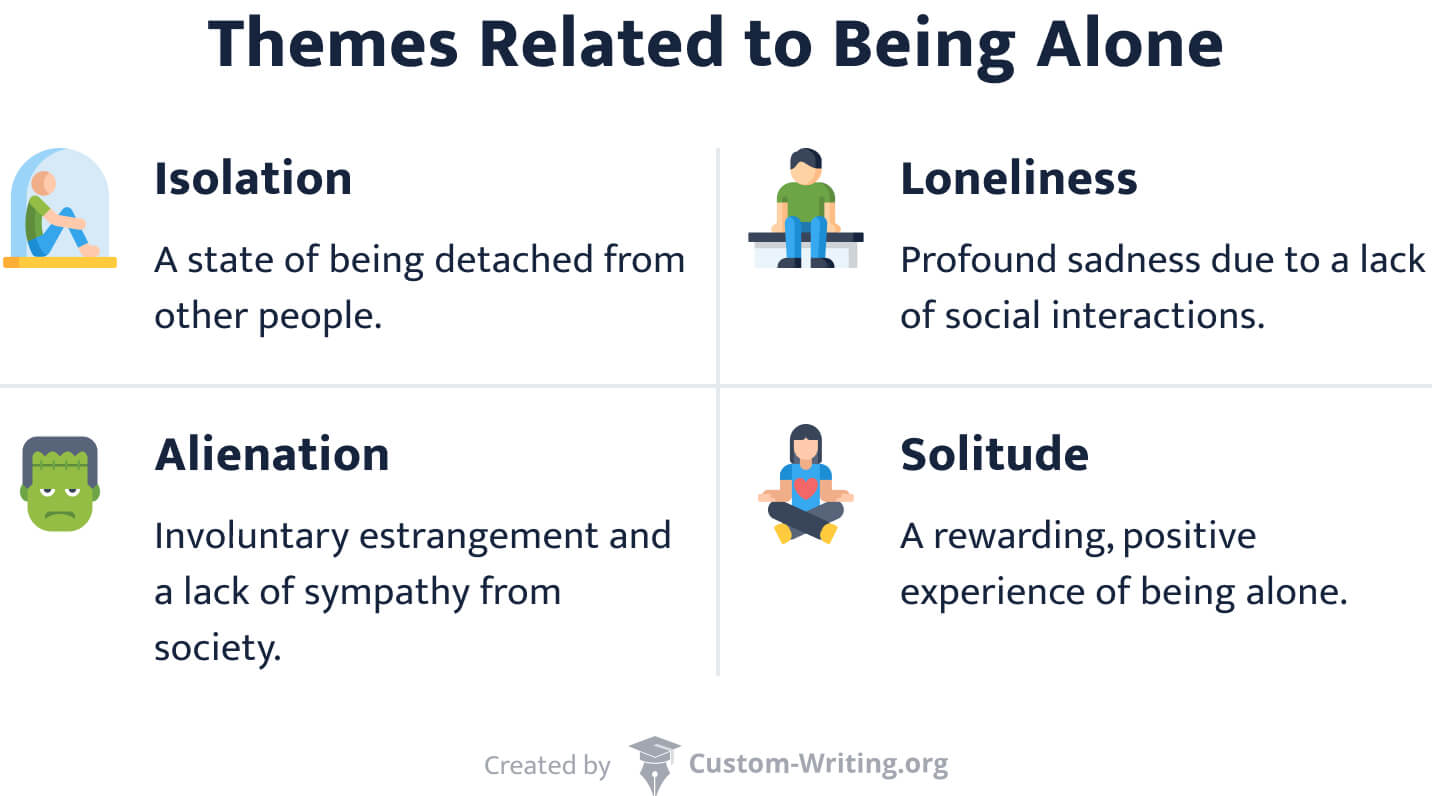
For your book, the most powerful contrast is between solitude (chosen, restorative aloneness) and loneliness/alienation (a painful internal state of disconnection, regardless of who is physically present).
A helpful way to frame this is as a continuum.
[PDF] The Expressions of Being Alone
The workbook 'The Expressions of Being Alone' from Concordia University offers a clear and useful model for understanding this. It presents being alone not as a single state, but as a spectrum of experiences.
Please review the following sections: Page 11 ('Definitions'): Focus on the diagram showing the continuum from 'Loneliness' to 'Solitude'. The key insight is that your position on this continuum is determined by your internal emotional experience. Pages 12-13 ('Definitions'): Read the definitions of 'Solitude' and 'Loneliness'. Note that solitude is compatible with feeling connected, while loneliness is defined by unmet social desires and distress. Page 83 ('In Conclusion'): The first paragraph summarizes this distinction perfectly: 'The expressions of being alone move on a continuum... Your emotional experience and appraisal of being alone will influence where you find yourself on the continuum.'
2. The Paradox: Why We Feel Lonelier in a Crowd
Now we arrive at the central question for your reader: Why does it hurt so much to feel alone when surrounded by people? The answer lies in the gap between expectation and reality, and the emotional labor of performance.
The following video explores the deep psychological reasons behind this phenomenon.
7 Deep Reasons Why You Feel Lonelier Around People Than Being Alone - The Hidden Psychology
The video '7 Deep Reasons Why You Feel Lonelier Around People' provides an excellent psychological explanation for this paradox, which it calls 'visible loneliness.'
Please watch these two key segments: From 02:01 to 03:49: This section introduces Carl Jung's concept of the 'persona'—the social mask we wear. It argues that when we're surrounded by performances instead of authentic selves, our soul recognizes the lack of real connection, leading to a profound loneliness. From 06:56 to 09:09: This part explains the painful 'cognitive dissonance' that occurs in a crowd. Your brain expects connection, so when you feel only emptiness, the contradiction amplifies the pain. It's like 'being hungry in a room full of plastic food.'
This "performance" of social roles is not just tiring; it's a form of self-abandonment that leads directly to feelings of alienation. It creates a state where you are physically present but psychologically absent, fragmented from your own authentic self.
Another resource explains this internal fragmentation beautifully.
The Psychology of People Who Prefer to Be Alone
The video 'The Psychology of People Who Prefer to Be Alone' expands on Jung's ideas, linking the pressure to perform with 'chronic psychic exhaustion.'
Watch the following clips: From 01:31 to 04:20: This section establishes Jung's core distinction: 'Loneliness is the painful emptiness. Solitude is the healing silence.' It frames solitude not as hiding, but as finding oneself. From 08:54 to 09:51 and 11:40 to 13:05: These segments describe the consequence of constant performance—a 'chronic psychic exhaustion' and 'fragmentation' of the psyche. This is the inner experience of alienation, where the authentic self is stifled.
3. From Concept to Prose: Writing the Distinction
Understanding the theory is one thing; translating it into the calm, empathetic prose your book requires is the next step. Your goal is to describe this internal landscape without clinical jargon, using metaphor and emotional truth.
The following resource is a masterclass in this style of writing. It's not a psychological text, but a piece of writing that embodies the tone you're aiming for.
The Ghosts in Our Closet: The Past Never Signs a Non-Compete
The article 'The Ghosts in Our Closet' by Frank Glassner demonstrates how to write about these deep emotional truths with a powerful, human voice. It shows, rather than tells, the difference between external appearances and internal realities.
Read two specific passages as stylistic models: In 'Chapter II: The Wonder Years', find the paragraph beginning 'This is where you first learn the difference between loneliness and solitude.' This passage perfectly captures how adolescence forces us to confront this distinction by performing an identity while feeling internally isolated. Read the 'Epilogue: The Ghosts We Gave Life To'. Pay close attention to the raw emotion in the passage about parental alienation. It is a devastatingly powerful example of the theme: 'Alienation is a lie told long enough to sound like truth. I never left. You think I left you, but I was pushed.' This is the epitome of distinguishing physical absence from psychological connection/disconnection.
Your Task: Writing About Alienation
Your task is to write a short passage (2-3 paragraphs) for your book that illustrates the difference between being alone and feeling alienated.
- Choose a scenario. You might contrast a quiet, restorative evening spent alone (solitude) with the painful experience of feeling invisible at a bustling family gathering, a work party, or even while sitting next to a partner (alienation).
- Anchor the feeling. Use one of your core phrases as an emotional north star. For example, you could explore the inner world of someone thinking, "No one actually understands how lonely I feel" (#2) while surrounded by laughter.
- Incorporate the 'why'. Weave in one of the psychological concepts we've discussed:
- The feeling of performing, wearing a social "mask."
- The exhaustion from surface-level conversations that fail to provide real connection.
- The painful gap between the connection you crave and the emptiness you feel.
The goal is to write a passage that allows someone to read it and think, "That's it. That's the feeling I couldn't find the words for."
Conclusion
Today, we've untangled the crucial difference between the physical state of being alone and the psychological pain of alienation. By understanding this distinction, you can give your readers the language to validate one of their most confusing and isolating emotions.
Key Takeaways:
- Aloneness and loneliness are not the same. Aloneness is a physical state; loneliness (or alienation) is an internal experience of painful disconnection.
- Solitude is restorative. It is chosen aloneness that allows for self-reconnection and peace.
- Alienation thrives in crowds. It is often caused by the performance of social roles, the lack of authentic connection, and the cognitive dissonance between an expected sense of belonging and a felt sense of emptiness.
In our next lesson, we will explore another powerful driver of alienation: the connection between financial precarity and feelings of shame and social withdrawal.