Hello! Welcome to your next lesson in the "Deconstructing the Emotional Core" module.
In our last session, you did the foundational work of a nonfiction author: you took the raw material of human experience—those 30 powerful emotional phrases—and began shaping it into a coherent structure by grouping them into thematic clusters. This process of thematic analysis has given you the raw building blocks for your book's chapters.
Today, we'll build on that work to address the learning outcome: to define the book's central narrative arc, moving from the validation of pain towards the 'permission to rest'. An arc isn't just for fiction; in narrative nonfiction, it's the emotional journey you consciously design for your reader. For this book, it's about creating a safe passage from a place of overwhelming pain to a state of quiet self-acceptance.
1. The Emotional Arc: Your Book's True Storyline
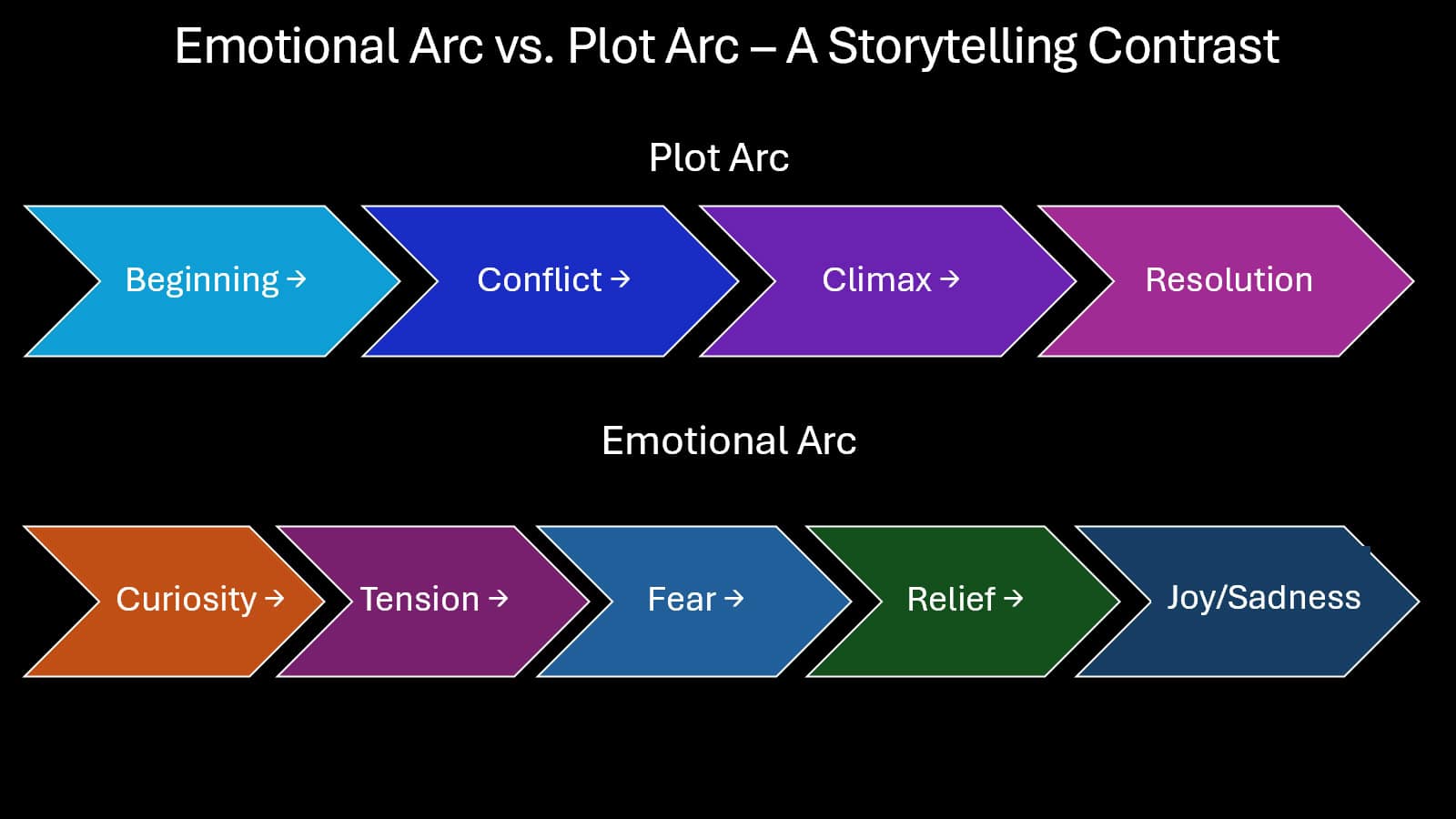
For a book like yours, the primary story is not a sequence of external events but a progression of internal feelings and realizations. The structure you build must serve this emotional journey.
To deepen this idea, let's hear from an expert in narrative nonfiction.
A Masterclass in Narrative Nonfiction with Ben Rawlence
Author Ben Rawlence, in his 'Masterclass in Narrative Nonfiction,' explains that the core of this genre is the 'story'—an emotional journey that is transformative and engaging.
Please watch from 00:49 to 01:45. Pay attention to his distinction between a story as 'information' versus a story as an 'emotional journey.' This is the foundational principle for your book's structure.
Your task is to define the shape of this emotional journey. What path will you lead your reader on? Fortunately, there are established frameworks for stories about suffering that can guide us.
2. A Framework for Narratives of Suffering
Scholars who study how people tell stories about illness and hardship have identified common narrative patterns. Understanding these patterns is crucial for you as an author because the narrative structure you choose will profoundly affect how your reader feels and what they take away from your book.
The sociologist Arthur W. Frank, in his seminal work The Wounded Storyteller, identified three primary "illness narratives." These are powerful tools for thinking about your book's arc.
The implications of plot lines in illness and memoir
The article 'The implications of plot lines in illness and memoir' from Nieman Storyboard provides an excellent summary of Arthur Frank's work. It will give us the language and concepts to define your book's arc with precision and care.
Please read the following sections from the article: Start with 'The wounded storyteller' to understand the core idea of illness as a 'loss of the destination and map.' Next, read the descriptions for the three narrative types: 'The restitution narrative,' 'The chaos narrative,' and 'The quest narrative.' As you read, consider which of these models aligns with your book's core promise and which you must actively avoid.
Let's break down these three narratives in the context of your project:
-
The Restitution Narrative: ("I was broken, and now I'm fixed.") This is the classic "happily ever after" story. It's often associated with toxic positivity because it implies that full recovery is the only acceptable outcome and can invalidate the experience of ongoing struggle. This is the narrative you must avoid. It breaks your core promise to the reader by offering a simplistic cure instead of deep validation.
-
The Chaos Narrative: ("I'm lost, things are bad, and there's no way out.") This narrative embodies the raw, spiraling experience of burnout, grief, and despair. It's where your reader is likely starting. Your book's opening must meet the reader here, acknowledging this chaos without judgment. To start anywhere else would be to lose their trust. However, a book that only lives in the chaos narrative can risk glorifying despair.
-
The Quest Narrative: ("The suffering is part of a journey that leads to a new, wiser self.") This is the framework for your book. The quest narrative accepts the pain as real and doesn't promise a return to a "before" state. Instead, it "meets suffering head on" and seeks to find meaning, wisdom, and a new way of being. As Frank says, wellness becomes "the claiming by the narrator of a newer, wiser state." This perfectly aligns with your goal of offering "quiet resilience" and "permission to rest."
Your book's central narrative arc will be a Quest Narrative that begins by validating the Chaos Narrative.
3. Defining the Three Stages of Your Book's Arc
Let's map this Quest Narrative onto your book's structure.
Stage 1: The Beginning — Validation in Chaos
The first part of your book must act as a mirror, reflecting the reader's state of chaos and making them feel seen. It says, "You are not alone in this feeling. This pain, this exhaustion, this sense of being lost—it is real." This is where you use the power of naming emotions to reduce their threat.
Toxic Positivity: The Reality of Suppressing Emotions
Dr. Tracey Marks' video on 'Toxic Positivity' explains the psychological power of naming an emotion, a technique called 'Affective Labeling.' This is the work your book will do in its opening stage.
Please watch the segment from 03:39 to 04:26. Notice how labeling an emotion makes it 'feel more real and lessens the threat.' This is the function of the first part of your arc.
Stage 2: The Middle — The Journey of Exploration
The main body of your book is the quest itself. Here, the thematic clusters you created become chapters that explore the different territories of this inner landscape: the weight of pretending, the ache of loneliness, the confusion of identity loss, the shame of financial pressure. You are not providing a map out, but rather a companion for the journey through. Each chapter bears witness to a different aspect of the struggle, helping the reader understand the contours of their own experience.
Stage 3: The End — A "Moment of Pause" and Quiet Resilience
The quest does not end with a triumphant victory or the vanquishing of all pain. True stories rarely have such neat endings. The goal is to bring the reader to a place of acceptance and self-compassion.
A Masterclass in Narrative Nonfiction with Ben Rawlence
Let's return to Ben Rawlence's masterclass. Here, he discusses the challenge of ending a true story. His concept of finding a 'moment of pause' is the key to crafting your book's conclusion.
Please watch from 11:23 to 13:09. Focus on his realization that you can't 'make up the ending' and must instead find a place that 'feels appropriate to bring that story to a close,' even if it's inconclusive.
This "moment of pause" is your book's destination: the "permission to rest." It's the moment the reader can finally put down their weapons, captured perfectly by phrase #30: "I'm not giving up, I'm just really tired of fighting." This isn't surrender; it's a form of quiet resilience—adapting to adversity without pretending it doesn't hurt. It's the "newer, wiser state" of the Quest Narrative.
4. Your Task: Sketching Your Narrative Arc
Now, let's make this concrete. Look at the thematic clusters you created in the last lesson. Your task is to arrange them along this three-stage arc.
-
Stage 1 (Validation): Identify 1-2 of your thematic clusters that best represent the initial state of chaos and overwhelming pain. These will likely form the opening chapters. They should immediately validate feelings like "I'm drowning and no one notices" or "I'm so tired of pretending I'm okay."
-
Stage 2 (Exploration): Arrange the bulk of your clusters (perhaps 4-6 of them) in the middle. These are the core chapters that explore specific themes like identity loss, loneliness, anger, and shame. Think about a logical flow. Does it make sense to talk about loneliness before identity loss? Or vice-versa?
-
Stage 3 (Permission): Select the 1-2 clusters that feel most suited to leading the reader toward the "moment of pause." The cluster that contains the idea of being "tired of fighting" is a natural fit here. This section isn't about solving problems but about shifting perspective towards self-compassion.
Take about 20 minutes to sketch this out. You can simply list the working titles of your clusters under the three stage headings: Beginning (Validation), Middle (Exploration), and End (Permission). There is no perfect order, but thinking about the reader's emotional progression will help you build a powerful and safe journey.
Conclusion
Today, you've moved from having a collection of themes to defining a purposeful narrative journey for your reader. You've chosen the Quest Narrative as your guiding structure, ensuring your book will be a work of deep validation, not false reassurance.
Key Takeaways:
- Your book's structure is an emotional arc, not a plot-driven one.
- The Quest Narrative provides the ideal framework: it honors the "chaos" of pain while guiding the reader toward a "newer, wiser state" of acceptance.
- The arc moves through three stages: Validation (meeting the reader in their chaos), Exploration (journeying through the themes), and Permission (arriving at a "moment of pause" and quiet resilience).
In our next lesson, we will use this defined arc as our guide to draft preliminary, empathetic chapter titles for your thematic clusters. You are now truly building the skeleton of your book.