Hello again. In our last lesson, you practiced freewriting, a technique for opening a direct channel to your unfiltered thoughts by outrunning your internal critic. We focused on the process of writing without censorship, establishing a crucial foundation.
Today, we build on that foundation. If freewriting is about opening the floodgates, this lesson is about learning to direct that flow. Our objective is to use targeted journaling prompts to begin exploring your inner world. We will move from the unstructured flow of freewriting to a more focused, inquiry-driven practice. This will equip you with a precise tool for self-excavation, helping you navigate the complex terrain of your own psyche with intention.
From Unstructured Flow to Focused Inquiry
Freewriting and prompt-based journaling are two sides of the same coin of written self-exploration. It's important to understand their distinct roles:
- Freewriting: This is an unstructured practice. Its goal is to generate raw material and build the muscle of non-judgmental expression. The primary aim is flow.
- Prompt-based Journaling: This is a structured practice. It uses a specific question or statement to direct your attention to a particular theme, memory, or pattern. The primary aim is insight.
A good prompt acts like a key. It's designed to unlock a specific door in your mind that you might not have noticed or known how to open. It brings focus to your reflection, guiding you toward areas that are psychologically rich, and often, areas we subconsciously avoid.
As you'll see in the video below, a powerful question can fundamentally change your perspective, casting light on the blind spots of your mind.
Test your understanding!
Imagine you are sitting down to write. Which of the following describes a scenario best suited for freewriting, and which is better for a targeted prompt?
- You feel a vague sense of unease and can't pinpoint why. Your mind feels chaotic and cluttered.
- You notice you consistently get irritated with a specific colleague and want to understand the root of your reaction.
Show answer
- This is an ideal scenario for freewriting. The unstructured nature of the practice allows you to dump the mental clutter onto the page without needing to make sense of it first. The source of the unease might reveal itself through the process.
- This is a perfect situation for a targeted prompt. A question like, "What does this person's behavior remind me of?" or "What trait in this person bothers me, and why?" would provide a focused starting point to investigate this specific pattern.
How to Engage with a Prompt
Answering a journaling prompt is more than a simple Q&A. It's an active process of engagement. There are many ways to "answer" a question to uncover its deeper truths.
The following video explores several creative and practical methods for working with prompts, turning them from simple questions into powerful tools for what Carl Jung called "shadow integration"—the process of bringing unconscious parts of yourself into awareness.
12 Hyper-Targeted Shadow Work Prompts & Questions For Self Discovery
Before we look at specific prompts, let's explore how to use them effectively. This video, '12 Hyper-Targeted Shadow Work Prompts & Questions For Self Discovery,' offers several methods for engaging with a question beyond just writing a literal answer.
Please watch the segment from 01:49 to 04:45. Pay attention to the different modalities suggested, such as journaling, self-talk, and visualization. The key idea is that there are multiple ways to approach an inquiry.
As the video suggests, you can approach a prompt in several ways. For this course, we will primarily focus on journaling, but keep these other methods in mind as they can be powerful complements:
- Journaling: Use the prompt as your starting point for a freewriting session. Write the question at the top of the page and then flow without censoring your response.
- Self-Talk: Pose the question to yourself out loud, perhaps while looking in a mirror, and listen to what comes out. The act of speaking can sometimes bypass the written word's hesitation.
- Visualization: Close your eyes and visualize a scene related to the prompt. If the question is "Who am I still angry at?", you might visualize a conversation with that person, observing your own feelings and reactions in that imagined space.
When journaling with a prompt, remember these guidelines:
- Honesty over Eloquence: The goal is truth, not beautiful sentences. Write the answer you are afraid to write. If your first response is sarcasm or dismissal, write that down. It's part of the truth.
- Follow the Thread: A good prompt will often lead to other questions, memories, or feelings. Don't feel obligated to stick rigidly to the original question. Follow where your mind leads you. The initial prompt is just the doorway.
A Starter Set of Prompts for Self-Exploration
Now it's time to begin the practice. We will start with prompts inspired by depth psychology, which are designed for excavation and self-discovery.
The following resource provides a rich collection of questions categorized by theme. These themes—like "The Self" and "The Shadow"—give us a useful map for our inner world.
50 Journal Prompts for Self-Discovery (Inspired by Jung)
This article, '50 Journal Prompts for Self-Discovery (Inspired by Jung),' offers a fantastic library of questions for deep reflection. The author, a psychotherapist, explains how these prompts help us meet the different parts of ourselves.
First, read the brief sections 'Why Use Jungian Prompts for Self-Discovery?' and 'How to Use These Prompts' for context. Then, read through the lists of questions under the headings 'The Self' and 'The Shadow.' Don't try to answer them all now. Simply notice which ones resonate, which ones feel challenging, or which ones you'd rather skip—that feeling of resistance often points to an area worth exploring.
Practical Exercise: Your First Targeted Journaling Session
From the prompts you just reviewed, you will now select a few to work with.
Instructions:
- Choose one prompt from each of the two categories below.
- For each prompt, set a timer for 10-15 minutes.
- Write the prompt at the top of a fresh page in your journal.
- Begin writing and do not stop until the timer goes off. Use the continuous writing method you learned in the last lesson. Let the answer be messy, contradictory, and honest.
Category 1: Exploring The Self (Who am I beneath the roles?)
Choose one:
- What feels most me—even if I rarely show it?
- When do I feel most whole, connected, or real?
- What inner voice have I been ignoring?
Category 2: Meeting The Shadow (What do I reject or hide?)
Choose one:
- What trait in others bothers me more than it should?
- What am I afraid people might see if they truly knew me?
- Where in my life am I self-sabotaging?
Take about 30 minutes to complete this exercise now.
A Glimpse of Other Journaling Styles
The deep, reflective prompts we've used today are excellent for excavation. However, journaling can also be a tool for daily alignment and mental preparation. Stoic philosophy, which we will explore in Module 4, offers a very different, more forward-looking style of journaling.
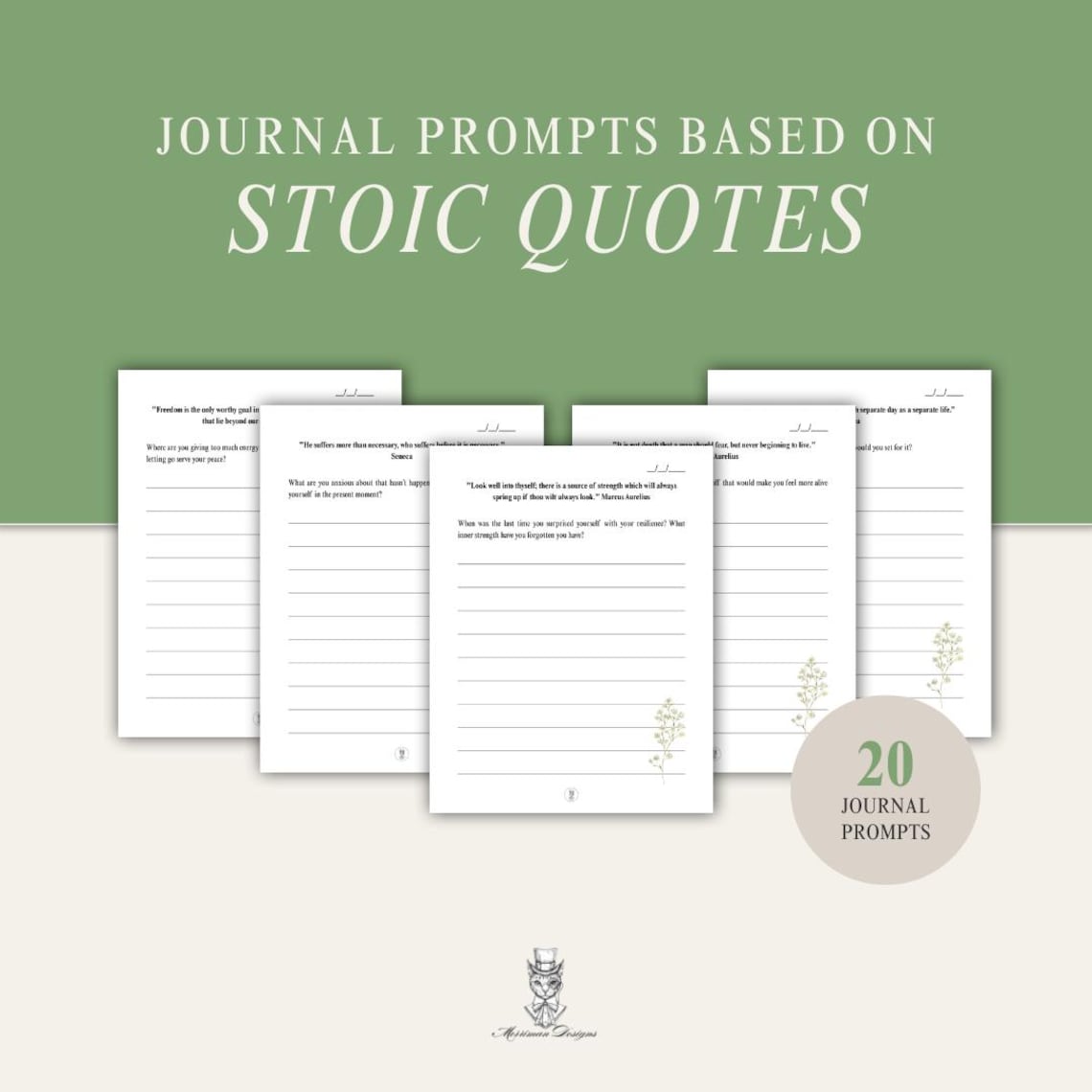
Stoic prompts are less about digging into the past and more about shaping your mindset for the present and future. They include questions like:
- "What is within my control today, and what is not?"
- "What challenges might I face, and how will I respond with virtue?"
- "If this were my last day, how would I live it?"
We will return to these in a few weeks. For now, it is simply useful to recognize that targeted journaling is a versatile practice that can be adapted for different goals—from deep psychological insight to daily emotional regulation.
Conclusion
In this lesson, you have added a crucial tool to your self-exploration toolkit. You've learned to move beyond the unstructured flow of freewriting into the focused inquiry of prompt-based journaling.
Key Takeaways:
- Targeted prompts provide structure and intention to your writing practice, guiding you toward specific areas of your inner world.
- Engaging with a prompt is an active process that prioritizes honesty over eloquence and encourages you to follow unexpected threads of thought.
- Different philosophical and psychological frameworks offer different styles of prompts—some for deep excavation (like Jungian-inspired questions) and others for daily mental discipline (like Stoic prompts).
You have now practiced all the foundational skills of this first module: non-judgmental observation, uncensored freewriting, and now, targeted inquiry.
In our next and final lesson for this week, you will synthesize these skills to confront this module's central question: What do I avoid knowing about myself? This will be a capstone reflection that brings everything you've learned together.