Hello! Welcome to the third lesson in our module on "The Architecture of Anxiety."
In our last session, we made a crucial distinction between fear, which responds to a concrete threat, and existential anxiety, which is the profound unease that arises when we confront the "givens" of human life: mortality, freedom, isolation, and the need to create meaning. We ended on the idea that this deeper anxiety doesn't ask for a simple solution, but for courage and confrontation.
However, the human mind is resourceful. When faced with such fundamental discomfort, it often deploys automatic, unconscious strategies to protect itself. Today, we will explore three of the most common of these strategies. Our learning outcome is to define rumination, avoidance, and projection as common psychological defense mechanisms.
By learning to name and understand these patterns, we move from being controlled by them to being able to observe them. This is the first and most critical step toward gaining inner clarity and reducing their power over us.
1. The Mind's Protection Squad: What Are Defense Mechanisms?
Before we dive into the specific mechanisms, let's establish what we mean by the term "defense mechanism." They are not conscious choices or signs of weakness. Rather, they are automatic psychological strategies the mind uses to shield us from anxiety and emotional pain. They are the ego's first responders, operating below the level of our awareness.
To get a clear overview, let's start with a short video from psychiatrist Dr. Tracey Marks.
Understanding Defense Mechanisms: The Mind's Protection Squad
This video, 'Understanding Defense Mechanisms,' introduces the core concept of what these mechanisms are and why they exist. It provides a helpful framework for our exploration.
Please watch from the beginning to 01:19, and then from 05:06 to 06:29. Focus on these key ideas: Defense mechanisms are unconscious processes that protect us from anxiety. They fall on a spectrum from 'primitive' to 'mature.' The ones we're discussing today are generally considered less mature or 'neurotic,' meaning they help us dodge feelings rather than process them.
As Dr. Marks explains, these defenses are a natural part of our psychological makeup. The goal isn't to eliminate them entirely—an impossible task—but to become aware of them. Awareness gives us the power to see when they are no longer serving us and to consciously choose healthier coping strategies instead.
With that foundation, let's define our three key mechanisms.
2. The Three Common Defenses
We will now look at each mechanism in detail. While they are distinct, you will likely see how they can overlap and work together to manage anxiety.
A. Rumination: The Unproductive Loop
Rumination is perhaps the most familiar of these defenses. It's the experience of having a thought or a worry get stuck on repeat. It feels like you're trying to solve a problem, but you're actually just running in a mental circle.
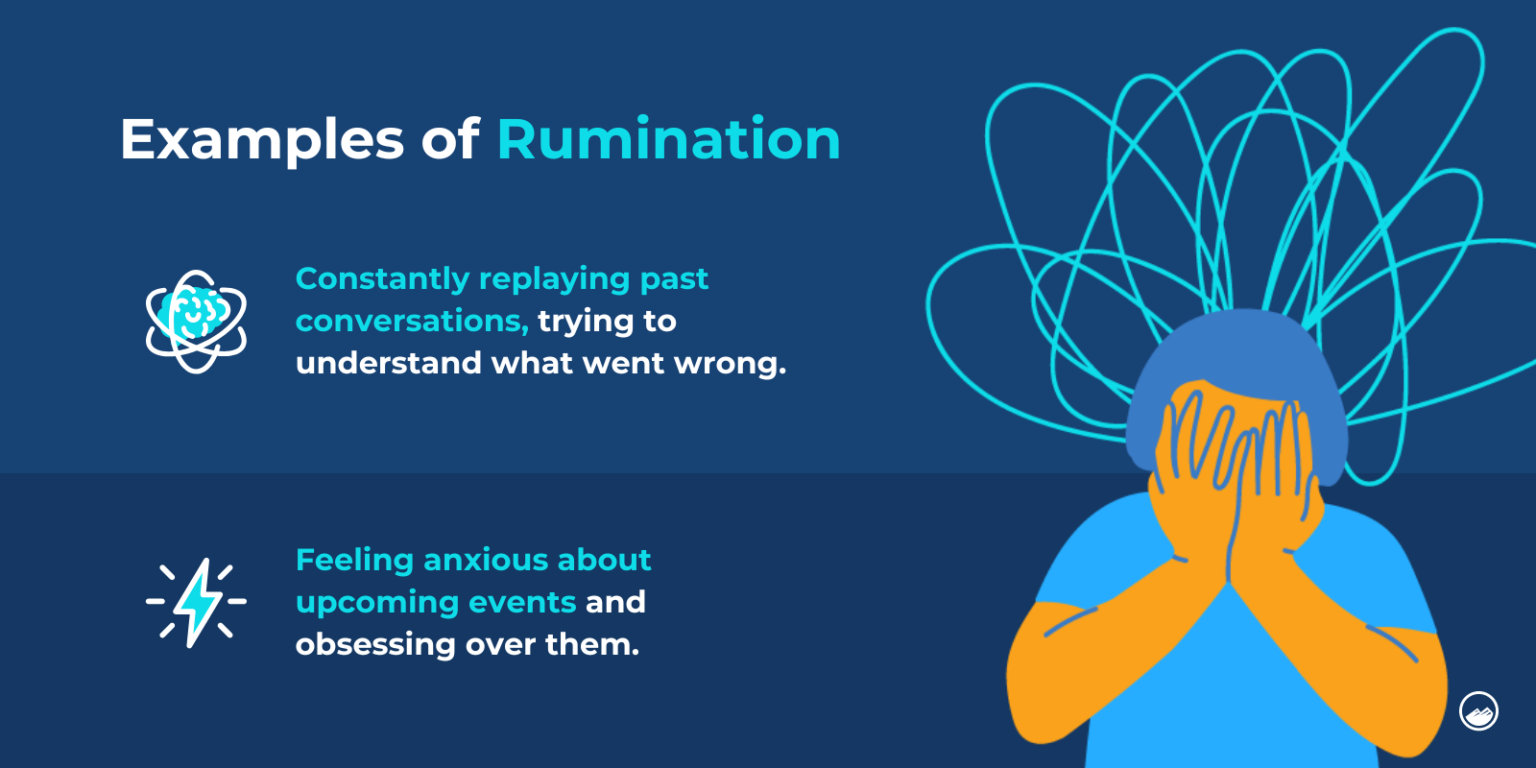
The following podcast discussion offers a very clear and relatable explanation of rumination. The analogy of "chewing your mental cud" is particularly insightful.
Rumination: How to Disrupt Obsessive Thoughts | Being Well Podcast
In this segment from the 'Being Well Podcast,' the hosts explore the definition and function of rumination. They do an excellent job of distinguishing it from productive reflection.
Please listen from the beginning (00:10) to 07:41. Pay close attention to the distinction between productive processing (like a cow digesting cud) and unproductive rumination (where we just keep chewing without digesting).
The key takeaway is that rumination is defined by its unproductiveness. You are not gaining new insight or coming to a resolution. Instead, as the podcast notes, you are often using the cognitive activity of thinking about the problem as a way to defend against truly feeling the painful emotion at its core. It’s a form of intellectual bypassing.
B. Avoidance: The Strategic Retreat
Avoidance is exactly what it sounds like: steering clear of thoughts, feelings, situations, or people that trigger discomfort. It is an incredibly powerful and effective defense in the short term, which is precisely what makes it so insidious.
This article by psychologist Dr. Sarah Sarkis provides a brilliant analysis of the paradoxical nature of avoidance.
Deconstructing Anxiety: Exploring the Patterns that Fuel ...
In this excerpt from 'Deconstructing Anxiety,' Dr. Sarkis explains why avoidance is a trap. It works so well at first that we don't notice its long-term cost.
Please read the section titled 'Avoidance.' Focus on its paradoxical nature: it's 'effective' for immediate relief but 'crippling' in the long run. Note the two 'fine print' items she describes.
The cycle of avoidance creates a feedback loop that strengthens anxiety over time. This image captures that process perfectly.

The two "fine print" costs of avoidance are crucial:
- You narrow your life: To keep avoiding the trigger, you have to make your world smaller and smaller.
- You weaken your resilience: By avoiding uncomfortable feelings, the "muscle" you use to tolerate emotional discomfort atrophies. Over time, you become less capable of handling even minor distress.
C. Projection: The Externalized Feeling
Projection is a more complex mechanism. It occurs when you unconsciously take an unwanted emotion or trait you have and attribute it to someone else. Instead of acknowledging your own feeling, you experience it as coming from the outside world.
The mindbodygreen article provides a very clear and accessible definition.
24 Common Defense Mechanisms + Why They're Used
This article, '24 Common Defense Mechanisms,' gives a straightforward definition of projection with clear, everyday examples.
Please read the section titled 'Projection.' The examples provided are very helpful for understanding this abstract concept.
Think of it like a movie projector. The film (the feeling of anger, insecurity, or criticism) is inside you, but your mind projects it onto the screen of another person. You then react to the image on the screen as if it were objective reality.
For example:
- Instead of feeling "I am critical of myself," you feel "Everyone here is so judgmental."
- Instead of acknowledging "I am feeling angry," you accuse someone else, "Why are you so angry with me?"
Projection allows you to disown the uncomfortable feeling, but it distorts your perception of reality and can create significant conflict in relationships.
Test your understanding!
For each scenario, identify which primary defense mechanism is at play: rumination, avoidance, or projection.
- After a minor disagreement with a friend, you spend the entire night replaying the conversation in your head, analyzing every word and gesture, feeling worse with each loop.
- You feel insecure about your own knowledge on a certain topic. In a group discussion, you find yourself thinking that another person is being arrogant and a "know-it-all."
- You receive an email that you suspect contains bad news. Instead of opening it, you decide to clean your entire apartment and organize your bookshelf.
- You're nervous about an upcoming social event. For days beforehand, you obsess over all the ways the evening could go wrong. You end up telling your friend you're not feeling well and don't go. As you sit at home, you tell yourself the people there are probably superficial and you wouldn't have enjoyed it anyway.
Show answer
- Rumination. You are stuck in an unproductive, repetitive thought cycle that is intensifying negative feelings rather than resolving them.
- Projection. You are taking your own feeling of insecurity about your knowledge and attributing a negative quality (arrogance) to someone else who is displaying knowledge.
- Avoidance. You are engaging in a distracting activity to put off facing a potentially uncomfortable feeling (the bad news in the email).
- This is a combination, which often happens in real life!
- Obsessing over what could go wrong is rumination.
- Not going to the event is avoidance.
- Telling yourself the people are superficial is likely a form of projection or rationalization to make the avoidance feel justified.
Conclusion
Today, we've put names and definitions to three powerful, unconscious processes that our minds use to shield us from anxiety.
Key Takeaways:
- Defense Mechanisms are automatic, unconscious strategies for avoiding emotional discomfort.
- Rumination is getting trapped in an unproductive, repetitive loop of negative thinking. It feels like problem-solving but is actually a way to avoid the core feeling.
- Avoidance is the act of steering clear of anything that might trigger anxiety. It provides short-term relief at the cost of long-term resilience and a narrowing of one's life.
- Projection is taking an unwanted internal feeling or quality and unconsciously attributing it to another person.
These are not moral failings; they are deeply human patterns. The goal of this lesson was simply to build your vocabulary. By knowing what to look for, you've already taken the first step toward reclaiming your awareness.
In our next lesson, we will put this new vocabulary to work. You will learn to identify your personal anxiety triggers and the psychological mechanisms they activate, moving from abstract definition to concrete self-observation.