Hello! In our last lesson, we explored Camus's three responses to the absurd: physical suicide, philosophical suicide, and revolt. We concluded that Camus rejects the first two as forms of escape and champions revolt as the only authentic path.
But "revolt" can sound like a grim, exhausting struggle. Why would anyone choose to live in a state of constant confrontation? This lesson answers that question. We will delve into the heart of Camus's argument and articulate why he sees revolt not as a life sentence of misery, but as the very source of our freedom, passion, and dignity. By embracing the tension of the absurd, we don't just endure life; we learn to live it to the maximum.
What is Revolt? A Revolution of Consciousness
First, it's crucial to understand that Camus is not talking about a political or violent revolution. The revolt he champions is an internal, metaphysical one. It is a rebellion of the mind.
Revolt is the conscious decision to live with the absurd, to keep the conflict between your desire for meaning and the world's silence constantly in view. It is the refusal to surrender to despair or to seek the comfort of a comforting delusion. It is a persistent, moment-to-moment "no" to resignation.
To get a clearer picture of this "metaphysical rebellion," let's start with a short, insightful article.
Albert Camus on Rebelling against Life's Absurdity
The article 'Albert Camus on Rebelling against Life's Absurdity' from Philosophy Break provides a very clear definition of this core concept.
Read the section titled 'Metaphysical rebellion: refusing delusion or despair'. Focus on how revolt is defined as a 'constant confrontation' that 'extends awareness to the whole of experience'.
As the article states, "The realization that life is absurd cannot be an end, but only a beginning." Revolt is the active process of living out the consequences of that realization. It is not a one-time decision but a continuous attitude. You don't "solve" the absurd; you live with it, lucidly. This act of sustained awareness is what Camus considers the opposite of renunciation or surrender.
The Paradoxical Path to Freedom
This is where Camus's thought becomes truly powerful and counter-intuitive. He argues that this state of revolt, which seems like a kind of prison, is actually the only way to be truly free. How can this be?
The path involves two key steps: redefining freedom and letting go of hope.
1. Redefining Freedom: Beyond Metaphysics
When philosophers talk about freedom, they often get stuck in the abstract debate of "free will vs. determinism." Camus finds this entire discussion irrelevant to how we actually live. He is not interested in whether we have some kind of cosmic, metaphysical freedom. He cares about the concrete, lived experience of freedom.
The following video by philosopher Gregory B. Sadler explains this shift in perspective and introduces the crucial ideas of the "method of persisting" and the rejection of abstract notions of freedom.
Albert Camus, The Myth of Sisyphus | Freedom in the Absurd | Philosophy Core Concepts
In this segment from 'Albert Camus, The Myth of Sisyphus | Freedom in the Absurd', Sadler explains how Camus sets aside the traditional problem of free will to focus on a more tangible, human freedom.
Watch the segment from 05:34 to 16:27. It's a bit longer, but it's the core of today's lesson. First (starting at 05:34), listen for how Camus describes 'metaphysical revolt' and why 'consciousness and revolt' are the opposite of giving up (renunciation). Then (starting at 12:51), pay close attention to why Camus says the problem of 'metaphysical liberty' doesn't interest him. What kind of freedom does he say is the only one he can know and experience?
As Sadler explains, Camus dismisses the abstract problem of free will. The only freedom that matters is the one we experience: the "freedom of thought and action." This is the freedom of a prisoner who, despite being physically confined, retains control over their inner world, their judgments, and their attitude. This is the freedom of Sisyphus. His fate is sealed, but his scorn for that fate is his own.
2. The Liberation of Hopelessness
This leads to the most radical part of Camus's argument. He claims that the privation of hope and future means an increase in man's availability.
What does this mean? Before encountering the absurd, we live for the future. We make plans, set goals, and weigh our chances, hoping for a promotion, a happy retirement, or even an afterlife. In doing so, Camus argues, we become "slaves of our liberty." We chain ourselves to the demands of a purpose that needs to be achieved, constantly orienting our present actions toward a future that may never come.
The absurd man, in recognizing there is no grand purpose and no guaranteed future, is liberated from this slavery. By giving up hope for a different life, you are finally free to fully inhabit this one. You are no longer saving your life for later; you are available to the richness, intensity, and passion of the present moment.
Test your understanding!
Think of a time you were intensely focused on a future goal (e.g., finishing a difficult project, waiting for an important event). In what ways did that focus on the future limit your experience of the present? Did it, in a way, make you less "free" to notice or engage with what was happening right in front of you?
Show answer
This is a personal reflection, but many people find that when they are fixated on a future outcome, the present becomes merely a means to an end. Days blur together, small joys are overlooked, and anxiety about achieving the goal can overshadow the actual process of living. By sacrificing the present for the future, you are giving up the only reality you truly possess. In Camus's terms, you are not fully available to your own life.
The Three Consequences: Revolt, Freedom, and Passion
For Camus, accepting the absurd leads to three consequences that define a meaningful life in a meaningless world.
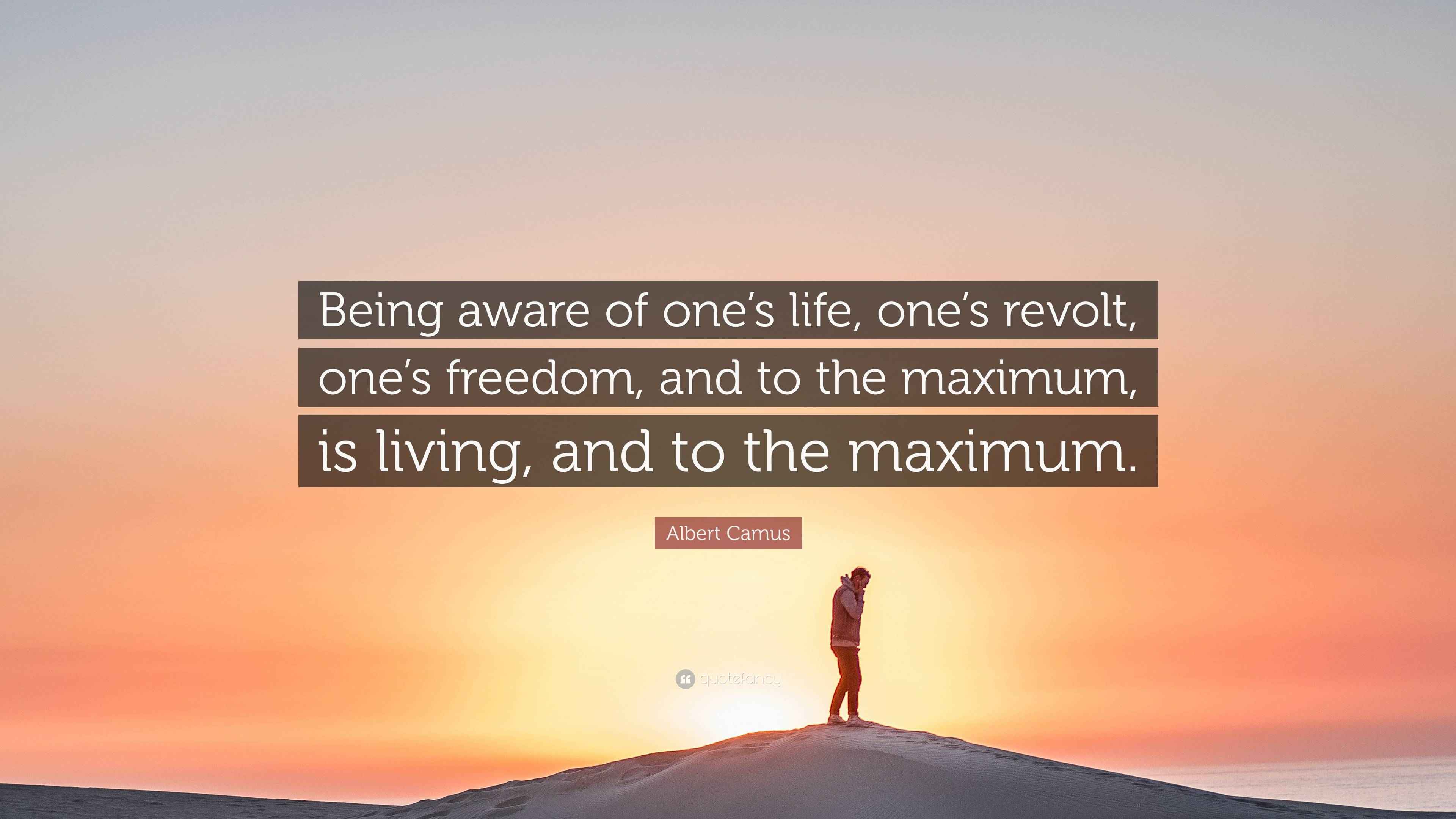
- Revolt: This is the foundational attitude. It's the conscious awareness that keeps the absurd alive. As Camus writes, "revolt gives life its value." The majesty of human life is found not in comfort, but in the sight of our intelligence grappling with a reality that surpasses it.
- Freedom: This is the inner freedom we've just discussed—freedom from the slavery of hope, from common rules, and from the need for external justification.
- Passion: If this life is all there is, the logical conclusion is to live it as intensely and completely as possible. This means seeking the quantity of experiences, not judging them by some preconceived notion of "quality." It is a call to live with a burning, passionate attention to the world.
This trinity—revolt, freedom, passion—is the essence of living fully in the face of absurdity.
The Absurd Hero: Sisyphus Happy
Camus uses the ancient Greek myth of Sisyphus to bring all these ideas together. Condemned by the gods to eternally push a boulder up a mountain only to have it roll back down, Sisyphus seems to be the ultimate symbol of futile, hopeless labor.
But Camus recasts him as the "absurd hero."
Albert Camus on Rebelling against Life's Absurdity
Let's return to the Philosophy Break article, which beautifully explains how Sisyphus transforms from a victim into a hero.
Read the final two sections, 'Sisyphus as tragic hero' and 'What do you make of Camus’s position?'. Focus on the moment when Sisyphus walks back down the mountain. Why does Camus consider this moment the key to Sisyphus's heroism and freedom?
Sisyphus's heroism lies in his consciousness. As he walks down the mountain, without the boulder, he is fully aware of his wretched condition. He has no hope that things will change. In this moment of lucid awareness, he is superior to his fate. By choosing to turn back and push the rock again, he makes the fate his own. He is not a passive victim; he is actively scorning the gods and his punishment through his persistence.
"His fate belongs to him. His rock is his thing," Camus writes. "There is no fate that cannot be surmounted by scorn."
This is why Camus can conclude his essay with the startling line: "One must imagine Sisyphus happy." This is not the shallow happiness of distraction or delusion. It is a grim, defiant, and profound joy found in the struggle itself. It is the happiness that comes from knowing you are free, living with passion, and facing your destiny with your eyes wide open.
Conclusion
Today, we have explored why Camus champions revolt as the path to a liberated life. It is a demanding philosophy, but one that offers profound strength and clarity.
Key Takeaways:
- Revolt is a state of constant, lucid awareness of the absurd, where you refuse both despair and false hope.
- This revolt leads to freedom by liberating you from the slavery of chasing future goals and external meanings. The only freedom that matters is the inner freedom to choose your attitude toward your fate.
- The consequences of the absurd, when embraced, are a life of revolt, freedom, and passion.
- Sisyphus is the ultimate absurd hero because he is conscious of his futility yet scorns his fate through his persistence, thereby finding a defiant happiness in the struggle itself.
You now have a complete picture of Camus's argument: from identifying the absurd, to rejecting the escapes, to embracing revolt as the path to freedom. In our next lesson, we will move from this powerful theory to personal practice by beginning to identify moments of the absurd in your own life.