Hello! Welcome to the final lesson of our module on confronting the absurd.
So far in this module, we've journeyed deep into the heart of Albert Camus's philosophy. We started by defining the absurd: the unresolvable clash between our deep-seated human need for meaning and a universe that offers none. We then explored Camus's three responses, rejecting both physical and philosophical suicide in favor of revolt—a conscious, lucid, and passionate rebellion against our condition. In our last lesson, you practiced identifying the moments in your own life when the "stage sets collapse" and this absurd reality makes itself felt.
Today, we take the final, most crucial step. Having looked the absurd in the face, we now turn to answer it. This lesson isn't about finding a pre-written answer in a book; it's about beginning the life-long process of writing your own. Your task is to tackle the ultimate question that follows from accepting the absurd: If life has no inherent meaning, what meaning do I choose to create?
The Liberation from Meaning
It's natural to first experience the loss of inherent meaning as a terrifying void. However, Camus invites us to see it differently: as a profound liberation. When we are no longer bound by any pre-ordained purpose, value system, or divine plan, we become radically free. Free to define for ourselves what is good, what is valuable, and how we will live.
This video explores the radical freedom that opens up once we stop searching for an external answer to the question of meaning.
Albert Camus: how to live in a meaningless world (Absurdism explained)
This video, 'Albert Camus: how to live in a meaningless world,' explains how abandoning the search for objective meaning leads to a kind of liberation. It sets the stage for creating our own values.
Watch the segment from 07:12 to 11:58. Pay close attention to the idea that giving up objective meaning also means giving up externally imposed values. The analogy of the 'knowing ant' (starting around 09:30) is particularly important—it illustrates how we can consciously choose our own boundaries and values, knowing full well they are our own creation.
This freedom is the foundation for creating your own meaning. You are the "knowing ant." The lines that define your world are not imposed upon you; you are the one holding the pen. The question is, what will you choose to draw?
Pathways to Created Meaning
"Create your own meaning" can feel like an impossibly large task. Where does one even begin? Fortunately, this isn't about inventing a grand, abstract purpose out of thin air. It's about identifying what is already vital and resonant within you and choosing to live in accordance with it.
The following video offers several concrete pathways for creating meaning in a meaningless world, grounded in Camus's work.
How To Find Meaning In A Meaningless Life - Albert Camus (Philosophy of Absurdism)
The video 'How To Find Meaning In A Meaningless Life' by Philosophies for Life breaks down Camus's ideas into actionable strategies. We'll focus on a few of these to give you some practical starting points.
Watch the following segments, treating them as different 'lenses' through which you can view the creation of meaning: Meaning through Passion & Action (02:44 - 06:20): Notice how meaning can be built by identifying your passions and connecting them to goals that have an impact. Meaning through Daily Choice (06:20 - 08:19): This section highlights that your created meaning isn't a single declaration, but the sum of your daily choices. Meaning through Connection (08:19 - 11:53): Explore the idea that in a world without divine purpose, human solidarity, love, and community can become powerful sources of meaning. Meaning through Integrity (11:53 - 14:54): This part connects meaning to the act of rebellion itself—living authentically and honoring your chosen values in the present moment.
These pathways are not mutually exclusive. Meaning can be a tapestry woven from your passions, your relationships, your daily choices, and your commitment to your own integrity.
A Toolkit for Self-Creation
Before you tackle the final reflection, let's use some structured exercises to gather the raw material. This process comes from the world of existential psychotherapy, which applies these philosophical ideas to help people build more authentic lives.
The following resource provides a set of powerful questions and exercises. We will adapt a few of them for our purpose.
9 Powerful Existential Therapy Techniques for Your Sessions
The article '9 Powerful Existential Therapy Techniques' from PositivePsychology.com offers practical tools for exploring personal meaning. We will use some of its questions as prompts for our own reflection.
You don't need to read the whole article. Instead, use it as a reference for the exercises below. Familiarize yourself with the questions under the headings 'Exploring the four worlds,' 'Considering values,' 'Most meaningful life,' and '4 Questions to Ask Your Clients.'
Writing & Reflection Exercise (20 minutes)
Open your journal and work through the following prompts. Don't censor yourself or strive for perfect answers. The goal is honest exploration.
Part 1: Mapping Your Worlds
Reflect on the "four worlds of human existence" mentioned in the article. Write a few sentences in response to each guiding question:
- Physical World: Knowing you will die, how do you want to live fully?
- Social World: What are other people for? What is your ideal relationship to community, friends, and humanity?
- Personal World: Who are you, truly? How do you create a coherent sense of self from your past, present, and future?
- Spiritual World: This is our central question, reframed. What is your personal value system? How should you live?
Part 2: Clarifying Your Values
Now, let's get more specific. Answer these questions from the "Considering values" section:
- How do you want to treat others and be treated?
- What moral values do you hold? (e.g., honesty, compassion, courage, justice, etc.)
- How well do you currently live up to them?
Part 3: Visualizing Your Meaningful Life
Adapt the "Most meaningful life" exercise. Close your eyes for a moment and imagine it. Then, write a detailed description. Don't hold back.
- What would you be doing in this life? (Your work, your hobbies, your daily activities)
- Who would you be with? What would those relationships feel like?
- Most importantly, what feeling or state of being defines this life? (e.g., freedom, connection, creativity, peace, intensity)
Test your understanding!
Imagine two people. One decides their meaning is to build a successful company. The other decides their meaning is to live a simple life of quiet contemplation and connection with nature. From an absurdist perspective, is one of these chosen meanings better or more valid than the other?
Show answer
No. From an absurdist perspective, neither is inherently better. The universe is indifferent to both ambitions. What matters is that the meaning is chosen freely and lived authentically. The "validity" of a chosen meaning comes from the individual's lucid commitment to it in the face of the absurd, not from the content of the meaning itself. The entrepreneur and the contemplative are both absurd heroes if they embrace their chosen struggle with passion, freedom, and a clear-eyed awareness of their mortal condition.
The Central Question: Your Written Reflection
You are now ready to confront the module's final question. The exercises above have provided the material; this is where you synthesize it into your personal answer.
Take the rest of your study time for this task. Write a reflection of at least 500 words exploring:
"If life has no inherent meaning, what meaning do I choose to create?"
Here are some guidelines:
- This is not a final answer. Think of it as a declaration of intent, a snapshot of your values and aspirations at this moment in your life.
- Draw on your previous reflections. Look at what you wrote about your "four worlds," your values, and your vision of a meaningful life. Weave these threads together.
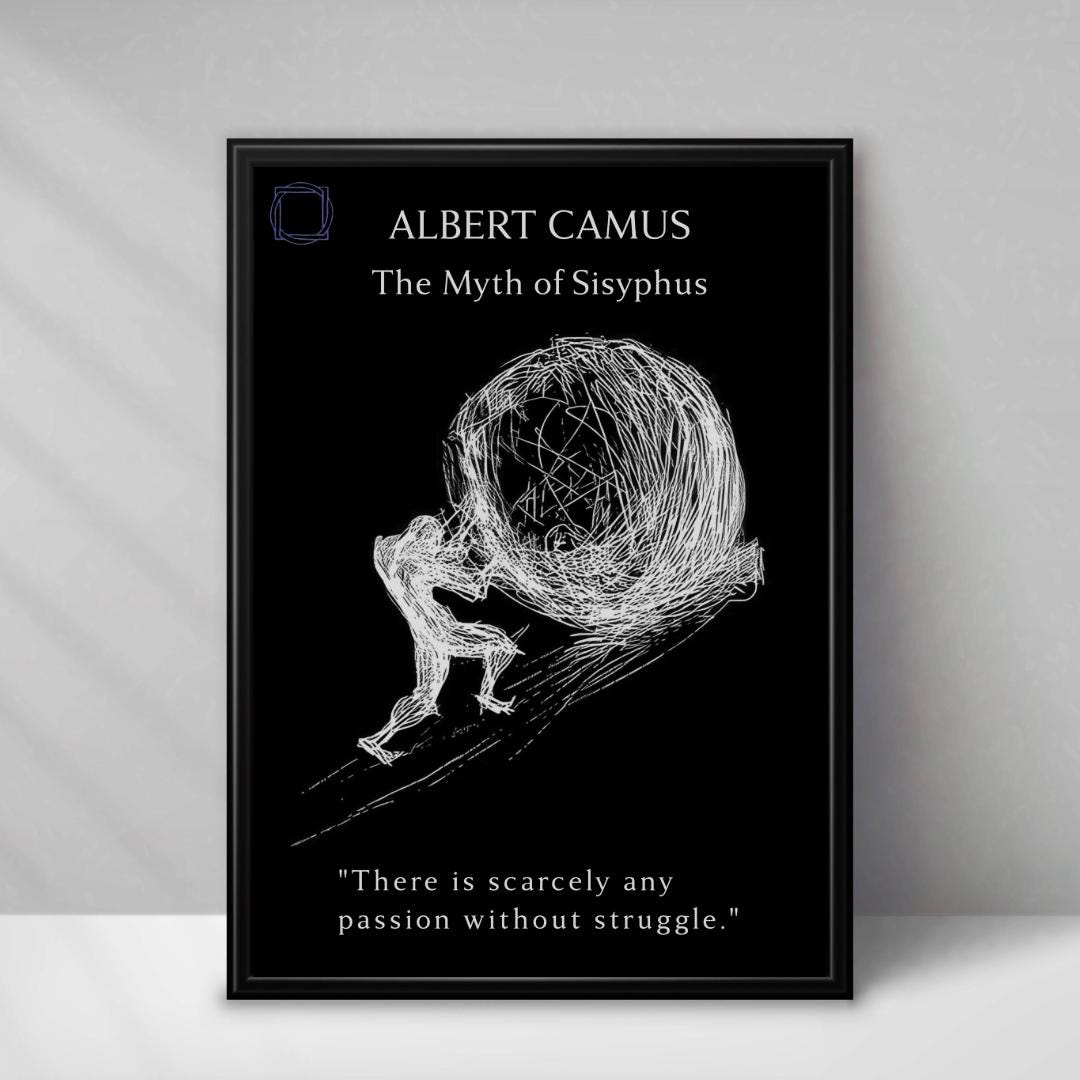
- Embrace the struggle. As Camus shows us with Sisyphus, meaning isn't a destination; it's found in the process. What "boulder" are you choosing to push? Why is the struggle itself worthwhile?
Conclusion
In this lesson, and throughout this module, we have journeyed from understanding the problem of the absurd to actively crafting a personal response. We have seen that the absence of inherent meaning is not a void to be feared, but a space of freedom to be filled with our own choices, passions, and commitments.
Key Takeaways:
- Accepting the absurd liberates you from the need to find an external, pre-ordained meaning for your life.
- Meaning is not found, it is created through conscious choices and actions.
- This act of creation can take many forms: pursuing passions, cultivating relationships, living with integrity, and making deliberate daily choices.
- Like Sisyphus, we can find fulfillment not in reaching a final goal, but in the struggle itself—in the act of pushing our chosen boulder.
You have now confronted one of the most profound challenges of the human condition. In the next module, we will turn from the outer world's lack of order to the project of building inner order.
Preview of the Next Lesson:
We will begin Module 4, "Stoic Foundations for Inner Order." Having faced the external chaos of a meaningless universe, we will now learn the ancient and practical art of building an unshakable inner citadel. Our first lesson will introduce the cornerstone of Stoic practice: the dichotomy of control, a simple but powerful tool for distinguishing what is up to us from what is not.