Introduction
In our last lesson, we built a toolkit for troubleshooting common hall pass complications. We established that many issues, like unexpected jealousy or broken rules, can be navigated with clear, empathetic communication. A core theme that emerged was that the quality of your initial agreements is the best form of prevention.
Today, we move into a new module, "Shared Experience: Voyeurism and Exhibitionism," building directly on that insight. This lesson addresses the learning outcome: Script a boundary negotiation for sharing experiences, from verbal recounting to live display.
We will construct a comprehensive framework for this critical conversation. The goal isn't just to decide what you'll do, but to create a safe, structured process for exploring possibilities together. You'll learn how to move from abstract desire to concrete, mutually-agreed-upon boundaries, ensuring that any shared experience enhances your connection.
The Foundation: Graduated Exposure and Structured Dialogue
Before scripting a negotiation, we need two foundational concepts: a map of the territory and a vehicle to travel through it.
-
The Map: A Graduated Scale of Sharing
Introducing new dynamics requires managing novelty to maintain emotional safety. Instead of jumping to the most intense option, we use a graduated scale. This allows you to find the precise level of sharing that excites both of you, without causing undue anxiety. A typical scale might look like this:- Level 1: Verbal Recounting. Sharing the story of the encounter after it has happened. This is the foundation, similar to the post-hall-pass debriefs we've discussed.
- Level 2: Delayed Media Sharing. The hotwife shares curated photos or video clips with her partner after the encounter. This introduces a visual element with the safety of time and curation.
- Level 3: Real-Time Remote Sharing. The hotwife sends text, audio, or photo updates to her partner during the encounter. This heightens the immediacy and sense of participation.
- Level 4: Live Remote Observation. The partner watches the encounter unfold in real time via a live video stream.
- Level 5: Live In-Person Observation. The partner is physically present in the same space during the encounter.
-
The Vehicle: A Formal Conversation Structure
A negotiation of this importance shouldn't happen casually. A structured conversation ensures both partners feel safe, heard, and respected. It transforms the process from a potentially anxious discussion into a collaborative project.
To understand the principles behind this approach, please review the following resource. It details the "why" and "how" of creating a safe space for these conversations.
10 Consent-First Ways to Invite Your Wife Into Cuckolding
The article '10 Consent-First Ways to Invite Your Wife Into Cuckolding' from CuckoldTherapy.com provides an exceptional framework for structured, ethical communication. We will use its principles to build our negotiation script.
Please read two sections: 'Three Core Mechanisms for Successful Communication': Focus on the concept of 'Managed Novelty,' which is the principle behind our graduated scale. 'Strategy 10: Ask for a Formal Conversation, Not an Outcome': Study the entire section. Pay close attention to the 'Conversation Structure' (Opening, Sharing, Clarification, Exploration, Closing) and the 'Agenda Template.' This will be the blueprint for our script.
Scripting the Negotiation Process
Armed with the graduated scale and the formal conversation structure, we can now build the script. This process has three parts: The Invitation, Setting the Stage, and The Negotiation Itself.
Part 1: The Invitation Script
The first step is to propose the conversation without pressure. The goal is simply to get agreement to talk, not to achieve a specific outcome.
Sample Script:
You: "I'd love to have a structured conversation about how we share your experiences when you're with someone else. It would be about 45 minutes, and the only goal is to understand each other's feelings and boundaries better, not to make any final decisions. Would you be open to scheduling a time for that this week?"
This script, adapted from the resource you just read, sets a clear, non-threatening frame.
Part 2: Setting the Stage
Once she agrees, you prepare. Share an agenda based on the template from the resource.
Sample Agenda:
- Topic: Exploring boundaries for sharing experiences.
- Duration: 45 minutes.
- Goal: To understand each other's comfort levels and desires, not to make decisions.
- Process: We'll each have uninterrupted time to share our thoughts, and we'll explore possibilities together without pressure.
- Follow-up: We can decide at the end if we want to talk again later.
This preparation lowers anxiety by making the process predictable and safe.
Part 3: The Negotiation Conversation Script
Here, we'll script the "Exploration Phase" of the conversation, using the graduated scale as our guide. This is where you collaboratively determine your boundaries.
A fantastic tool for this phase is a "Yes, No, Maybe" checklist. It depersonalizes the options and allows for clear, low-pressure responses.
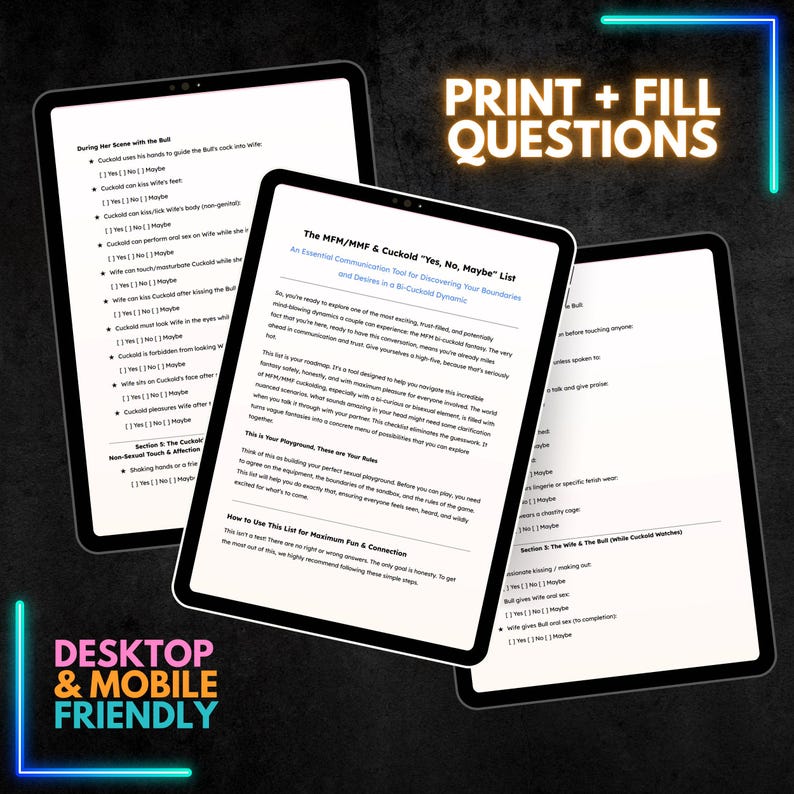
Let's script the conversation, imagining you are using a checklist you've created based on our scale.
Conversation Script (Exploration Phase):
-
You (Facilitator): "Okay, for this part, let's just explore some possibilities. Let's use our 'Yes, No, Maybe' list to make it easy. No commitments, just honest reactions. How does that sound?"
-
Partner: "Sounds good."
-
You: "Great. Let's start with Level 1: Verbal Recounting. We already do this with our debriefs. On a scale of 1 to 10, how is your comfort and excitement with this level?"
- (Discuss and note down feelings. Clarify what details are exciting and what might be off-limits.)
-
You: "Okay, next is Level 2: Delayed Media Sharing—things like you sending me some photos or a short video clip after the fact. Let's break this down."
- Question 1: "How do you feel about taking photos/videos for me?" (Yes/No/Maybe)
- Question 2: "What about showing your face?" (Yes/No/Maybe)
- Question 3: "What about the other person's face?" (Yes/No/Maybe)
- Question 4: "Should we have a rule about how this media is stored or when it's deleted?"
(This is a direct application of the "Boundary check" idea from the 'Playful Magazine' article, where you discuss who sees photos and the rules around them.)
-
You: "Moving on to Level 3: Real-Time Remote Sharing. This would be you sending me updates during the date via text, audio, or photos. How does the idea of that land with you?"
- Question 1: "Would this feel exciting, or would it take you out of the moment?"
- Question 2: "What kind of updates would be hot to send/receive? (e.g., a picture of your outfit, a text about how it's going, an audio clip of the ambient sound)"
- Question 3: "Are there any details that are off-limits for real-time sharing?"
- Question 4: "How frequently should check-ins happen?"
-
You: "Now for Level 4: Live Remote Observation. This means me watching on a live video stream. This is a bigger step."
- Question 1: "What's your initial gut reaction to this idea?" (Yes/No/Maybe)
- Question 2: "What would need to be in place for you to feel safe and comfortable with this? (e.g., technical setup, me being muted, you having the ability to turn it off at any time)."
- Question 3: "Would my role be purely passive observation?"
-
You: "Finally, let's talk about Level 5: Live In-Person Observation. This is me being in the room."
- Question 1: "Again, initial gut reaction?" (Yes/No/Maybe)
- Question 2: "If 'Maybe' or 'Yes,' what does that look like? Am I hidden or visible? Silent or able to speak?"
- Question 3: "What are the hard boundaries on my interaction (with you, with the bull)?"
- Question 4: "What non-verbal signals would we use to check in or stop?"
(These specific negotiation points are inspired by the 'Boundary check' sections in the resource below, which provides excellent, concrete examples of boundaries for live scenarios.)
11 Hotwife Ideas: From Mild to Wild - Playful Magazine
To get more ideas for specific, practical boundaries to discuss at each level, the '11 Hotwife Ideas' article from Playful Magazine is very useful. Its 'Boundary check' subsections offer concrete examples.
You don't need to read this whole article now, but quickly scan the 'Boundary check' subsections for challenges #1 (Photo Session), #3 (Bar Stranger), #5 (Dinner Date Dare), #6 (Teasing Text Marathon), and #8 (Party Invitation). Notice how they specify what to negotiate: photo privacy, signals, physical contact rules, real-time info sharing, and interaction levels. These are the kinds of details to include in your own negotiation.
After going through the levels, you close the conversation as outlined in the CuckoldTherapy resource: summarize what you've learned about each other's boundaries, appreciate the openness, and schedule a follow-up if needed.
Conclusion
Successfully negotiating shared experiences is one of the most important skills in this lifestyle. By replacing ambiguity with a structured, collaborative process, you build a strong foundation of trust and safety.
Key Takeaways:
- A formal negotiation process, with a clear agenda and structure, minimizes anxiety and promotes honest communication.
- Using a graduated scale of sharing (from verbal to live) allows you to find the perfect level of involvement that works for both partners.
- A "Yes, No, Maybe" checklist is a practical, low-pressure tool for exploring specific boundaries within each level of sharing.
- The goal of the negotiation is not to "win" or persuade, but to co-create a set of agreements that generates mutual excitement and deepens intimacy.
Next Lesson Preview:
Now that we have a script to negotiate the boundaries for sharing, our next lesson will focus on the practical execution. We will design a graduated scale of voyeuristic participation, from remote text/audio to in-person observation. This means taking the level you've agreed upon and planning the specific logistics, techniques, and roles to make it a successful and erotic experience.