Hello! Welcome to the final lesson of your course on ESOPs.
In our last session, we built a powerful decision-making framework with an "Offer Scorecard" for objective analysis and a "Personal Fit Scorecard" for subjective assessment. We used this to evaluate a couple of straightforward scenarios.
Today, we'll put that framework to the ultimate test. The learning outcome for this lesson is to apply this comprehensive decision-making framework to multiple real-world case studies to decide whether to accept, negotiate, or decline an offer. We will dive into three detailed, realistic scenarios that you, as a web developer in India, might face. This final step will solidify your ability to analyze any offer with confidence.
Let's begin!
A Quick Recap: The Decision Framework
As a reminder, our decision process involves two parts:
- Part A: The Offer Scorecard (Objective): We rate the company's potential and the quality of the ESOP terms.
- Part B: The Personal Fit Scorecard (Subjective): We assess our own financial situation, risk tolerance, and career goals.
By combining these two scores, we land on a clear action: Accept, Negotiate, or Decline.
Case Study 1: The Early-Stage FinTech Dream
Imagine you've received an offer from a promising, but very young, startup.
The Persona:
You are a React developer with two years of experience. You are single, have saved up a decent emergency fund (about 6 months of expenses), and are comfortable taking some calculated risks for a potentially high reward.
The Offer:
- Company: "Fin-novate," a 15-person startup in Bangalore. They are seed-funded and aim to build a new payment platform for small businesses. The two founders are ex-Google engineers with a strong reputation.
- Salary: ₹14 LPA. This is slightly below the market rate of ₹16 LPA for your experience.
- ESOP Grant: 5,000 stock options.
- Vesting: Standard 4-year schedule with a 1-year cliff. After the cliff, options vest monthly.
- Strike Price: ₹20 per option.
- Valuation Info: The company just raised its seed round. The total number of shares ("fully diluted shares outstanding") is 1 Crore (10 million). The company's valuation is ₹40 Crores. This means the Fair Market Value (FMV) is ₹40 per share (₹40 Crore / 1 Crore shares).
- Exercise Window: 90 days after you leave the company.
Applying the Framework
Let's break this down using our scorecards.
Part A: The Offer Scorecard
- Company Potential (High): The founders have a strong background, and the market they are targeting is large. This is a positive sign.
- Financial Health (Medium): Being seed-funded is good, but it's the earliest stage. The risk of failure is at its highest. You'd need to trust the founders' vision to secure future funding.
- ESOP Grant Quality (Medium-Low):
- Ownership Stake: Your 5,000 options represent 0.05% of the company (5,000 / 1,00,00,000). This is a typical grant size for an early employee.
- Potential Upside: The FMV (₹40) is double your strike price (₹20). This is a good sign. The "paper gain" at grant is (₹40 - ₹20) * 5,000 = ₹1,00,000.
- Exercise Window (Very Low): The 90-day window is a major red flag. If you leave after, say, 2 years, you would have vested 2,500 options. You would need to pay ₹50,000 (2,500 * ₹20) plus perquisite tax on your paper gain, all within three months. This creates immense financial pressure.
Part B: The Personal Fit Scorecard
- Financial Readiness (Medium): The lower salary means less money for your savings and personal goals. While you have an emergency fund, a large, unexpected expense (like exercising options) could be a strain.
- Risk Profile (High): You are comfortable with risk, which aligns well with an early-stage startup.
- Career Alignment (High): Working with ex-Google founders in a small team could be a massive learning experience, boosting your career regardless of the financial outcome.
The Decision Matrix:
We have a Medium-to-Low Offer Score (strong vision but very high risk and a bad exercise window) and a Medium Personal Fit (you're risk-tolerant, but the financials are tight). This puts us squarely in the ⚠️ "Negotiate or Decline" category.
The Action:
Your best move is to negotiate. The offer's biggest weakness is the 90-day exercise window. You could say:
"I'm very excited about the vision and the team. The compensation is almost there for me. However, the 90-day exercise window presents a significant personal financial risk. Would you be open to extending it to at least one year, or ideally longer? This would make it much easier for me to commit fully, knowing I have more flexibility in the future."
If they agree, the offer becomes much stronger. If they refuse, declining might be the wisest choice, as the offer forces you to take on a level of financial risk that doesn't match the reward.
Case Study 2: The Stable Public MNC
Now, let's look at a very different kind of opportunity from a big, established company.
The Persona:
Same as before: a React developer with two years of experience, but this time you are prioritizing financial stability and predictable growth.
The Offer:
- Company: "Global Tech Inc.," a large, publicly-traded US tech company with a major office in Hyderabad (think Google, Microsoft, or Amazon).
- Salary: ₹19 LPA. This is at the top of the market range.
- Equity Grant: Restricted Stock Units (RSUs) valued at $20,000 USD (approx. ₹16.6 Lakhs).
- Vesting: The RSUs vest over 4 years, with 25% (worth $5,000) being granted to you each year on your work anniversary. There is no "strike price" or "exercise cost."
Before we analyze, it's crucial to understand RSUs, which are common in MNCs.
RSU vs ESOP – Differences, Taxation, Which is Better?
The article 'RSU vs ESOP' from Treelife provides an excellent breakdown of how RSUs differ from ESOPs, especially regarding cost, risk, and taxation in India.
Please read the sections defining RSUs ('What is an RSU?'), the key differences table ('RSU vs ESOP – Key Differences'), and the pros and cons of each. Focus on why an RSU has no upfront cost and how its risk profile is lower than an ESOP's.
Applying the Framework
Part A: The Offer Scorecard
- Company Potential & Financial Health (Very High): The company is a market leader, profitable, and stable. The risk of it failing is extremely low.
- RSU Grant Quality (High):
- Guaranteed Value: Unlike options, RSUs have value as long as the stock price is above zero. You pay nothing to get the shares.
- Liquidity: Because the company is publicly traded, you can sell your vested shares on the stock market immediately (subject to company trading windows). The cash is real and accessible.
- Taxation: The main thing to be aware of is that the value of the shares at vesting is taxed as salary. So, when you receive your shares worth ~$5,000, that amount is added to your income and taxed, with your employer often withholding shares to cover the tax bill.
Part B: The Personal Fit Scorecard
- Financial Readiness (High): The high salary comfortably covers all your needs and savings goals. There is no exercise cost to worry about.
- Risk Profile (High): This offer perfectly fits a low-to-moderate risk tolerance. It provides predictable, steady wealth creation without the "all-or-nothing" nature of startup ESOPs.
- Career Alignment (High): Working at a top MNC is a great brand on your resume and provides structured growth opportunities.
The Decision Matrix:
We have a High Offer Score and a High Personal Fit. This is a clear ✅ Strong "Go".
The Action:
Accept the offer. It provides a high, stable salary and a predictable path to building wealth through equity with minimal personal financial risk. It's a trade-off: you give up the 100x lottery ticket potential of a startup for the much higher probability of a solid 2x-4x return on your equity over a few years.
Case Study 3: The Growth-Stage "Soonicorn"
Now it's your turn. Let's analyze a tempting but complex offer.
Test your understanding!
You have received an offer from a well-known Indian startup that is growing aggressively and is expected to become a "Unicorn" soon.
The Offer:
- Company: "QuickKart," a Series D-funded logistics company famous for its fast growth and demanding work culture. They have a history of employee turnover but are also known for providing liquidity to employees.
- Salary: Market rate.
- ESOP Grant: 1,000 stock options, vesting over 4 years.
- Strike Price: ₹500 per option.
- Valuation Info: The company is transparent that the FMV from its last funding round was ₹2,500 per share.
- Exercise Window: A very generous 5 years.
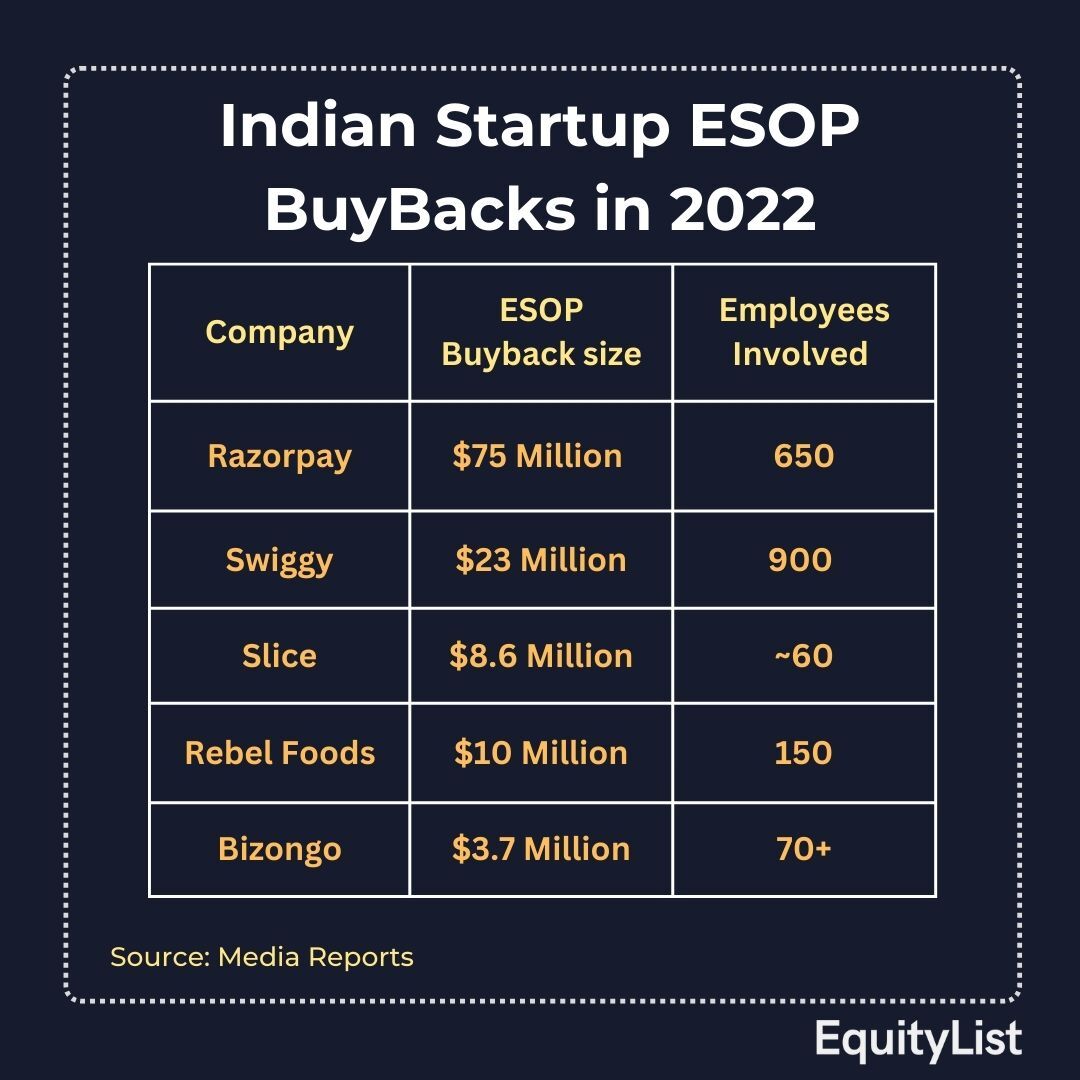
- Green Flag: The company has conducted two ESOP buyback programs in the past three years. The image below shows real examples of such buybacks in the Indian ecosystem.
Your Task:
Apply the decision framework.
- Score the offer (Part A) and consider your personal fit (Part B).
- What is your final decision (Accept, Negotiate, or Decline)?
- Most importantly, what are the top 3 questions you would ask the HR/hiring manager before making your final decision?
Show answer
This is a classic high-risk, high-reward scenario with both strong green and red flags.
1. Framework Application:
-
Part A (Offer Score): High.
- Company Potential: High. Being a late-stage, "Soonicorn" means they have proven their business model.
- Financial Health: Strong. Series D funding implies significant investor confidence.
- ESOP Grant Quality: Very High. The paper gain is substantial ((₹2,500 - ₹500) * 1,000 = ₹20 Lakhs). The 5-year exercise window is extremely employee-friendly and removes almost all financial pressure to exercise upon leaving. The history of buybacks provides a credible path to liquidity before an IPO.
-
Part B (Personal Fit Score): Medium.
- Financial Readiness: High. The market-rate salary covers your needs. The long exercise window means you don't need immediate cash to exercise, removing a major financial barrier.
- Risk Profile: This is the key. The offer's risk isn't financial; it's cultural. The "demanding work culture" and "high employee turnover" mean there's a real risk you might burn out and leave before you've vested a significant amount of your options. Your personal ability to thrive in such an environment is the biggest variable.
2. The Final Decision:
The decision is 🤔 "Negotiate/Accept with Eyes Wide Open."
The offer is financially very strong. The primary risk is not losing money, but failing to vest your options due to the work environment. The decision hinges on your confidence in surviving and thriving there.
3. Top 3 Questions to Ask:
Given that the main risk is related to vesting and culture, your questions should probe these areas:
- "Could you tell me about the average tenure for an engineer in this team? I want to get a realistic picture of the career path and what it takes to succeed here long-term." (This directly addresses the turnover issue and your ability to stay long enough to vest.)
- "The company has a great track record of ESOP buybacks. Could you share any details on the general frequency of these events and what percentage of vested options employees were typically able to sell?" (This helps you quantify the liquidity potential and not just rely on anecdotes.)
- "What happens to unvested options in the event of an acquisition? Is there any provision for accelerated vesting (single or double-trigger) in the ESOP policy?" (This is a crucial question for any late-stage startup, as an acquisition is a likely exit scenario. It protects you if the company is sold.)
Based on the answers, you can make a more informed decision about whether the potential multi-lakh reward is worth the cultural risk.
Conclusion and Course Wrap-Up
Congratulations! You have officially completed the entire course on Employee Stock Options.
We started from the very basics—understanding what a share is—and have now worked through complex, real-world case studies to build a robust decision-making process. You have learned about vesting, valuation, liquidity events, Indian tax law, and negotiation strategies.
Key Takeaways from Today's Lesson:
- Real-world offers are rarely perfect. They involve a mix of strengths and weaknesses that you must weigh carefully.
- The same offer can be great for one person and terrible for another. Your personal financial situation and risk tolerance are just as important as the offer itself.
- Always use a structured framework to move from confusion to clarity. Don't let a large "paper value" distract you from asking the tough questions about red flags like short exercise windows or poor company culture.
You are now equipped not just with knowledge, but with a process. This framework is a tool you can use throughout your career as you evaluate new opportunities. Your goal was to gain a full understanding of ESOPs, and you've built the skills to do just that.
Well done on your commitment to this journey. I wish you the very best in your career and in making informed decisions that will help you build long-term wealth.