Hello! Welcome back to the final module of our course.
In the last lesson, we did some crucial financial detective work. We calculated the real cash cost of exercising your ESOPs, combining the exercise price and the immediate perquisite tax. You learned that turning "paper wealth" into actual shares requires a significant upfront cash investment.
That naturally leads to the next big question: now that you know the cost, is it worth the risk? This brings us to today's learning outcome: to define your personal risk tolerance for holding illiquid, high-risk assets like startup stock options. This lesson is less about formulas and more about self-reflection. We'll build a framework to help you understand your own comfort level with financial risk, which is the key to making a wise decision about your ESOPs.
1. What Makes Startup Stock "High-Risk" and "Illiquid"?
Before you can decide how much risk you're willing to take, you need to understand the specific risks of startup equity. The terms "high-risk" and "illiquid" are thrown around a lot, so let's be very clear about what they mean in this context.
High-Risk: The "All or Nothing" Bet
Unlike a fixed deposit or a blue-chip stock, startup equity doesn't offer slow, steady growth. It's a game of extremes.
Everything you need to know about ESOPs
To start, let's watch a clip from the 'Everything you need to know about ESOPs' video by Zero1 by Zerodha. It gets straight to the point about the fundamental risk of startup shares.
Watch from 01:56 to 02:29 and again from 05:43 to 06:07. Notice the repeated warning: the value of your shares could go to zero, and you must be okay with that.
The video's core message is the most important rule of startup investing: most startups fail. If the company goes out of business, your shares become worthless. The money you paid to exercise them, and the tax you paid, is gone forever.
This is what financial experts call a "power-law distribution." A tiny handful of startups become massive successes (like Flipkart or Zomato), creating life-changing wealth for early employees. The vast majority either fail or stagnate, resulting in zero or negligible returns. When you accept startup equity, you are betting that your company will be one of the rare winners.
Illiquid: Your Money is Locked Up
Now, let's tackle the concept of "liquidity." An asset is liquid if you can convert it into cash quickly and easily. Your savings account is very liquid. Shares of a large public company like Tata Motors are also liquid because you can sell them on the stock market any business day.
Startup shares are the opposite. They are illiquid.

This means even if your startup is doing well and your shares are worth a lot on paper, you can't just sell them. You are in a holding pattern, waiting for a liquidity event, which as we've learned, is typically an IPO or an acquisition. This could take years, or it might never happen.
Higher Salary vs. More Equity: Which is Better?!
The video 'Higher Salary vs. More Equity' by Recruiter Preston gives a fantastic summary of all the risks involved—including illiquidity. This will help you see the full picture.
Watch the section from 06:32 to 08:09. Pay attention to the list of risks he mentions: legal jargon, vesting periods, the uncertainty of an exit event, and the risk of the company failing.
2. The Spectrum of Risk Tolerance
Now that we have a clear picture of the risks, let's talk about you. Risk tolerance is your personal and emotional comfort level with the possibility of losing money in an investment. There's no right or wrong answer; it's a personal trait, like being an introvert or an extrovert.
Some people are perfectly fine with high-risk, high-reward bets. The uncertainty excites them. Others feel immense stress at the thought of losing even a small amount of money and prioritize safety and predictability. Most of us are somewhere in between.
This infographic provides a great visual guide to the spectrum of risk tolerance.
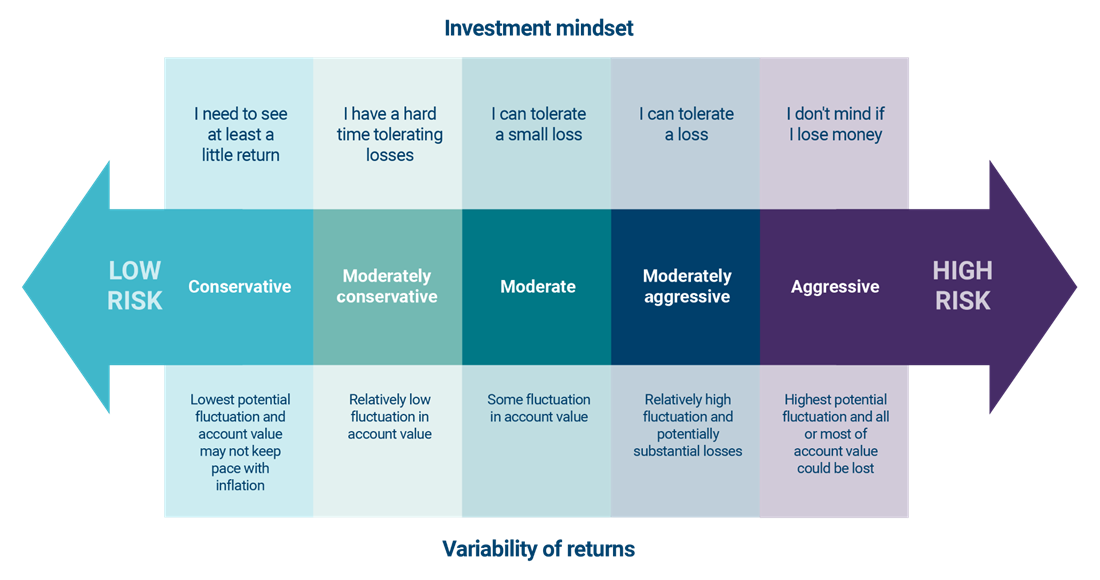
Think about where you might fall on this scale.
- Conservative: Your main goal is to not lose money. You prefer guaranteed, even if small, returns.
- Moderate: You're willing to take on some risk for better returns but want a balanced approach. You wouldn't want to risk everything.
- Aggressive: Your main goal is to maximize your gains, and you're comfortable with the risk of significant losses to achieve that.
3. A Framework for Assessing Your Own Risk Tolerance
To figure out where you land on that spectrum, you need to ask yourself some honest questions. This isn't just a theoretical exercise. Your answers will have a direct impact on whether you should prioritize a higher salary or more equity.
Let's borrow from a framework suggested by financial experts.
A Framework For Thinking About Exercising Your Stock Options
The article 'A Framework For Thinking About Exercising Your Stock Options' by Compound Planning frames this perfectly. It treats exercising your options as a serious investment decision into a 'single, high-risk, illiquid asset.'
Read the introduction to the framework and 'Step 1. Assess your liquidity and risk exposure'. The article prompts you to take a clear inventory of your financial situation before making any moves.
Inspired by that framework and others, here are the key areas to reflect on:
A. Your Financial Foundation ("Can I afford the loss?")
- Emergency Fund: Do you have 3-6 months of essential living expenses saved in an easily accessible account? If not, taking on high-risk investments is like building a house without a foundation.
- Debt: Do you have high-interest debt, like from a credit card? It makes little sense to make a risky investment when you have a guaranteed "return" by paying off debt that's costing you 15-20% a year.
- Income Stability: How secure is your job? Is your income predictable? If you have a stable income, you might feel more comfortable taking risks with a smaller portion of your wealth.
B. Your Life Stage and Goals ("What's my timeline?")
Guide to Employee Stock Option Plans (ESOPs)
The 'Guide to Employee Stock Option Plans (ESOPs)' from SeedBlink directly connects risk tolerance to your career stage and financial goals.
Find the section 'Step 1 — Negotiation' and read the bullet points under 'Ultimately, the decision depends on your circumstances'. This highlights how your personal situation influences your choice.
As the article suggests, consider the following:
- Career Stage: Are you early in your career with decades to recover from a potential loss? Or are you more established, with more to lose and less time to make it back?
- Financial Dependents: Do you support a spouse, children, or aging parents? The more people depend on your financial stability, the lower your risk tolerance should generally be.
- Short-Term Goals: Are you saving for a house down payment, a wedding, or a master's degree in the next 1-3 years? Money for these goals should be kept safe and liquid, not locked in risky startup stock.
C. Your Psychological Makeup ("How would I feel?")
- The Sleep Test: If you exercised your options and the next day the company announced bad news, causing the paper value to drop 50%, would you be able to sleep at night? Or would it cause you significant stress?
- Regret: Which would you regret more: taking a risk and losing money, or playing it safe and missing out on a huge potential gain?
4. Tying It All Together: Salary vs. Equity
Your personal risk tolerance directly translates into how you should view the trade-off between a higher salary and more ESOPs.
Higher Salary vs. More Equity: Which is Better?!
Let's return to the 'Higher Salary vs. More Equity' video, which makes this connection crystal clear.
Watch from 08:09 to 09:57. The video explicitly states that your choice depends on your risk tolerance and contrasts the path for someone who is risk-averse versus someone who is okay with risk.
Here's a simple way to think about it:
-
If you have a lower risk tolerance (you lean towards Conservative/Moderate):
- You should prioritize a higher, stable salary that covers all your needs and savings goals.
- View ESOPs as a lottery ticket—a nice bonus if it works out, but not something you're depending on.
- You might be more comfortable with stock options from a large, stable MNC than from a risky early-stage startup.
-
If you have a higher risk tolerance (you lean towards Aggressive/Moderately Aggressive):
- You might be comfortable accepting a lower-than-market-rate salary in exchange for a larger grant of options.
- You have a solid financial foundation (emergency fund, no high-interest debt) that can absorb the total loss of your ESOP investment.
- You are psychologically prepared for the possibility that the equity will be worth zero.
Test your understanding!
Two developers, Priya and Rohan, get identical offers from a very early-stage startup:
- High Salary, Low ESOPs
- Average Salary, High ESOPs
Priya is single, has a large emergency fund, and no debt. She's excited by the startup's mission and believes it could be a huge success.
Rohan is saving for a down payment on a house he wants to buy in two years and helps support his parents. He is nervous about the startup market.
Which offer should each of them likely lean towards, based on their risk tolerance?
Show answer
- Priya demonstrates a higher risk tolerance. Her solid financial base and lack of dependents mean she can afford to take the risk. She would likely be more comfortable choosing the Average Salary, High ESOPs offer, betting on the long-term potential.
- Rohan demonstrates a lower risk tolerance. His short-term financial goal (house down payment) and financial responsibility for his parents mean he needs stability and predictable cash flow. He should lean towards the High Salary, Low ESOPs offer to ensure he meets his financial obligations.
Conclusion
Today, we journeyed inward to explore the very personal concept of risk tolerance. You've learned that making a smart ESOP decision isn't just about the numbers; it's about aligning those numbers with your own life and personality.
Key Takeaways:
- Startup stock options are high-risk because the company could fail, making them worthless. They are illiquid because you can't easily sell them and must wait for an IPO or acquisition.
- Your personal risk tolerance is your emotional and financial ability to handle this uncertainty and potential for loss. It exists on a spectrum from conservative to aggressive.
- You can assess your risk tolerance by analyzing your financial foundation (savings, debt), life stage (goals, dependents), and psychological makeup.
- This assessment helps you decide where you stand on the salary vs. equity trade-off. A lower risk tolerance favors a higher salary, while a higher risk tolerance may justify taking more equity.
What's Next?
Now that you have a framework for defining your risk tolerance, our next lesson will put it into practice. We will describe specific personal financial situations where prioritizing a higher cash salary over ESOPs is the more prudent choice. We'll look at concrete scenarios that will help you solidify your decision-making process.