Hello! Welcome back to our course on ESOPs.
In our last lesson, we discussed the significant costs involved in exercising your stock options. We learned that a major part of this cost, besides the strike price, is an immediate tax liability you have to pay. This is often the biggest financial hurdle for employees and a key reason why some are forced to let their valuable options expire.
Today, we'll zoom in on this crucial topic of taxation. Your goal for this lesson is to identify the two main tax events for ESOPs in India: at the time of exercise and at the time of sale. Understanding when you are taxed is the first and most important step in managing your ESOPs effectively. This is the foundation for our entire module on taxes.
The Two Taxable Moments
In India, the tax authorities view the wealth you create from ESOPs in two separate stages. Consequently, they tax you at two different points in your ESOP journey.
Let's start with a short, clear video from Mint that introduces these two events.
This video, 'How are ESOPs in India taxed', gets straight to the point. It will introduce you to the two fundamental moments when ESOPs trigger a tax event.
Please watch from 00:53 to 01:07, and then again from 03:31 to 03:47. Listen for the clear declaration of the two points of taxation.
As the video states, you are taxed:
- When you exercise the options.
- When you sell the shares you acquired.
It's crucial to understand that these are two separate events, taxing two different portions of your gain. Let's break each one down.
Tax Event #1: Exercising Your Options (Perquisite Tax)
The first tax event happens the moment you decide to buy your vested shares by paying the exercise price.
From the government's perspective, your company is giving you a valuable asset (a share) for a price much lower than its current worth. This difference in value is considered a benefit, or a "perquisite"—similar to a bonus. In India, this perquisite is treated as part of your salary income for that year and is taxed accordingly.
Let's look at the key terms:
- Exercise Price: The low price you pay to the company for the share.
- Fair Market Value (FMV): The share's market price on the day you exercise it.
The taxable amount for this event is the "paper gain" you make on that day.
Taxable Perquisite = (Fair Market Value - Exercise Price) x Number of Shares
This amount is added to your income for the year, and you pay tax on it at your personal income tax slab rate. This is the tax bill we discussed in the last lesson—the one you have to pay upfront in cash, even though you haven't sold the shares yet.
This article provides a clear written explanation of this first tax event.
ESOP Distribution & Taxation: A Guide
The guide 'ESOP Distribution & Taxation' from fi.money explains this concept very clearly.
Please read the section titled '1. Upon Exercise of the Options'. It explains exactly how this perquisite is calculated and that it's considered part of your salary income.
Tax Event #2: Selling Your Shares (Capital Gains Tax)
The second tax event occurs later, when you decide to sell your shares and convert them into actual cash. This could be years after you exercised them.
When you sell an asset like a share for more than you paid for it, the profit is called a "capital gain." The government taxes this profit.
A common point of confusion is what the "cost" of the share is when calculating this gain. Is it the very low exercise price you paid? No. To avoid taxing you on the same gain twice, the tax authorities consider the "cost" of your share to be the Fair Market Value (FMV) on the day you exercised it.
So, the taxable amount for this second event is:
Taxable Capital Gain = (Sale Price - FMV on Exercise Date) x Number of Shares
This gain is taxed as a capital gain, which has different rules and rates than salary income (we'll cover those details in a future lesson).
Let's return to the fi.money article to see their explanation of this second step.
ESOP Distribution & Taxation: A Guide
Let's continue with the same guide.
Now, read the next section titled '2. Upon Sale of Shares'. Pay close attention to how the cost for calculating the gain is defined as the FMV at the time of exercise.
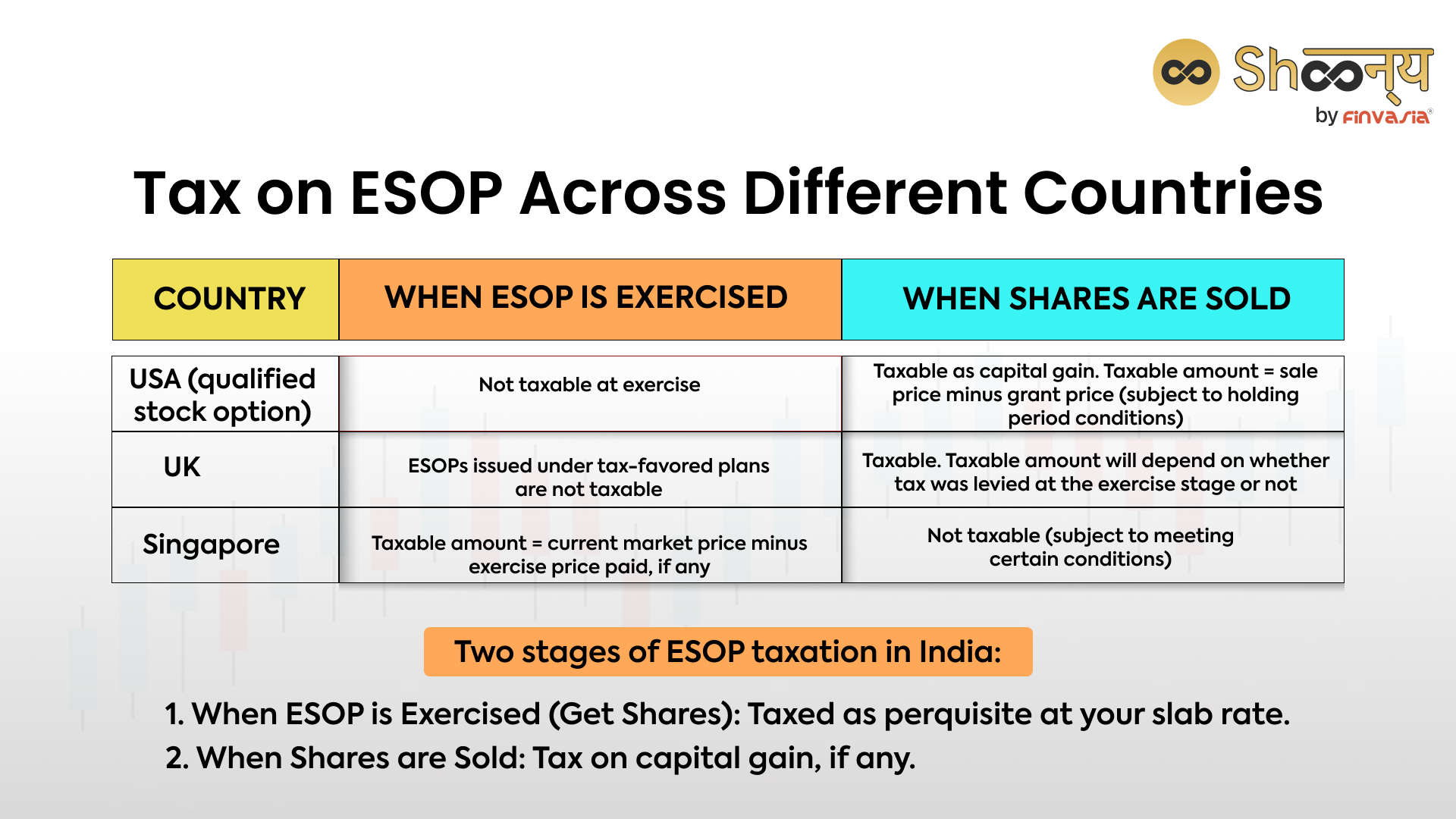
A Visual Summary
To put it all together, you are taxed twice, but on two different portions of the total profit.
- Perquisite Tax: On the initial gain from your discount (FMV - Exercise Price).
- Capital Gains Tax: On the subsequent gain from the share's value appreciation after you became an owner (Sale Price - FMV).
This image provides a great, concise summary of this two-stage process for India.
Test your understanding!
An employee in India has the following ESOP journey:
- Step 1: She is granted 100 options with an exercise price of ₹50.
- Step 2: Two years later, she exercises all 100 options. The Fair Market Value (FMV) of each share on this day is ₹800.
- Step 3: One year after that, she sells all 100 shares for ₹1,200 each.
At which steps in this journey does a tax event occur?
Show answer
A tax event occurs at two steps:
- Step 2 (Exercise): When she buys the shares, she has to pay perquisite tax on the paper gain of (₹800 FMV - ₹50 Exercise Price) = ₹750 per share.
- Step 3 (Sale): When she sells the shares, she has to pay capital gains tax on the profit of (₹1,200 Sale Price - ₹800 FMV on exercise date) = ₹400 per share.
Notice that the total gain of ₹1,150 per share (from ₹50 to ₹1,200) is split into two parts, each taxed at a different time and under different rules.
Conclusion
You've now learned one of the most fundamental rules of ESOPs in India. Understanding this two-step tax process is essential for financial planning.
Key Takeaways
- ESOPs in India are taxed at two distinct points: at the time of exercise and at the time of sale.
- Tax Event 1 (Exercise): The difference between the Fair Market Value (FMV) and your exercise price is taxed as a perquisite (part of your salary income). You pay this tax in cash even if you don't sell the shares.
- Tax Event 2 (Sale): The difference between your sale price and the FMV on the day you exercised is taxed as a capital gain. This tax is paid after you receive cash from the sale.
Preview of the Next Lesson
Now that you can identify when you are taxed, the next question is how much tax you'll owe. In our next lesson, we will focus on the first tax event. You will learn how perquisite tax is calculated on the 'paper gain' when you exercise your options, and you'll work through a practical example to calculate the liability.