Hello! Welcome to your next lesson on Employee Stock Options.
In our last session, we explored the different timelines—the "when"—for exercising your stock options. We saw that whether you're still with the company, leaving your job, or in the middle of a sale, the timing is critical. We also briefly touched on the fact that exercising isn't free.
Today, we're diving deep into that cost. This lesson directly addresses one of the most important practical questions you'll face: how much money do you actually need to turn your options into shares?
By the end of this 60-minute lesson, you will be able to describe the total cost of exercising options, including paying the strike price and the immediate tax liability. This is a crucial step in understanding the real-world financial commitment of ESOPs.
The Two Components of Your Exercise Cost
When you decide to exercise your vested options, you have to pay for two things at once:
- The Strike Price: This is the payment you make directly to your company.
- The Perquisite Tax: This is the income tax you owe to the government immediately upon exercising.
Let's break down each of these costs.
1. The Strike Price Payment
As we've discussed, the strike price (or exercise price) is the special, predetermined price per share that was fixed when your options were first granted. Think of it as the "insider price" you locked in long ago.
To calculate the first part of your cost, you simply multiply the number of options you are exercising by this strike price.
Total Strike Price Cost = (Number of Options Exercised) × (Strike Price per Share)
Let's look at an article that explains this step clearly.
A Founder's Guide to ESOPs in India: Attracting an
The following resource, 'A Founder's Guide to ESOPs in India,' explains the mechanics of exercising your options. We'll focus on the first step: the purchase.
Please read the section titled "Step 1: Exercising the Option (The Purchase)." Pay attention to the example calculation showing how the total payment to the company is determined.
For example, if you decide to exercise 1,000 vested options and your strike price is ₹20 per share, the amount you must pay to your company is:
1,000 shares × ₹20/share = ₹20,000
This payment officially converts your options into shares, making you a part-owner of the company. However, your spending doesn't stop here. The moment you do this, the second cost is triggered.
2. The Immediate Tax Liability: Perquisite Tax
This is the part that surprises many employees. Even though you haven't sold the shares or received any cash, the Indian government views the act of exercising as you receiving a valuable benefit (a "perquisite").
Why is it taxed?
Because you are buying a valuable asset (a share with a certain market value) for a much lower price (your strike price). The difference between these two is considered instant income in the eyes of the tax authorities.
Imagine your company sold you a brand new car worth ₹10 Lakhs for just ₹1 Lakh. The government would say you received a benefit of ₹9 Lakhs and would tax you on that amount as if it were part of your salary. ESOPs work the same way.
The following video from Mint explains this tax event very clearly.
This short video explains the two tax points for ESOPs in India. Let's focus on the first one, which occurs at the time of exercise.
Watch from 00:53 to 01:42. The video explains that the tax is levied on the difference between the Fair Market Value (FMV) and your exercise price, and is taxed at your salary income tax rate.
Calculating the Perquisite Tax
To calculate this tax, you need three pieces of information:
- Strike Price: The price you pay per share.
- Fair Market Value (FMV): The market value of the share on the day you exercise. For a private company, this is determined by an independent valuation. For a public company, it's the price on the stock exchange.
- Your Income Tax Slab Rate: The tax rate applicable to your income (e.g., 10%, 20%, 30%).
The calculation happens in two steps:
Step A: Find the Taxable "Paper Gain"
Taxable Perquisite Value = (FMV per Share − Strike Price per Share) × Number of Shares Exercised
Step B: Calculate the Tax Owed
Perquisite Tax Owed = Taxable Perquisite Value × Your Income Tax Slab Rate
This "paper gain" is added to your salary income for the year, and you pay tax on it accordingly.
Let's walk through a detailed example to make this crystal clear.
ESOPs for Beginners - Metamorph
The article 'ESOPs for Beginners' provides an excellent case study of an employee named Navya. Let's follow her journey to see exactly how the tax at exercise is calculated.
Please read from the heading "What are the taxation implications on ESOPs?" down to the end of "Stage 3: Exercise (April 2022)." Focus on how the perquisite tax liability of ₹1.5 lakh is calculated for Navya.
Putting It All Together: The Total Out-of-Pocket Cost
Now, let's combine both costs to find the total amount of money you need to have ready in your bank account before you can exercise.
Total Cost to Exercise = (Strike Price Payment) + (Perquisite Tax Owed)
Let's use our running example:
- Options to exercise: 1,000
- Strike Price: ₹20 / share
- FMV on exercise date: ₹250 / share
- Your Tax Slab: 30% (+ cess, but we'll keep it simple at 30%)
-
Strike Price Payment:
1,000 shares × ₹20 = ₹20,000 (Paid to the company) -
Perquisite Tax Owed:
- Taxable Value: (₹250 FMV - ₹20 Strike Price) × 1,000 shares = ₹230,000
- Tax Owed: ₹230,000 × 30% = ₹69,000 (Paid to the government)
-
Total Out-of-Pocket Cost:
₹20,000 + ₹69,000 = ₹89,000
You would need to pay ₹89,000 to acquire shares that have a "paper value" of ₹250,000 (1,000 shares × ₹250 FMV). You have not yet received any cash, but you have already spent a significant amount.
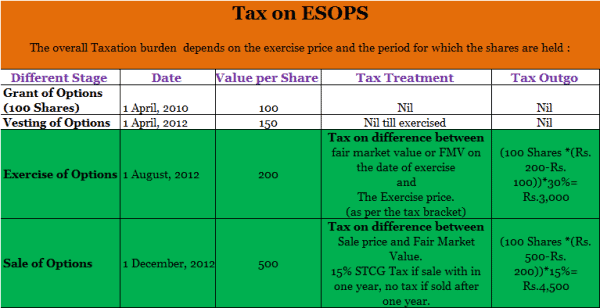
This visual table summarizes the entire process, showing the tax impact at both exercise and sale. For now, focus on the "Exercise of Option" row.
A Special Rule: Tax Deferral for Eligible Startups
Paying a large tax bill on paper gains can be very difficult. Recognizing this, the Indian government introduced a relief measure in 2020 for employees of certain eligible startups (those recognized by the DPIIT - Department for Promotion of Industry and Internal Trade).
If you work for an eligible startup, you can defer (postpone) paying the perquisite tax. You don't have to pay it immediately upon exercise. Instead, the tax becomes due at the earliest of the following events:
- When you eventually sell the shares.
- When you leave the company.
- At the end of a specified period (roughly 4-5 years from the share allotment).
This is a huge benefit as it removes the immediate need for cash to pay the tax bill, but remember it's a deferral, not a waiver. The tax is still owed eventually.
Test your understanding!
An employee, Priya, works at a tech startup. She has 500 vested options.
- Her strike price is ₹50 per share.
- She decides to exercise them when the company's FMV is ₹850 per share.
- Priya is in the 30% income tax bracket.
Calculate the following:
- The total amount she needs to pay her company.
- The perquisite tax she owes to the government.
- Her total out-of-pocket cost to exercise the options.
Show answer
- Strike Price Payment: 500 shares × ₹50/share = ₹25,000.
- Perquisite Tax Owed:
- Taxable Value: (₹850 FMV - ₹50 Strike Price) × 500 shares = ₹800 × 500 = ₹400,000.
- Tax Owed: ₹400,000 × 30% = ₹120,000.
- Total Out-of-Pocket Cost: ₹25,000 (to company) + ₹120,000 (to government) = ₹145,000.
Priya needs ₹145,000 in cash to become the owner of shares with a paper value of ₹425,000 (500 shares x ₹850 FMV).
Conclusion
Understanding the cost of exercising is fundamental to making smart decisions about your ESOPs. It's not just about the "insider price"; it's a two-part calculation that requires a significant cash outlay.
Key Takeaways
- The total cost to exercise has two parts: the strike price payment to the company and the perquisite tax paid to the government.
- The perquisite tax is calculated on your "paper gain" (FMV minus Strike Price) and is taxed at your personal income tax slab rate.
- This total cost is an out-of-pocket expense that you must pay before you can sell your shares and realize any cash profit.
- For employees of eligible startups in India, there is an option to defer the perquisite tax payment, which can provide significant financial relief.
Preview of the Next Lesson
We've just seen that exercising can be expensive. In our previous lesson, we learned that when you leave a company, you only have a limited time—the Post-Termination Exercise Period (PTEP)—to pay these costs. So, what happens if that window closes and you haven't exercised your options? In our next lesson, we will explore the consequences of not exercising your options within the post-termination exercise window.