In our last lesson, we focused on sophisticated client-side data-fetching patterns like stale-while-revalidate, request deduplication, and speculative prefetching. These techniques are essential for making a UI feel fast and responsive. Now, we're going to shift our perspective and look at how a change in server-side architecture can solve many of the same problems at their root, dramatically simplifying the frontend's responsibilities.
This lesson introduces the Backend for Frontend (BFF) pattern. You'll learn how creating a dedicated, intermediate API layer for each frontend client can resolve issues like data over-fetching and the "chatty interface" problem. Our goal is to equip you to evaluate when a BFF is a strategic simplification and when it's unnecessary complexity, a critical judgment you'll be expected to make in a senior-level system design interview.
The Problem: The One-Size-Fits-All API
Imagine an e-commerce platform with a web application, a native mobile app, and an in-store kiosk. All these frontends need to display product information. A common but problematic approach is to have a single, general-purpose /products API that serves all of them.
This "one-size-fits-all" model quickly breaks down:
- The web app might need detailed specifications, high-resolution images, and a full list of reviews for its rich desktop layout.
- The mobile app, on a slower network, needs only a product title, a thumbnail, and the average rating to display in a list view. It is sensitive to payload size to conserve data and battery.
- The kiosk might only need inventory status and price.
A single, generic API forces the mobile client to over-fetch and then discard large amounts of data, or it forces the API team to create a maze of query parameters (?view=mobile_list, ?fields=title,thumbnail) that bloats the backend service. This creates a "chatty interface," where clients might need to make multiple calls to different microservices just to render a single screen. This increases latency and client-side complexity.
This is where the Backend for Frontend pattern provides an elegant solution.
Introducing the Backend for Frontend (BFF) Pattern
The BFF pattern proposes creating a separate backend service for each distinct frontend experience. Instead of a single API gateway that serves everyone, you create multiple, specialized gateways.
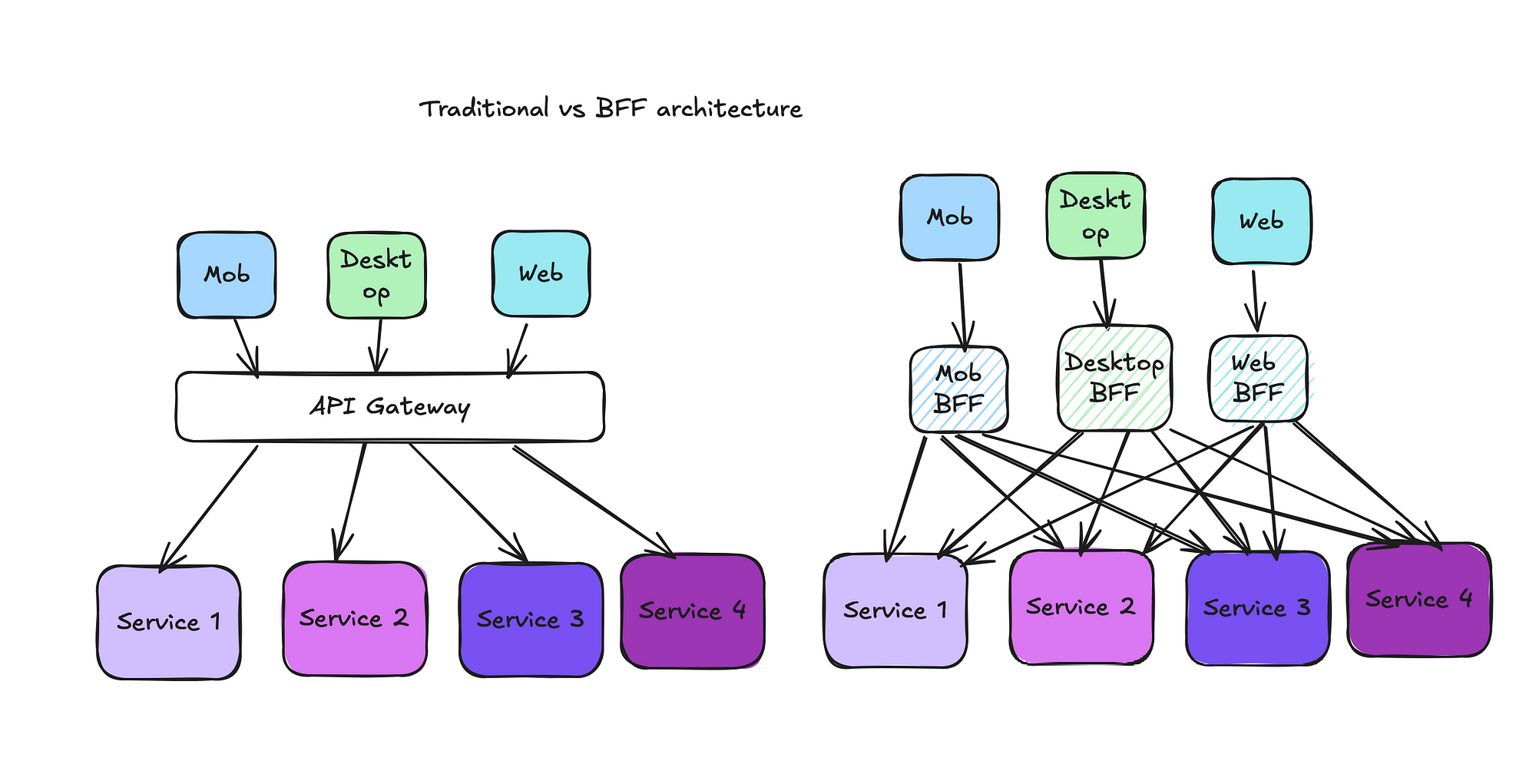
The key insight, articulated by its originator Sam Newman, is that a BFF is not just another API layer; it's an extension of a specific frontend application, living on the server.
Sam Newman - Backends For Frontends
Sam Newman's article is the canonical source on the BFF pattern. It lays out the problem of the general-purpose API and introduces the BFF as a solution.
Start with the Introduction to understand the historical context. Read the section The General-Purpose API Backend to see a detailed breakdown of the problem we're trying to solve. Finally, read Introducing The Backend For Frontend for the formal definition of the pattern. Focus on the idea that the BFF is "tightly coupled to a specific user experience."
The BFF acts as a server-side aggregator and translator. It receives a simple request from its frontend, makes the necessary (and often complex) calls to downstream microservices, and then transforms that data into the exact shape the frontend needs.
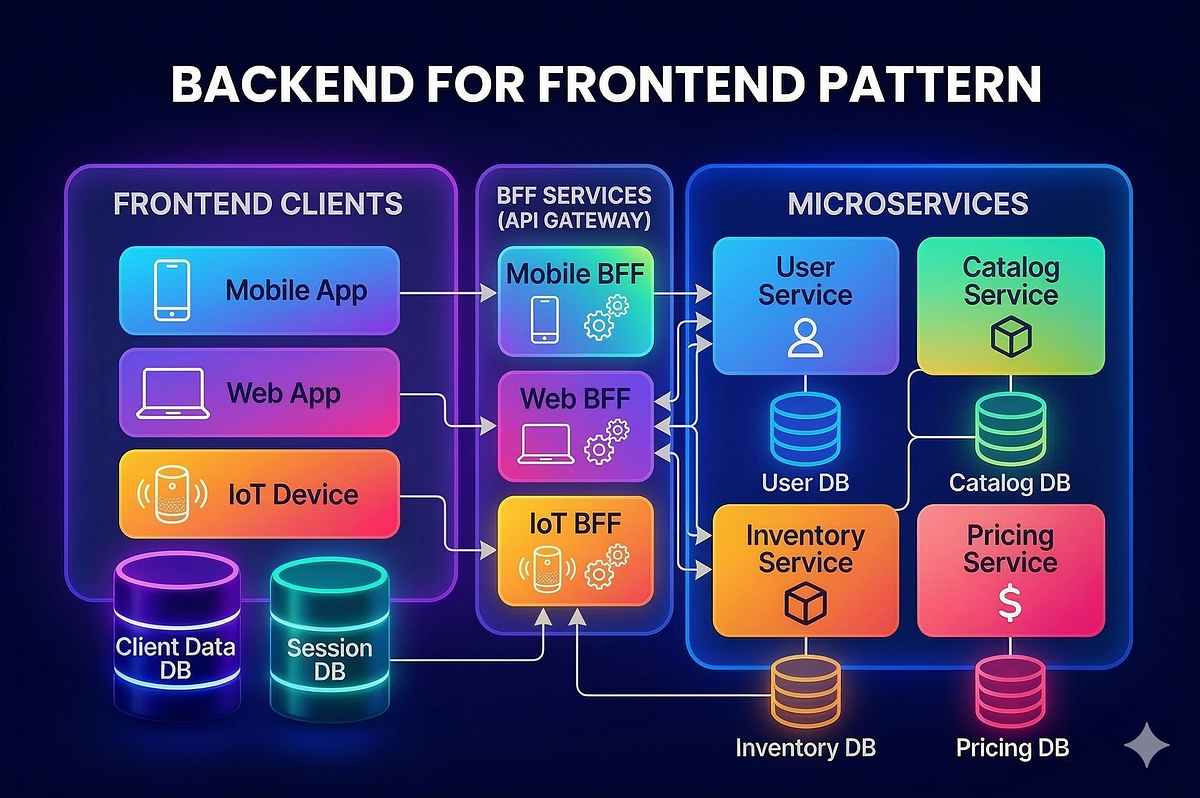
How a BFF Works in Practice
Given your experience with NestJS, let's look at a concrete example. Imagine a mobile dashboard that needs to show a user greeting, the status of their last order, and their unread notification count. This data comes from three different microservices: UserService, OrderService, and NotificationService.
Without a BFF, the mobile app would have to make three separate network requests, handle three loading states, and then stitch the data together on the client. With a BFF, the process is much cleaner.
Mastering API Patterns: BFF vs. Gateway vs. GraphQL (2026 Guide) · Tirnav | Tirnav Solutions
This article provides an excellent, concise code example that demonstrates the core function of a BFF: aggregation and transformation.
Focus on the section on the BFF pattern. Study the NestJS code example closely. You'll see how it uses Promise.all to fetch data from three services in parallel and then constructs a new, simplified payload specifically for the mobile app's dashboard. This is the core value proposition of a BFF in action.
The client simply makes one call to GET /mobile/dashboard, and the BFF handles all the complexity of fanning out requests and shaping the response.
Evaluating the Trade-offs: When to Use a BFF
The BFF pattern is powerful, but it's not a silver bullet. A senior engineer must know when it simplifies architecture versus when it adds unnecessary overhead.
When a BFF Simplifies Architecture:
- Diverse Frontend Clients: This is the classic use case. If you are serving web, mobile, and third-party applications with distinct UI/UX needs, a BFF for each is almost always a win.
- Team Autonomy and Velocity: In large organizations, frontend and backend teams often have different priorities and release cadences. A BFF, owned by the frontend team, allows them to iterate quickly. They can create, modify, and deploy their own API endpoints without waiting for a separate backend team. This is an application of Conway's Law, where the architecture reflects the team structure.
- Simplifying the Client: By offloading data aggregation and business logic to the BFF, the client-side code becomes much simpler. It can focus on its core competency: presentation and user interaction. This also improves client performance by reducing computation and network chatter.
- Integrating with Legacy Systems: A BFF can serve as an "anti-corruption layer," providing a clean, modern API facade over older, clunky backend services or monoliths.
When a BFF Adds Complexity:
- Single Frontend: If your system only has one client (e.g., a React web app), a BFF is likely over-engineering. It's more efficient to work with the backend team to design a single, well-structured API.
- Operational Overhead: A BFF is another service. It must be developed, deployed, monitored, and scaled. This adds to the operational burden. As the article "Mastering API Patterns" points out, you must decide if the extra cost and effort are worth the benefits.
- Code Duplication: If your Web BFF and Mobile BFF both need to fetch user profiles, you might duplicate that data-fetching logic. This can be mitigated with shared libraries, but it's a risk to manage.
- Potential Bottleneck: While it solves the generic API bottleneck, each BFF can become a single point of failure for its corresponding frontend. If the Mobile BFF goes down, the entire mobile app is down.
This concept of the BFF as an organizational pattern is a key senior-level insight. The decision to use it is often as much about team structure and autonomy as it is about technology.
Discussing Backend For Front-end - Nicolas Fränkel - NDC London 2023
This NDC talk by Nicolas Fränkel provides a fantastic, opinionated take on why BFFs are primarily an organizational solution, not just a technical one.
Watch his critique of microservices and his explanation of Conway's Law. This sets the stage for why organizational structure dictates architectural choices. The core of his argument is from "my solution", where he explicitly states that a BFF is "handled, managed, developed, and deployed by the front-end team." He then demonstrates two different implementations (starting from here): one as a separate Python application and another as a plugin within an API Gateway. This highlights the key idea: the pattern is flexible, and the implementation can vary.
BFF vs. API Gateway vs. GraphQL
In a system design interview, you will likely be asked to compare the BFF pattern with an API Gateway or GraphQL.
- API Gateway: A general-purpose entry point that handles cross-cutting concerns like authentication, rate limiting, and routing. It's typically client-agnostic. A BFF is client-specific and focuses on data transformation. They are not mutually exclusive; a common pattern is to have an API Gateway that routes traffic to different BFFs.
- GraphQL: An alternative solution to the same problem of over/under-fetching. GraphQL empowers the client to request the exact data it needs. A BFF dictates the data contract from the server. Choosing between them depends on your architectural goals.
This short video does an excellent job of clarifying the relationship and trade-offs between BFFs and GraphQL.
Watch the segment from "how they fit" to see the different ways these patterns can be arranged architecturally, including a hybrid BFF that uses a GraphQL interface. The section "break it down" provides a great set of questions to ask when deciding which pattern to use. Finally, review the summary of pros and cons, which reinforces the trade-offs regarding cost, agility, and points of failure.
Conclusion
You now have a robust framework for evaluating the Backend for Frontend pattern. It's a powerful tool for decoupling frontends from complex microservice architectures, enabling team autonomy and optimizing client performance. However, it introduces operational overhead and is not a one-size-fits-all solution.
Key Takeaways:
- BFF solves the "one-size-fits-all" API problem by providing a dedicated, tailored API for each frontend experience.
- It acts as an aggregator and translator, simplifying client logic and improving performance by shaping data on the server.
- The decision to use a BFF is often an organizational one, driven by the need for frontend team autonomy and velocity (Conway's Law).
- The core trade-off: A BFF buys you client simplicity and team independence at the cost of increased operational complexity and the need to manage another service.
- BFFs, API Gateways, and GraphQL are related but distinct patterns that can even be used together in sophisticated architectures.
In our next lesson, we will dive deeper into designing request orchestration for a complex UI. You'll see how the BFF is the perfect place to implement robust patterns for handling concurrent and dependent data sources, including strategies for graceful degradation when some backend services fail.