Welcome back. In our last lesson, we designed a comprehensive logging strategy to create a rich, structured narrative of events within our application, a critical tool for debugging and observability. Now, we shift from observing problems after they occur to proactively preventing one of the most pervasive security threats on the web: Cross-Site Scripting (XSS).
This lesson addresses a cornerstone of frontend security architecture. As an engineer who has built large-scale e-commerce platforms, you understand that user-generated content is both a core feature and a significant attack surface. We will go beyond basic definitions to architect a robust, multi-layered defense against XSS, using the distinct but complementary techniques of output encoding, input sanitization, and a strict Content Security Policy (CSP). Mastering this will enable you to design systems that are secure by default, a hallmark of a senior engineer.
1. Understanding the Threat: What is XSS?
Cross-Site Scripting (XSS) occurs when an attacker injects malicious code, typically JavaScript, into a trusted website. When another user visits the compromised page, their browser executes this script, believing it's legitimate. This can lead to session hijacking, data theft, or unauthorized actions performed on the user's behalf.
The following video provides an excellent overview of what makes XSS so dangerous.
This clip from the "Mastering Web Security" series explains the core problem of XSS and its potential impact.
Watch the section from the introduction to XSS to understand how malicious scripts can gain the same permissions as your application's code.
XSS attacks are generally categorized based on how the malicious payload is delivered and executed.

The three primary types are:
- Stored (Persistent) XSS: The malicious script is permanently stored on the target server, for instance, in a database as a user comment or product review. Every user who views this content gets the payload. This is the most damaging type.
- Reflected (Non-Persistent) XSS: The malicious script is embedded in a URL or other request data. The server "reflects" this script back in the HTTP response (e.g., in an error message or search results), and the victim's browser executes it. This attack is delivered via a crafted link.
- DOM-based XSS: The vulnerability exists entirely in the client-side code. A script reads data from a source like the URL fragment (
location.hash) and writes it directly into the DOM, where it is executed. The server is never involved.
The video below explains these three types in more detail.
These sections of the video detail the mechanics of Stored, Reflected, and DOM-based XSS attacks.
Watch the initial explanation of the three main types. Then, for a more detailed walkthrough, you can review the sections covering Reflected and DOM-based XSS.
2. Deep Dive 1: The Core Mitigation Toolkit
To build a resilient defense, you need to understand the distinct roles of three fundamental techniques: validation, sanitization, and escaping. They are often confused, but a senior engineer must know precisely when and why to use each.
This next clip provides one of the clearest explanations of this critical distinction.
This crucial segment from "Mastering Web Security" breaks down the difference between validation, sanitization, and escaping.
Please watch this entire section carefully, from the introduction of the three concepts to the end of the discussion on escaping. This is the foundation for our mitigation architecture.
Let's architect our defense around these concepts.
Output Encoding: The Default Defense
Output encoding is your primary and most important line of defense. Its purpose is to treat all data as text, never as code. It works by converting special characters into their safe, display-only equivalents (e.g., < becomes <). This is done at the very last moment, right before rendering data into a specific context.
Modern frameworks like React, which you are proficient in, provide this protection automatically for most rendering.
"Reviewing and Securing React Applications" - Amanvir Sangha
This talk from OWASP London demonstrates React's built-in output encoding and how it can be bypassed.
Watch the segment from the introduction of default encoding to see how React handles potentially malicious strings.
However, different parts of an HTML document interpret characters differently. You must use the correct encoding for the specific context where the data is being placed. The OWASP Cheat Sheet is the industry-standard guide for this.
Cross Site Scripting Prevention - OWASP Cheat Sheet Series
This document from the OWASP Foundation is the definitive guide to preventing XSS. This section details the different types of output encoding required for various contexts.
Read the entire section on Output Encoding. Pay close attention to the distinct methods for HTML Contexts, HTML Attribute Contexts, JavaScript Contexts, CSS Contexts, and URL Contexts.
Input Sanitization: For When HTML is a Feature
What if you need to allow users to submit HTML? This is common in rich-text editors for a CMS or formatted comments. In this case, encoding everything would break the feature. This is where input sanitization comes in.
Sanitization involves parsing the user's HTML and stripping out all dangerous elements and attributes (<script>, onerror, etc.), leaving only a safe subset of tags (<b>, <i>, <p>, etc.).
The de facto standard library for this in the JavaScript world is DOMPurify.
"Reviewing and Securing React Applications" - Amanvir Sangha
This clip shows a practical example of using DOMPurify to secure user-supplied HTML in a React application.
Watch from the introduction of DOMPurify. Note how it's used in conjunction with dangerouslySetInnerHTML to provide a secure way to render formatted content.
Architectural Rule: Never use a function like React's dangerouslySetInnerHTML without first passing the content through a robust sanitization library like DOMPurify. The function is named "dangerously" for a reason—it explicitly opts out of React's default encoding protection.
3. Deep Dive 2: Content Security Policy (CSP)
Even with perfect encoding and sanitization, a bug could still introduce a vulnerability. Content Security Policy (CSP) is a defense-in-depth mechanism that acts as a crucial safety net. It's an HTTP response header that tells the browser which domains and sources are allowed to load resources like scripts, styles, and images.
If an attacker manages to inject a <script src="https://malicious.com/evil.js"> tag, a correctly configured CSP will instruct the browser to block the request.
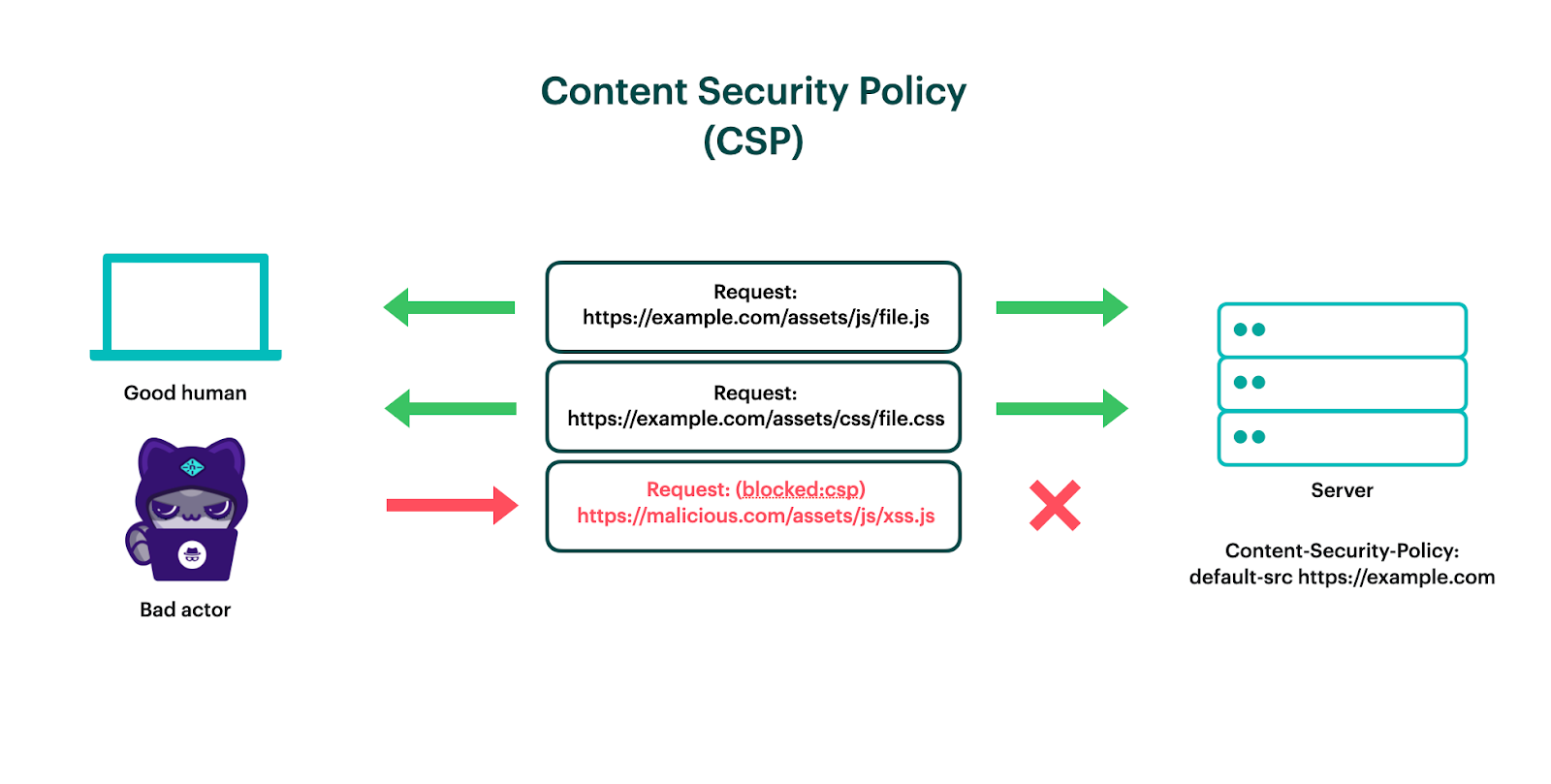
However, not all CSPs are created equal. A senior engineer knows that simple domain allow-lists are often too permissive and can be bypassed. The modern, recommended approach is a strict CSP that uses nonces or hashes.
- A nonce is a unique, randomly generated string for each HTTP response. You add this nonce to your CSP header and to each legitimate
<script>tag. The browser will only execute scripts with the correct nonce. - A hash involves pre-calculating the SHA hash of a script's content and adding it to the CSP header. The browser will only execute scripts whose hash matches one in the policy.
The web.dev article below is an excellent guide to implementing a modern, strict CSP.
Mitigate cross-site scripting (XSS) with a strict Content ...
This article from Google's web.dev team explains why strict CSP is superior to allow-list CSPs and how to implement it.
First, read the introduction to understand the concept of a nonce-based CSP. Next, focus on Step 3, which covers the practical architectural changes required, such as removing inline event handlers (onclick) and javascript: URIs. Finally, review Step 5 to understand the deployment process, particularly the use of the Content-Security-Policy-Report-Only header for safe, non-breaking rollout.
While CSP is powerful, it has limitations and cannot be your only defense. It doesn't protect against all injection vectors, especially if the policy is misconfigured (e.g., allows 'unsafe-eval').
4. Trade-Off Analysis
| Strategy | Primary Goal | When to Use | Pros | Cons |
|---|---|---|---|---|
| Output Encoding | Treat all data as literal text, preventing execution. | Always, by default. Use for displaying any user-controlled data that is not intended to be HTML. | The strongest and most fundamental defense. Handled automatically by modern frameworks. | Breaks legitimate HTML formatting if that is a required feature. |
| Input Sanitization | Allow a safe subset of HTML while removing dangerous tags and attributes. | Only when you must render user-supplied HTML, like in a rich-text editor or formatted comments. | Allows for rich user content while mitigating XSS. | Complex to get right (use a library like DOMPurify). Can be bypassed if library is outdated or improperly configured. Adds processing overhead. |
| Strict CSP | Prevent the browser from loading or executing unauthorized scripts as a defense-in-depth measure. | Always, on every page. It acts as a safety net if encoding or sanitization fails. | Highly effective at blocking many XSS vectors. Mitigates other attacks like clickjacking. | Requires significant refactoring of legacy code (e.g., removing inline scripts). Can be complex to manage, especially with third-party scripts. |
5. Design Challenge
Scenario: You are architecting the XSS mitigation strategy for an e-commerce product page. The page must support:
- A product description managed via a rich-text editor by vendors.
- User-submitted reviews which are plain text, but can include emojis.
- A "Share to Social" widget that requires loading a third-party script from
//widgets.social.com/share.js. - Product images served from
https://images.my-cdn.com.
Task: Describe the complete, multi-layered security architecture to prevent XSS. Specify which technique (encoding, sanitization, CSP) you would use for each feature and explain your reasoning. Provide a sample CSP header for this page.
6. Senior-Level Insight
A mid-level engineer knows that XSS is bad and that dangerouslySetInnerHTML is dangerous. They rely on their framework's default escaping and might stop there. A senior or staff engineer, however, architects for failure. They assume that any single defense layer could be bypassed and therefore builds a multi-layered system. In an interview, they wouldn't just say "use CSP"; they would specify a strict, nonce-based CSP, explain why it's superior to a domain allow-list, and discuss the engineering effort needed to refactor code to support it. They think about the data's entire lifecycle and the specific context of its rendering—is it in an HTML body, an href attribute, or preloaded state in an SSR application? Each context demands a specific mitigation, and a senior engineer can articulate the complete matrix of threats and defenses.
7. Common Mistakes in Interviews
- Confusing Sanitization and Encoding: Saying "I'll sanitize the username" when you mean you'll encode it for display.
- Stopping at Validation: Believing that rejecting certain characters on input is a sufficient defense. Attackers are creative; validation is easily bypassed.
- Proposing a Weak CSP: Suggesting a CSP with
'unsafe-inline'or a broad allow-list likescript-src: *without acknowledging that this provides almost no security. - Ignoring Edge Cases: Forgetting that
hrefattributes, CSSurl()values, and server-side rendered initial state are all potential XSS vectors that require specific handling. - "I'd use a library": While correct, a senior candidate must be able to explain what the library is doing (e.g., "I'd use DOMPurify, which parses the HTML into a DOM tree, traverses it against a configurable allow-list of tags and attributes, and then serializes it back to a safe HTML string.").
8. Quiz
-
A user profile page needs to display a user's name, which is plain text. Which of the following is the most appropriate and secure primary strategy?
a) Sanitize the name using DOMPurify before rendering.
b) Rely on the frontend framework's default output encoding.
c) Implement a strict CSP and do nothing else.
d) Validate the name to ensure it contains no special characters. -
What is the main purpose of using a "nonce" in a Content Security Policy?
a) To encrypt the content of a script tag.
b) To prove to the browser that a specific script was intentionally included by the server for that response, and is not from an injection.
c) To ensure a script is only executed once per page load.
d) To sign third-party scripts from a CDN. -
When is it appropriate to use input sanitization instead of output encoding?
a) When displaying any user-provided string.
b) When storing data in a database.
c) Only when you must allow users to submit and view formatted HTML content.
d) Never; output encoding is always sufficient. -
Which of the following is a key vulnerability of DOM-based XSS?
a) The malicious payload is stored permanently in the server's database.
b) The attack is invisible to the server, as the payload is often in the URL fragment (#) and processed only by client-side JavaScript.
c) It can only be mitigated by a Web Application Firewall (WAF).
d) The server reflects malicious code from a query parameter back in the response. -
Open-ended: A teammate wants to implement a comment section where users can format their comments with bold and italic text. They propose storing the user's raw HTML in the database and rendering it on the client with
dangerouslySetInnerHTML. Briefly outline the security risks of this approach and propose a secure architectural solution, mentioning specific libraries and functions you would use.
Conclusion
In this lesson, we dissected the threat of Cross-Site Scripting and constructed a robust, multi-layered architectural defense. We learned to differentiate and properly apply the core tools of output encoding, input sanitization, and Content Security Policy.
Key Takeaways:
- Defense in Depth: No single solution is foolproof. A secure architecture combines multiple layers: encoding by default, sanitizing when HTML is a feature, and a strict CSP as a final safety net.
- Context is King: The correct mitigation depends entirely on where and how you are using the data. Always encode for the specific output context (HTML, attributes, JS).
- Sanitize with Purpose: Only sanitize when you explicitly need to render user-supplied HTML. Use a battle-tested library like
DOMPurifyand never roll your own. - Adopt a Strict CSP: Move beyond weak allow-list policies. Implementing a modern, nonce-based CSP is a high-impact measure that significantly hardens your application against injection attacks.
We have now secured our application against malicious code injection. In the next lesson, we will tackle another critical web vulnerability: Cross-Site Request Forgery (CSRF). We will architect mitigations using anti-CSRF tokens and SameSite cookie attributes to ensure that all actions taken within our application are intentional and initiated by the user.