Hello! Welcome to the first lesson of your personalized DevOps interview preparation course.
Our goal over the next week is to sharpen your knowledge on key DevOps topics, transforming your hands-on experience into confident, articulate interview answers. We'll start with the fundamentals and progressively dive into the more advanced areas you identified, like Kubernetes and Terraform.
Today's lesson focuses on the "why" behind DevOps. We'll explore its core cultural principles and see how they solve the classic problems of traditional software delivery. A strong grasp of this is essential, as it forms the foundation for answering many opening interview questions like "What is DevOps?" or "Why is DevOps important?".
1. The Traditional Divide: The "Wall of Confusion"
Before DevOps, the software world was typically split into two camps: Development (Dev) and Operations (Ops). You've likely seen remnants of this structure in your career.
- Development's Goal: Build and ship new features as quickly as possible.
- Operations' Goal: Keep the production systems stable, secure, and reliable.
These conflicting priorities often created what is famously called the "wall of confusion." Developers would write code and "toss it over the wall" to the operations team to deploy and manage.

This separation leads to several predictable challenges:
- Blame Games: When something breaks in production, Ops blames "buggy code," while Dev claims "it worked on my machine," blaming the production environment.
- Silos: Teams work in isolation, with limited understanding of each other's workflows, challenges, and goals.
- Slow Releases: Deployments become large, infrequent, high-risk events because the coordination is complex and the fear of failure is high.
To get a feel for this classic problem, watch the beginning of the following video which sets the historical context.
Top DevOps Interview Questions & Answers | DevOps Interview Questions For Freshers | Intellipaat
This video from Intellipaat starts by explaining the historical 'toss it over the wall' problem that led to the birth of DevOps.
Watch the first minute of the video (from 00:00 to 01:00) to understand the background of the traditional conflict between Dev and Ops.
2. DevOps Principles as the Solution: The CALMS Framework
DevOps is not just a role or a set of tools; it's a cultural philosophy that addresses these challenges by bringing Dev and Ops together. The goal is to enable an organization to deliver value to customers faster and more reliably.
A great way to structure your understanding of DevOps principles is through the CALMS framework. It's a mnemonic that covers the five essential pillars of a successful DevOps transformation.
To get a quick overview of a similar model (C.A.M.S.), watch the following video. It provides a concise explanation of each pillar.
DevOps Principles - The C.A.M.S. Model
This video from Coding Tech explains the C.A.M.S. model (Culture, Automation, Measurement, Sharing), which is a popular variant of the CALMS framework.
Watch from 00:35 to the end (04:49). Pay close attention to how each principle is defined as a way to solve people and process problems, not just technical ones.
Now, let's break down each component of the CALMS framework in more detail.
C - Culture
This is the heart of DevOps. It's about breaking down silos and fostering a culture of shared responsibility. Instead of "Dev vs. Ops," the team shares ownership of the product from creation to production operation.
Key cultural traits include:
- Shared Ownership: The "you built it, you run it" mentality means developers are involved in the operational health of their applications. This aligns incentives—developers who are on-call for their own code are more likely to write reliable, operable software.
- Blameless Post-mortems: When incidents occur, the focus is on identifying systemic causes and improving processes, not on pointing fingers at individuals. This creates psychological safety, encouraging people to innovate and take calculated risks.
- Collaboration: Teams communicate openly and work together towards common business goals.
A - Automation
You're already heavily involved in this area through your work with Terraform, scripting, and CI/CD pipelines. In DevOps, automation is foundational. It aims to eliminate manual, repetitive, and error-prone tasks.
- How it solves problems: By automating the build, testing, and deployment processes (CI/CD), teams can release software faster and more reliably. Automating infrastructure provisioning with tools like Terraform (Infrastructure as Code) ensures environments are consistent, which eliminates the "it works on my machine" problem.
L - Lean
This principle comes from lean manufacturing and focuses on delivering value to the customer efficiently.
- Key Concepts:
- Small Batch Sizes: Instead of massive, risky "big bang" releases, work is broken down into small, manageable changes that are deployed frequently. This reduces the risk of each deployment and allows for faster feedback.
- Eliminate Waste: Identify and remove any process or activity that doesn't add value to the end product.
- Continuous Improvement: The team regularly reflects on its processes and experiments with ways to make them better.
M - Measurement
You cannot improve what you cannot measure. Measurement provides the feedback loops necessary to make data-driven decisions.
-
How it solves problems: Instead of guessing, teams track key metrics to understand their performance and the impact of changes. This moves the conversation from subjective opinions to objective data. The most respected metrics in this area are the DORA metrics:
- Deployment Frequency: How often an organization successfully releases to production.
- Lead Time for Changes: The time it takes to get a commit from code to production.
- Change Failure Rate: The percentage of deployments causing a failure in production.
- Time to Restore Service: How long it takes to recover from a failure in production.
These metrics help balance speed (Deployment Frequency, Lead Time) with stability (Change Failure Rate, Time to Restore).
S - Sharing
Sharing reinforces the cultural pillar. It's about creating channels for knowledge, tools, and feedback to flow freely between teams.
- How it solves problems: When teams share best practices, tools, and insights from monitoring, they build collective intelligence. This prevents knowledge silos, reduces bottlenecks, and ensures everyone is working from a common understanding. Your experience with creating Terraform modules and standardized pipelines is a perfect example of enabling sharing across teams.
For a more detailed written explanation of these principles, please read the following sections from an article by Pensero.ai.
A Guide to DevOps Frameworks for Engineering Leaders in 2026
This guide provides an excellent breakdown of the core principles that are common across all major DevOps frameworks.
Read the section titled 'Core DevOps Principles Across Frameworks'. Focus on how each principle—Collaboration, Automation, Measurement, and Continuous Improvement—is described as a solution to a traditional organizational problem.
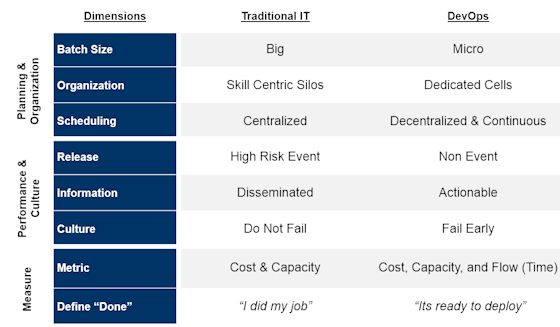
3. Tying It All Together: Traditional vs. DevOps
The following table starkly contrasts the old way of working with the new DevOps paradigm. This is a powerful visual to have in mind for an interview.
Test your understanding!
Imagine your team is consistently spending two full days manually configuring and deploying a new version of a Kafka connector, a process that has led to production errors twice in the last quarter due to missed configuration steps.
Which CALMS principle is most directly being violated, and how would you propose addressing it using one or more of the other principles?
Show answer
The principle most directly violated is Automation. The process is manual, slow, and error-prone.
Here's how other CALMS principles could be applied to solve it:
- Automation: You would propose creating a fully automated CI/CD pipeline for the connector deployment, using tools like Terraform (for connector resource definition) and Azure DevOps Pipelines. This directly addresses the manual effort and inconsistency.
- Lean: By deploying smaller changes to the connector more frequently via the automated pipeline, you reduce the risk of each deployment (small batch sizes).
- Measurement: You could measure the Lead Time for Changes before and after automation to prove the improvement. You would also track the Change Failure Rate to show that the automated, tested process is more reliable.
- Sharing: Once built, this automated pipeline template can be shared with other teams, allowing them to benefit from the same reliable process.
Key Takeaways
- The Core Problem: DevOps exists to solve the fundamental conflict between Development (speed) and Operations (stability) by breaking down the "wall of confusion."
- It's Culture First: DevOps is a cultural philosophy centered on shared responsibility, collaboration, and continuous improvement, not just a set of tools.
- The CALMS Framework: This is an excellent model for explaining the key pillars of DevOps in an interview: Culture, Automation, Lean, Measurement, and Sharing.
- From Silos to Shared Goals: The ultimate goal is to align all teams around the common objective of delivering value to the customer quickly and reliably.
Next Up
This lesson covered the "why" and "what" of DevOps. In our next lesson, we will dive into a practical application of the Automation principle by tackling the learning outcome: "Design a multi-stage CI/CD pipeline with appropriate quality gates and testing strategies." This will be a great opportunity to connect your hands-on experience with structured design principles.