Welcome to the first lesson of your PMP preparation course. Your goal is to pass the PMP exam, and this course is designed with that single objective in mind. Our journey begins by deconstructing the exam itself. A deep understanding of its structure, content domains, and question formats is the essential first step toward building an effective study plan and managing your time on exam day.
In this lesson, you will learn to describe the structure, domains, and question types of the current PMP exam. We will cover the logistics of the exam—how long it is and how it's organized—before moving on to the content areas it tests and the formats you'll encounter for the questions.
The PMP Exam at a Glance
Let's start with a high-level overview. The PMP exam is a comprehensive test designed to evaluate your knowledge and experience in leading and directing projects. The following infographic from the Project Management Academy provides a concise summary of what to expect on exam day.
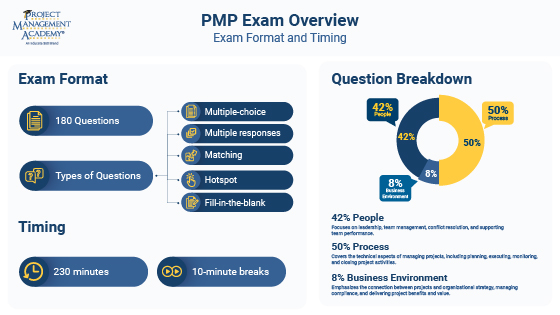
As you can see, the exam consists of 180 questions to be completed within a 230-minute timeframe. It is divided into three domains, with the majority of questions focusing on Process (50%) and People (42%). Let's break these elements down further.
Exam Structure and Timing
The Project Management Institute (PMI), the organization that issues the PMP certification, provides the official rules of the exam. The exam's timing and structure are strictly defined to ensure a standardized experience for all candidates.
The exam has 180 questions in total. However, only 175 of these are scored. The remaining 5 are "pretest" questions, which are not scored and are used by PMI to test questions for future exams. You will not be able to identify these pretest questions, so you must treat every question as if it counts towards your final score.
The total allotted time for the exam is 230 minutes. To help you manage this long session, the exam is divided into three sections, with an optional 10-minute break after the first and second sections.
Project Management Professional (PMP)® Examination ...
For the official details on the exam's structure, please read the "PMP Examination Information" section from PMI's Exam Content Outline (ECO).
In this document, focus on the section titled "PMP Examination Information". Pay close attention to the details about the number of questions, the total exam time, and the specific rules for the two breaks. The key rule to remember is that once you take a break, you cannot return to the questions in the preceding section.
To summarize the key points:
- Total Questions: 180 (175 scored + 5 unscored pretest)
- Total Time: 230 minutes
- Structure: Three sections of 60 questions each.
- Breaks: Two optional 10-minute breaks. The first break is offered after question 60, and the second after question 120.
This structure means you have an average of about 76 seconds per question. Effective time management is critical, a skill we will work on throughout this course.
The Three Domains of Project Management
The PMP exam questions are not random; they are carefully distributed across three core domains that define the work of a project manager. Knowing these domains and their weightings helps you focus your study efforts proportionately.
The official breakdown is as follows:
- Domain I: People (42%): This domain focuses on the skills needed to lead a project team effectively. Topics include conflict management, team building, stakeholder engagement, and mentoring.
- Domain II: Process (50%): This is the largest domain and covers the technical aspects of managing a project. It includes planning, risk management, scheduling, budget management, and managing project changes.
- Domain III: Business Environment (8%): This domain connects projects to the broader organizational strategy and environment. It covers topics like project benefits, value delivery, and organizational change management.
To get a quick summary of these domains, watch this short clip from a popular PMP training video.
The PMP Cheat Sheet - How to Tell if You're Ready for the PMP Exam
This video provides a concise overview of the three PMP exam domains and their weightings.
Watch the section from this clip, where the presenter introduces the People, Process, and Business Environment domains and shows their percentage on the exam.
A critical aspect of the modern PMP exam is its focus on different project management approaches. The PMI Exam Content Outline states that approximately half of the examination represents predictive (or "waterfall") project management approaches, and the other half represents agile or hybrid approaches.
Given your 15 years of experience as an architect and contractor, you likely have a strong foundation in predictive methodologies, which are common in construction. A significant part of our work will be to build upon that foundation by covering the agile and hybrid concepts, principles, and practices required to pass the exam.
PMP Exam Question Types
Finally, let's look at how you will be tested. The PMP exam has moved beyond simple multiple-choice questions to include a variety of formats designed to better assess real-world problem-solving skills.
How Long is the PMP Exam? All You Need to Know
The article "How Long is the PMP Exam?" provides excellent descriptions of the various question types you'll encounter.
Please read the section titled "PMP Exam Question Types". Start from the introductory paragraph and continue through the descriptions of each type: Multiple Choice Multiple Response Hot Area Drag and Drop (also referred to as Matching) Fill in the Blank As you read, visualize how these question types might apply to a project scenario. For instance, a "Drag and Drop" question could ask you to sequence project management processes correctly.
Being familiar with these formats is crucial. It prevents surprise on exam day and allows you to focus on the content of the question rather than the mechanics of answering it. We will practice all these question types extensively in later lessons and mock exams.
Conclusion
This lesson has laid the groundwork for your PMP exam preparation by demystifying the test itself. You now have a clear map of what to expect.
Here are the key takeaways:
- Exam Structure: The exam is a 230-minute test with 180 questions, broken into three sections with two optional 10-minute breaks.
- Content Domains: The questions are divided across three domains: People (42%), Process (50%), and Business Environment (8%).
- Methodologies: Expect an even 50/50 split between questions on predictive (waterfall) and agile/hybrid approaches.
- Question Types: The exam uses various formats, including multiple-choice, multiple-response, drag-and-drop/matching, hotspot, and fill-in-the-blank questions.
In our next lesson, we will dive deeper into the single most important document for your PMP studies: the PMP Exam Content Outline (ECO). While we touched on it today for structure and domains, our next session will focus on interpreting the specific tasks listed within each domain. This will give you a detailed blueprint of the exact knowledge and skills the exam is designed to test.