Hello! Welcome to the next module in your journey to becoming a full-stack developer.
So far, you've built a complete, database-driven web application using Django. In your Task Manager, Django handles everything: it processes data, interacts with the database, and renders the final HTML that the user sees in their browser. This is a powerful and common approach called server-side rendering.
Today, we're going to explore a different, more modern architectural style that is essential for full-stack developers: the REST API.
Today's goal is to explain the purpose of a REST API in a web application context. By the end of this lesson, you'll understand what a REST API is, how it works, and why it's a fundamental tool for building flexible and scalable applications. This conceptual lesson lays the groundwork for the next hands-on phase of our course, where you'll build an API for your Task Manager.
1. What is an API?
Before we dive into "REST," let's quickly clarify what an "API" (Application Programming Interface) is. In simple terms, an API is a set of rules and definitions that allows different software applications to communicate with each other.
Think of it as a well-defined contract. One piece of software offers a service (like providing data or performing an action), and the API specifies exactly how other software can request that service.
What Is a REST API? Definition, Benefits, and Examples
For a concise definition and some real-world examples you use every day, please read the first section of this article from Orderful.
Read the section titled 'What Is an API?'. It provides a clear definition and uses examples like Google Maps and Spotify to illustrate the concept.
2. What Makes an API "RESTful"?
"REST" stands for REpresentational State Transfer. It's not a strict protocol or a specific technology, but rather an architectural style—a set of guiding principles for designing networked applications. An API that follows these principles is called a "RESTful API" or simply a "REST API".
Let's watch a short video that introduces the concept using a simple analogy.
This video from IBM Technology provides a friendly introduction to REST APIs using an ice cream shop example. It will help you build an initial mental model of what we're discussing.
Watch the first 1 minute and 45 seconds of the video. Focus on how the web page (the client) communicates with the server through the REST API.
The video introduces two core principles of REST that are crucial to understand:
-
Client-Server Separation: This is perhaps the most important concept. In a REST architecture, the client (the user interface, like a web browser running JavaScript) and the server (the backend that stores the data) are completely separate. They are developed and can be updated independently. This is a major shift from your current Django project, where the front-end (templates) and back-end (views) are tightly coupled.
-
Statelessness: The server does not keep track of the client's state between requests. Every single request from the client to the server must contain all the information the server needs to understand and process it. The server doesn't remember previous interactions. This design simplifies the server and makes it much easier to scale.
3. The Core Mechanics of a REST API
How does this client-server communication actually happen? REST APIs leverage the standard features of the HTTP protocol that powers the web.

Let's break down the key components of a typical REST API interaction:
- Resources: In REST, every piece of data is a "resource." In your project, a task is a resource. A user is another resource. These are the "nouns" of your application.
- Endpoints (URIs): Each resource has a unique address, called an endpoint or URI (Uniform Resource Identifier). For example,
/api/tasks/could represent the collection of all tasks, while/api/tasks/42/would represent the specific task with an ID of 42. - HTTP Methods (Verbs): To interact with these resources, we use standard HTTP methods. You might recognize these as the "verbs" that act on the "nouns" (resources). This maps directly to the CRUD (Create, Read, Update, Delete) operations you already know:
GET: Retrieve a resource (e.g., get all tasks, or get a single task).POST: Create a new resource (e.g., add a new task).PUT/PATCH: Update an existing resource (e.g., edit a task's title or mark it as complete).DELETE: Remove a resource (e.g., delete a task).
- Data Format (Representation): The "Representational" part of REST means the server sends back a representation of the resource's state. This is almost always in JSON (JavaScript Object Notation) format because it's lightweight and easily understood by web browsers and other programming languages.
The following video provides an excellent, practical walkthrough of these concepts.
This video from Programming with Mosh uses a great example of a movie rental service to explain how resources, endpoints, and HTTP verbs work together.
Watch from 00:56 to 05:33. Pay close attention to how different HTTP requests (GET, POST, PUT, DELETE) are sent to different endpoints (e.g., /api/customers vs. /api/customers/1) to perform different actions.
Test your understanding!
Imagine you have a REST API for your Task Manager project. Based on what you've just learned, what HTTP method and endpoint would you most likely use to perform the following actions?
- Fetch the details of the task with an ID of 15.
- Delete the task with an ID of 23.
- Create a brand new task.
Show answer
GET /api/tasks/15/: You use theGETmethod to retrieve data, and you specify the unique ID of the resource in the endpoint.DELETE /api/tasks/23/: You use theDELETEmethod to remove a resource, specifying its ID in the endpoint.POST /api/tasks/: You use thePOSTmethod to create a new resource. The request is sent to the collection endpoint (/api/tasks/), and the data for the new task (like its title) would be included in the body of the request.
4. The Purpose: Why Use a REST API?
So, why go through the trouble of building a separate API? Why not stick with the integrated Django approach?
The primary purpose is decoupling. By separating the client from the server, you gain enormous flexibility.
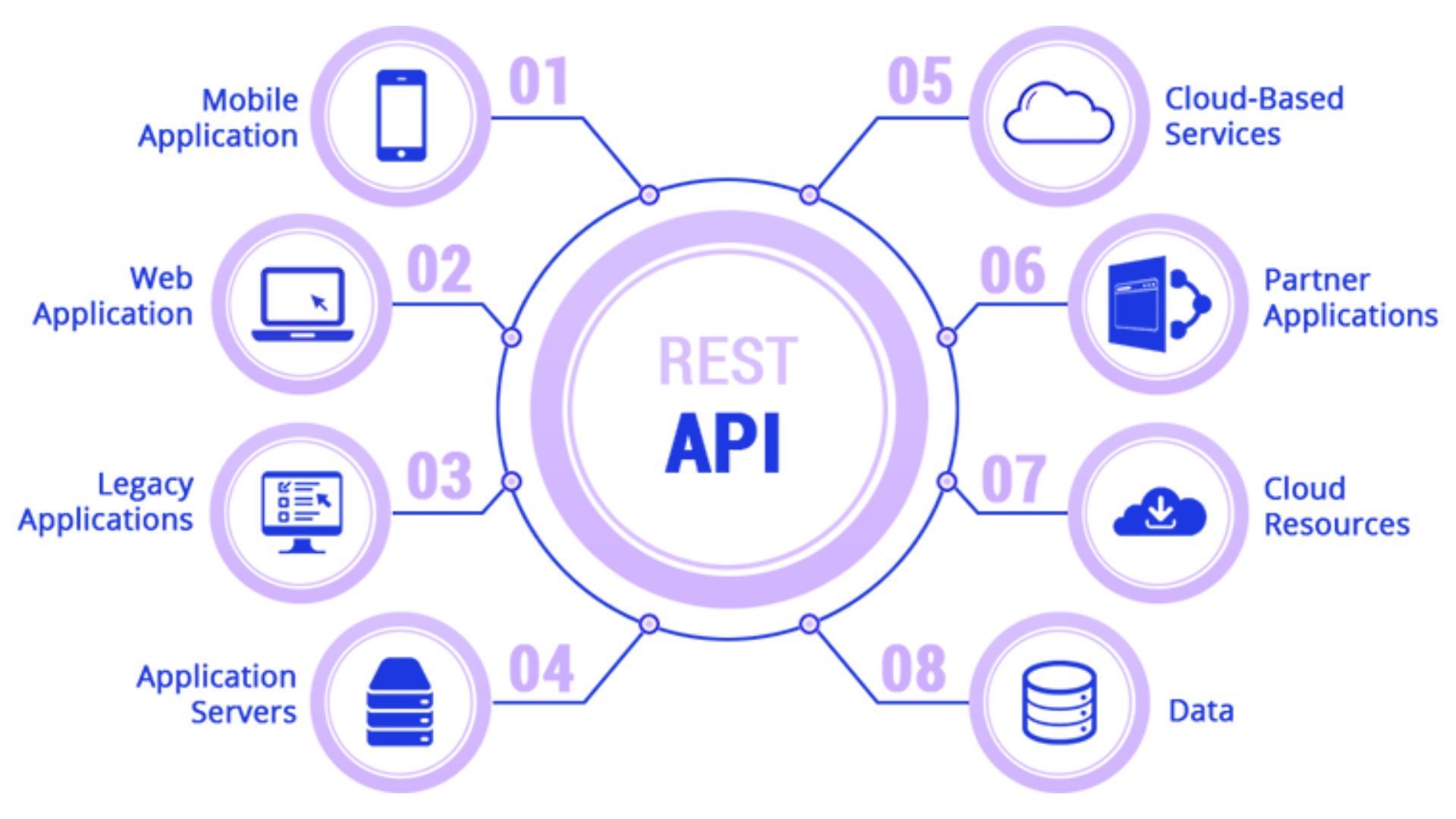
Here are the key benefits this decoupling provides:
- Platform Independence: Your Django backend can serve a web application built with a modern JavaScript framework (like React or Vue.js), a mobile app (iOS/Android), a desktop application, or even another server. You write the backend logic once and reuse it everywhere.
- Independent Development: Front-end and back-end teams can work in parallel. As long as they agree on the API "contract" (the endpoints, methods, and data format), their work doesn't block each other.
- Scalability: Because the server is stateless, you can easily add more servers to handle increased traffic without worrying about complex session synchronization.
- Technology Flexibility: You can write your front-end in JavaScript and your back-end in Python (with Django!). If you decide to rewrite your front-end in a new technology later, you don't have to touch the back-end as long as the API contract remains the same.
For a comprehensive text-based summary of these concepts, the following article is an excellent resource to review and bookmark.
What is REST API (RESTful API)? Explained
This Codecademy article provides a well-structured explanation of REST principles, client-server communication, and the advantages of this architecture.
Skim through the sections on 'Client-server architecture,' 'What is a REST API?,' 'Client-server communication in REST,' and 'Advantages and disadvantages of REST.' This will reinforce what you've learned in the videos and provide more detail on topics like HTTP status codes.
Conclusion
In this lesson, we've moved from the world of tightly-coupled, server-rendered applications to the flexible, decoupled world of REST APIs. You've learned that a REST API is an architectural style that uses standard HTTP protocols to allow separate client and server applications to communicate.
Key Takeaways:
- An API is a contract that lets software components talk to each other.
- REST is an architectural style for designing APIs based on principles like client-server separation and statelessness.
- REST APIs use endpoints (URIs) to identify resources (data).
- Standard HTTP verbs (
GET,POST,PUT,DELETE) are used to perform CRUD operations on these resources. - The main purpose of a REST API is to decouple the front-end from the back-end, enabling flexibility, scalability, and independent development.
Preview of the Next Lesson:
Now that you understand the "what" and "why" of REST APIs, it's time for the "how." In our next lesson, you'll install and configure Django REST Framework (DRF), a powerful toolkit for building web APIs. You'll take the first practical steps toward turning your Task Manager into a modern, full-stack application with its own API.