Introduction
In our last session, you mastered the fundamental rules for differentiating polynomials by handling sums, differences, and constant multiples. This allowed you to move from the laborious limit definition to a much faster, algebraic approach. We concluded by posing a critical question: how do we handle functions that are multiplied together or divided by one another?
This lesson directly answers that question by introducing two of the most powerful tools in your differentiation toolkit: the Product Rule and the Quotient Rule. By the end of this lesson, which corresponds to Section 3.2 of your Stewart textbook, you will be able to differentiate complex functions formed by the multiplication or division of simpler functions, such as or . Mastering these rules is essential for tackling the more intricate functions we will encounter throughout the course.
The Product Rule: Beyond Simple Sums
A common early mistake in calculus is to assume that the derivative of a product is simply the product of the derivatives. Let's quickly prove this is false. Consider and .
- The product is . Using the Power Rule, we know .
- The derivatives of the individual functions are and . The product of these derivatives is .
Clearly, , so a more sophisticated rule is needed. This is the Product Rule, discovered by Gottfried Leibniz.
The Product Rule: If and are both differentiable functions, then
In prime notation, this is often written more concisely as:
In words: "The first function times the derivative of the second, plus the second function times the derivative of the first."
To understand where this rule comes from, you can review its proof. The textbook provides a formal proof based on the limit definition, while the video offers a clear walkthrough of the algebraic steps involved.
Your textbook's section on "The Product and Quotient Rules" begins with a derivation and explanation of the Product Rule.
Please read the first part of this section, starting from the introduction, which dispels the "product of derivatives" misconception. Then, review the formal statement of the rule and work through Examples 1, 2, and 3 to see it in action. You can skim the formal proof for now, but focus on the application in the examples.
Calculus 3.2 The Product and Quotient Rules
The video "Calculus 3.2 The Product and Quotient Rules" by Asher Roberts provides an excellent supplement to the textbook, walking through the same concepts verbally.
First, watch the introduction and proof from the beginning. This will reinforce why the rule is necessary and how it is derived. Next, watch the segment with worked examples. Pay close attention to: The differentiation of xe^x, which is a classic application. The example that can be solved either with the Product Rule or by simplifying first. This highlights that you should always consider the most efficient path. The final example, where you must find f'(4) using given values for g(4) and g'(4). This tests your conceptual understanding of the rule's structure.
Example Walkthrough:
Let's apply the Product Rule to the function .
Here, we can set and .
-
Find the derivatives of the parts:
- (using the Power, Difference, and Constant Multiple Rules)
- (as we learned in the last module)
-
Apply the Product Rule formula :
-
Simplify the result:
We can factor out the common term .
This step-by-step process—identify parts, differentiate parts, assemble using the rule, and simplify—is a reliable method.
The Quotient Rule: Handling Division
Just as with products, we need a special rule for quotients. The formula is a bit more complex, so a mnemonic is often used to remember it.
The Quotient Rule: If and are differentiable, then
In prime notation:
A popular mnemonic to remember the numerator is: "Low d-high minus high d-low." Here, "low" refers to the denominator , "high" refers to the numerator , and "d" means "the derivative of." The full saying goes: "Low d-high minus high d-low, square the bottom and away we go!"
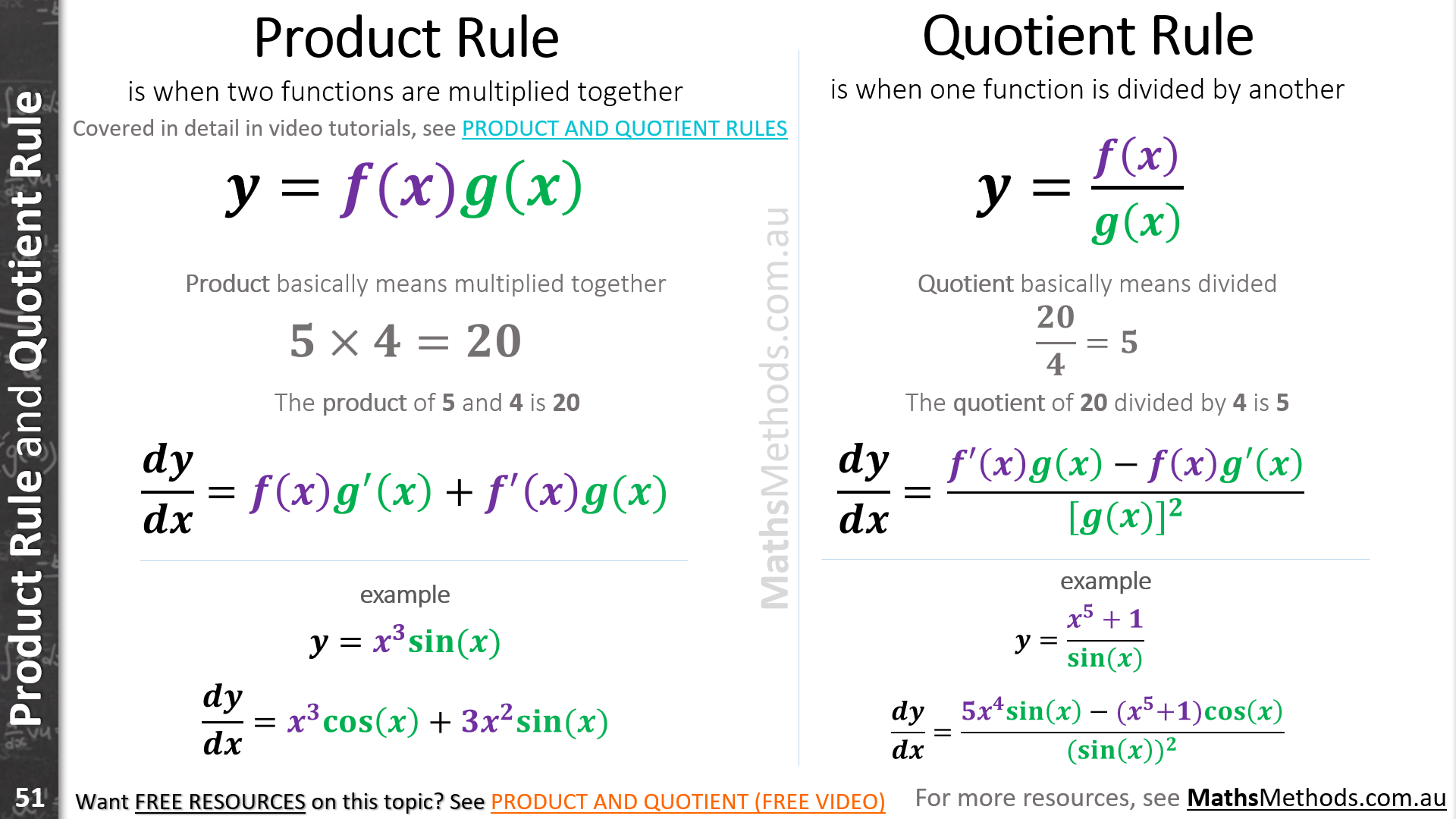
The image below provides a great summary of both the Product and Quotient rules.
Now, let's turn back to the textbook and video to see the formal statement and examples.
The textbook continues by introducing the Quotient Rule.
Read the section beginning with The Quotient Rule. Pay close attention to the formula and the "in words" description. Work through Example 4 carefully, as it's a typical application for differentiating a rational function. Also, read the important NOTE that follows Example 5, which advises when to avoid the Quotient Rule in favor of algebraic simplification.
Calculus 3.2 The Product and Quotient Rules
The Asher Roberts video also covers the Quotient Rule with detailed examples.
Watch the final segment of the video on the Quotient Rule. The first example is a rational function, which involves careful bookkeeping. The second example shows how to use the rule to find the slope of a tangent line and its equation, connecting back to earlier concepts.
When to Simplify First
As both the textbook and video point out, applying these rules is not always the most efficient method. Consider the function:
You could use the Quotient Rule with and . However, it's much simpler to perform the division first. Recall that .
Now, you have a simple sum of power functions, which you can differentiate easily using the rules from the previous lesson:
This approach is faster and less prone to algebraic errors than using the full Quotient Rule. A key part of developing your calculus skills is learning to recognize when a problem can be simplified before differentiation.
Conclusion
In this lesson, you have added two indispensable rules to your calculus toolkit. You now have a complete set of methods for differentiating functions that are combined using addition, subtraction, multiplication, or division.
Key Takeaways:
- The derivative of a product is not the product of the derivatives. You must use the Product Rule: .
- The derivative of a quotient requires the Quotient Rule: .
- Remember the mnemonic for the Quotient Rule: "Low d-high minus high d-low, square the bottom and away we go."
- Always look for opportunities to simplify an expression algebraically before applying the Product or Quotient Rule, as this can often save time and prevent errors.
To solidify your understanding, I recommend working through exercises 1-25 (odd numbers) and 43 from section 3.2 in your textbook (LINK).
In our next lesson, we will continue expanding our library of derivatives. Having established the rules for combining functions, we will turn our attention to deriving the derivatives of the six fundamental trigonometric functions: sine, cosine, tangent, and their reciprocals. You will see how these new derivatives combine with the Product and Quotient Rules to solve even more interesting problems.