Introduction
In our last lesson, we explored memory fences and the __threadfence() intrinsic, a mechanism for enforcing the order and visibility of memory operations, primarily for coordinating threads across different blocks via global memory. This is crucial for correctness, but it raises a question: for the most tightly-coupled group of threads—those within a single warp—is there a more direct and efficient way to communicate than writing to and reading from memory?
This lesson introduces a powerful set of tools for exactly this purpose: warp-level primitives. We will focus on "shuffle" instructions, which allow threads within a warp to read data directly from each other's registers. This is one of the fastest communication paths available on the GPU. You will learn how these primitives work, why the modern _sync versions are critical for writing correct code, and how to use them to implement a highly efficient parallel reduction, a fundamental pattern in high-performance computing.
From Shared Memory to Direct Data Exchange
Recall that threads within a thread block can communicate using shared memory. This involves a three-step process: a thread writes its data to shared memory, all threads synchronize with __syncthreads(), and then another thread reads that data. While much faster than global memory, this still involves memory load and store operations.
Warp-level primitives bypass this entirely. They enable direct register-to-register data transfer between threads in the same warp. Given your interest in low-level systems and performance, you can think of this as the GPU equivalent of an extremely fast, specialized interconnect that operates only between the 32 threads of a warp.
These instructions are often called "shuffles" because they move data around (or "shuffle" it) between the 32 lanes of the warp.
Lecture 4: warp shuffles, and reduction / scan operations
This lecture slide deck by Prof. Mike Giles provides a concise introduction to warp shuffles. It will introduce you to the fundamental idea and the main variants.
Please read the first few slides, covering the four variants and their basic syntax (syntax definitions). Crucially, pay close attention to the slide titled "Very important", which highlights the key rule for using these primitives correctly.
As the slides point out, there are four main shuffle variants:
__shfl_sync(mask, var, srcLane): Gets the value ofvarfrom the thread at the specifiedsrcLane. This is a direct, indexed read.__shfl_up_sync(mask, var, delta): Getsvarfrom the thread atcurrent_lane - delta.__shfl_down_sync(mask, var, delta): Getsvarfrom the thread atcurrent_lane + delta.__shfl_xor_sync(mask, var, laneMask): Getsvarfrom the thread whose lane ID iscurrent_lane XOR laneMask. This creates a "butterfly" communication pattern useful in algorithms like FFTs and some reductions.
The Importance of Synchronous Primitives and the mask
You'll notice all these functions have a _sync suffix and take a mask as their first argument. This is a modern feature (introduced in CUDA 9) that is absolutely essential for writing correct and portable code. Legacy versions of these primitives existed without the _sync suffix and mask, but they relied on implicit assumptions about thread execution that are no longer guaranteed.
The mask is a 32-bit integer where each bit corresponds to a thread in the warp (bit 0 for lane 0, bit 1 for lane 1, etc.). A '1' in a bit position means the corresponding thread is a participant in the shuffle operation.
- Why is this needed? As we saw in our lesson on thread divergence, not all 32 threads in a warp are guaranteed to be active at any given instruction. If an active thread tries to shuffle data from an inactive thread, the result is undefined.
- What does
_syncdo? The_syncprimitives first synchronize the participating threads specified in themask, ensuring they have all reached the shuffle instruction before the data exchange happens. This solves the divergence problem by making the set of participating threads explicit.
Relying on old, non-_sync primitives is now considered unsafe programming. The following article from NVIDIA's technical blog explains this in detail. It's a critical concept for anyone serious about writing robust GPU code.
Using CUDA Warp-Level Primitives | NVIDIA Technical Blog
This NVIDIA blog post is the definitive guide to modern warp-level primitives. It explains their purpose, the role of the mask, and why legacy approaches are unsafe.
First, read the introductory section Warp-level Primitives to get an overview. Next, read Synchronized Data Exchange, which explains how the mask specifies the set of participating threads. Then, jump to the section Implicit Warp-Synchronous Programming is Unsafe. This is the most important part; it clearly explains why you must use the _sync versions and cannot assume threads stay synchronized. Finally, review the best practices in Update Legacy Programming.
The key takeaway is that you must carefully determine which threads are meant to participate in a collective operation and provide that information via the mask. For many simple cases where all 32 threads are involved, you can use 0xffffffff (a 32-bit integer with all bits set to 1), often defined as FULL_MASK.
Application: A High-Performance Warp-Level Reduction
Now, let's apply these concepts to a practical and important algorithm: the parallel reduction. The goal is to compute a single value (e.g., a sum) from values held by each thread. We previously discussed doing this with shared memory, but a shuffle-based reduction is often faster for the final intra-warp step.
We will use __shfl_down_sync to implement a tree-like reduction. Imagine we want to sum a value that each thread in a warp holds in a register called val. The final sum should end up in lane 0's val register.
The basic operation __shfl_down_sync(FULL_MASK, val, delta) means "get the value of val from the thread delta lanes to my right (higher ID)." We can structure this in a loop where delta is progressively halved.
Let's visualize this with a simplified 8-thread warp.
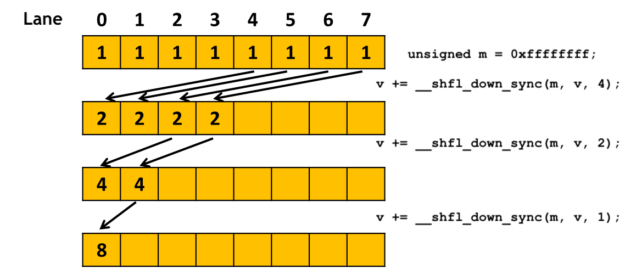
The code to perform this reduction on a full 32-thread warp is remarkably concise:
// Each of the 32 threads in the warp has a 'val' in a register.
// We assume all 32 threads are participating.


#define FULL_MASK 0xffffffff

for (int offset = 16; offset > 0; offset /= 2) {
    val += __shfl_down_sync(FULL_MASK, val, offset);
}

// After the loop, the thread with lane ID 0 (threadIdx.x % 32 == 0)
// will have the sum of all 32 'val's in its 'val' register.
Let's trace the first iteration (offset = 16):
- Threads with lane IDs 0-15 execute
val += __shfl_down_sync(...). - Thread 0 gets the
valfrom thread 16. - Thread 1 gets the
valfrom thread 17. - ...
- Thread 15 gets the
valfrom thread 31. - Threads 16-31 also execute the instruction, but since their source lanes (
laneId + 16) are outside the warp, they receive their ownvalback. Their accumulated sum is not used in subsequent steps.
After this first step, the partial sums for the entire warp are held in lanes 0-15. The loop continues:
offset = 8: Lanes 0-7 accumulate from lanes 8-15.offset = 4: Lanes 0-3 accumulate from lanes 4-7.offset = 2: Lanes 0-1 accumulate from lanes 2-3.offset = 1: Lane 0 accumulates from lane 1.
The final result resides in lane 0. This entire operation happened without any shared memory reads/writes or __syncthreads() calls, making it extremely fast.
Choosing the Right Shuffle
While __shfl_down_sync is great for a reduction where one thread becomes the final owner of the data, __shfl_xor_sync can also be used. In an XOR-based reduction, all threads get a partial sum at each step, and at the end, every thread holds the final total sum. This can be useful if all threads need the final result.
// Alternative reduction where all threads get the final sum
for (int offset = 1; offset < warpSize; offset *= 2) {
    val += __shfl_xor_sync(FULL_MASK, val, offset);
}
The choice between them depends on what you need to do with the result. If only lane 0 needs the final sum to write it to memory, __shfl_down_sync is more direct. If all threads need the sum for a subsequent calculation, __shfl_xor_sync is more suitable.
Conclusion
You have now learned about one of the most powerful tools for fine-grained optimization in CUDA. Warp-level primitives, particularly the modern _sync variants, provide a safe and highly performant mechanism for direct, register-to-register communication within a warp. This avoids the overhead of shared memory and is fundamental to many state-of-the-art kernel implementations.
Key Takeaways:
- Warp-level primitives enable direct register-to-register communication between threads in a warp, which is faster than using shared memory.
- The
__shfl_*_syncfamily of instructions provides different patterns for this data exchange (down,up,xor,indexed). - The
_syncsuffix and themaskparameter are critical for correctness. They make participation in the collective operation explicit, preventing bugs related to thread divergence. - Relying on legacy, non-
_syncprimitives is unsafe and not guaranteed to work correctly on modern hardware or with future compilers. - A common and highly efficient use case for shuffle instructions is the implementation of intra-warp parallel reductions.
In this lesson, we focused on exchanging data. In our next lesson, we will explore another class of warp-level primitives: vote functions like __any_sync and __all_sync, which allow threads in a warp to make collective boolean decisions efficiently.