Introduction
In our last lesson, we successfully implemented a high-performance tiled matrix multiplication kernel using Triton. This accomplishment, achieved in roughly 25 lines of Python, demonstrated the remarkable productivity and expressive power of Triton's block-centric programming model.
This final lesson brings our journey full circle. We will now critically compare the Triton approach with its raw CUDA C++ equivalent, providing the analytical framework you'll need as a future GPU kernel engineer. Our comparison will pivot on three crucial axes: developer productivity, code complexity, and, most importantly for your interests in high-performance systems, achieved performance. By understanding the trade-offs between Triton's high-level abstractions and CUDA's low-level control, you will be equipped to choose the right tool for the right task.
Productivity and Abstraction: The Core Trade-off
The fundamental difference between CUDA and Triton lies in their programming models and level of abstraction. CUDA gives you direct, granular control over the hardware, whereas Triton automates many low-level details, allowing you to focus on the high-level algorithm.
To make this concrete, let's first look at what it takes to write a simple kernel in CUDA C++. In the previous lesson, we implemented a GELU kernel in Triton. The following video walks through the implementation of the exact same kernel in raw CUDA.
Stanford CS336 Language Modeling from Scratch | Spring 2025 | Lecture 6: Kernels, Triton
This segment from the Stanford CS336 lecture provides a step-by-step guide to writing a GELU kernel in CUDA C++ and loading it into Python.
Please watch from this demonstration. As you watch, take note of the "manual" steps the programmer must perform: Writing the C++ kernel function with the __global__ specifier. Explicitly calculating the global thread index: int idx = blockIdx.x * blockDim.x + threadIdx.x;. Manually performing the boundary check: if (idx < num_elements). Writing the C++ wrapper function to handle tensor checks, memory allocation, and kernel launch configuration (<<<...>>>). Using Python's JIT capabilities to load the C++ code as a module.
As you can see, even for a simple element-wise operation, the CUDA C++ path involves significantly more boilerplate and direct management of hardware concepts like thread indexing.
The Programming Model Shift
This difference is not merely syntactic; it reflects a fundamental shift in the programming model. The following video explains this distinction clearly.
Lecture 14: Practitioners Guide to Triton
This video from the GPU MODE channel offers an excellent conceptual breakdown of the programming model differences between CUDA and Triton.
Watch the segment from The Programming Model. The key concept to grasp is the distinction between CUDA's two-tiered decomposition (grid -> blocks -> threads operating on scalars) and Triton's one-step decomposition (grid -> programs/blocks operating on vectors/tiles).
This shift from a per-thread (scalar) to a per-program (vector) mindset is what enables Triton's productivity. You are no longer responsible for the intricate dance of threads within a block; you simply describe the operation on a tile of data, and the Triton compiler handles the rest.
The following article from OpenAI, Triton's creators, provides a concise summary of which optimizations are manual in CUDA versus automatic in Triton.
Introducing Triton: Open-source GPU programming for neural ...
This article explains the motivation behind Triton and highlights the challenges of traditional GPU programming.
Please read the section The challenges of GPU programming. Pay close attention to the table comparing what a developer must handle manually in CUDA versus what Triton automates.
Head-to-Head: Performance Analysis
With such a significant gain in developer productivity, the crucial question for a performance engineer is: what is the performance cost? Is this high-level abstraction "free," or do we sacrifice significant speed?
Let's look at the benchmarks. First, from the Stanford lecture, we can see a comparison for the very GELU kernel we just discussed.
Stanford CS336 Language Modeling from Scratch | Spring 2025 | Lecture 6: Kernels, Triton
This part of the lecture compares the performance of four different GELU implementations.
Watch the section from the benchmark results. The lecturer compares: Manual PyTorch (unfused): Multiple separate kernel calls. PyTorch built-in: A pre-compiled, optimized kernel. CUDA C++: The kernel we reviewed earlier. Triton: A Python-based implementation. torch.compile: PyTorch's JIT compiler, which often generates Triton code.
The results are revealing. Both our hand-written CUDA and Triton kernels offered a huge speedup (around 4-5x) over the naive, unfused PyTorch implementation by eliminating memory round-trips. Interestingly, they perform nearly identically to each other. This suggests that for many common operations, Triton's compiler is sophisticated enough to generate code that is just as efficient as a hand-written C++ version. Furthermore, torch.compile can sometimes find even better optimizations, demonstrating the power of modern JIT compilers.
This trend holds for more complex operations as well. Let's examine some real-world benchmarks.
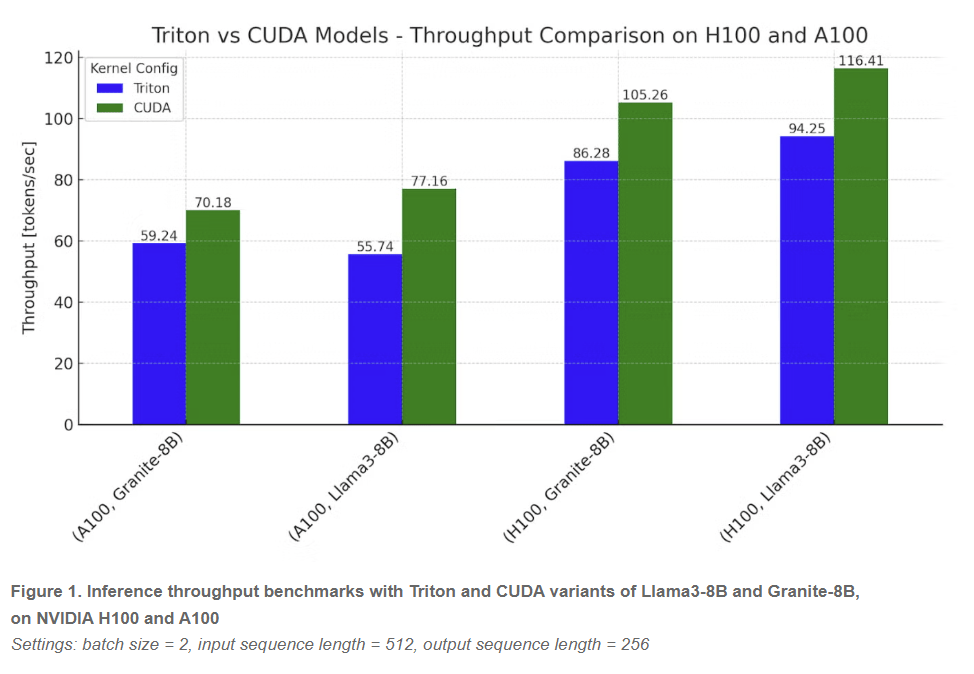
This chart shows that for highly-tuned, production-grade kernels, an expert CUDA implementation can still yield superior performance—in this case, between 15% and 23% higher throughput. This is the trade-off in action: the final percentile of performance often requires dropping down to the metal with CUDA.
The article below provides additional benchmark data for matrix multiplication and fused softmax, reinforcing this point.
Triton Kernel Programming vs CUDA: The New Way to Write Deep ...
This article presents representative benchmark numbers for common deep learning operations.
Please review the tables in the section titled Benchmark: CUDA vs Triton. Note how Triton is often competitive with or faster than hand-tuned CUDA but can still be slower than vendor-supplied libraries like cuBLAS that use hardware-specific features like Tensor Cores directly.
The Kernel Engineer's Decision Framework
You now have a clear picture of the landscape. As a GPU kernel engineer, your job is not to be a zealot for one tool but to select the most effective one for the job. Here is a practical framework for making that decision.
Triton Kernel Programming vs CUDA: The New Way to Write Deep ...
This final section of the article provides an excellent, pragmatic guide on when to choose each tool.
Read the section When to Choose Triton Over CUDA?. This summarizes the decision-making process based on the specific engineering goal.
To summarize the key points:
- Start with
torch.compile: Always begin by using the highest-level tool available. PyTorch's JIT compiler is incredibly powerful and can often fuse operations and generate high-performance Triton kernels automatically. - Use Triton for Rapid Development and Fusion: When
torch.compileis insufficient or you need a custom operator not available in standard libraries, Triton is your go-to. It's perfect for quickly prototyping new kernels, implementing complex kernel fusions (e.g., attention variants, custom normalization layers), and achieving 80-95% of peak performance with a fraction of the development effort. - Use CUDA for Absolute Peak Performance: When you have profiled your application and identified a single kernel that is the overwhelming bottleneck, and you need to squeeze out every last drop of performance, it's time to write raw CUDA. This allows you to manually control memory layouts, instruction scheduling, and directly use hardware intrinsics (like
wmmafor Tensor Cores) in ways that a compiler might not discover automatically. This is the "last mile" of optimization.
Most expert kernel engineers adopt a hybrid approach, using Triton for the majority of their custom kernels and reserving CUDA for the few mission-critical parts where the additional development time is justified by the performance gains.
Conclusion: Your Path Forward
This lesson concludes not only our module on integrating kernels but the entire course. We have embarked on an intensive journey, beginning with the fundamental building blocks of C++ and computer architecture, and progressively building up to the intricate world of high-performance GPU programming. You have learned the language of the hardware with CUDA—mastering its memory hierarchy, execution model, and optimization patterns for critical algorithms like parallel reductions and matrix multiplication. Finally, you have ascended to a higher level of abstraction with Triton, understanding how to harness its power to balance productivity and performance.
Key Takeaways from Today's Lesson:
- Triton vs. CUDA is a trade-off: You exchange the ultimate low-level control of CUDA for the immense developer productivity and automated optimizations of Triton.
- Productivity: Triton's Python-based, block-centric model drastically reduces boilerplate and cognitive overhead compared to CUDA's thread-centric C++ approach.
- Performance: For many problems, Triton's compiler produces code with performance comparable to hand-written CUDA. However, for the absolute peak performance, expert-tuned CUDA that directly manipulates hardware features remains the gold standard.
- The Engineer's Workflow: A pragmatic approach involves starting with high-level compilers (
torch.compile), moving to Triton for custom kernels, and finally resorting to CUDA for the most critical, "last-mile" optimizations.
You set out to master high-performance computing in AI, and you have now built the foundational knowledge required of a GPU Kernel Engineer. The concepts covered in this course—GEMM optimization, memory coalescing, warp-level primitives, tiling strategies, and performance profiling—are the very topics that dominate technical interviews and daily work in this field.
Your journey is far from over, but you are now equipped for the next stage. The path forward involves applying this knowledge:
- Build: Challenge yourself by re-implementing kernels from influential papers. Try building a FlashAttention kernel from scratch, or optimize parts of the 3D Gaussian Splatting rasterizer.
- Explore: Dive into the source code of projects like PyTorch or NCCL to see how these principles are applied in production systems.
- Specialize: Deepen your expertise in a specific domain, whether it's optimizing inference for large language models, accelerating training for generative models, or working on graphics rendering pipelines.
Congratulations on completing this demanding course. You have demonstrated the focus and dedication required for a career in low-level, high-performance systems. The field needs engineers with your skills to build the future of AI, and you are now well on your way.