Introduction
In our previous lesson, we established the standard "Ahead-of-Time" (AOT) workflow for building and packaging custom CUDA kernels into installable PyTorch extensions using setup.py. This method gives you maximum control by allowing you to write raw CUDA C++, but as you've likely gathered, it's a verbose process that demands meticulous attention to low-level hardware details.
This lesson introduces a powerful alternative: Triton. Developed by OpenAI, Triton is a Python-embedded language for writing GPU kernels. It aims to strike a balance, offering significantly higher productivity than raw CUDA without sacrificing the performance needed for state-of-the-art AI workloads. We will explore Triton's high-level programming model and its core abstractions, which allow you to think about parallel computation in a more structured way. This will lay the conceptual groundwork for writing our own high-performance Triton kernels in the next lesson.
The Performance-Productivity Trade-off
To appreciate why Triton exists, it's essential to understand the landscape of GPU programming. On one end, you have high-level frameworks like PyTorch running in "eager mode." This is incredibly flexible and easy for research, but it can be inefficient. Each operation (e.g., a matrix multiplication followed by an addition and then a ReLU) often triggers a separate kernel launch, leading to significant overhead from repeatedly reading and writing data to the slow, off-chip global memory (DRAM).
On the other end, you have raw CUDA C++. This gives you the power to "fuse" those operations into a single kernel, minimizing global memory traffic and maximizing hardware utilization. As we've seen throughout this course, however, achieving this performance requires manually managing memory coalescing, shared memory tiling, and thread synchronization—complex tasks even for experts.
Triton was created to bridge this gap. The following article provides an excellent overview of this motivation.
Introduction to GPU Programming with Triton - Medium
This article from Medium provides context on the challenges that led to Triton's development.
Please read the introduction and the section titled So why Triton??. Focus on the described trade-off between the flexibility of PyTorch's eager execution and the performance of custom CUDA.
Triton's solution is to provide a high-level, Pythonic interface that compiles down to highly optimized machine code. It automates many of the most tedious aspects of CUDA programming, allowing you to focus on the high-level logic of your algorithm. The official OpenAI announcement provides a concise summary of the challenges Triton automates.
Introducing Triton: Open-source GPU programming for neural ...
This is the original blog post from OpenAI introducing Triton.
Read the section The challenges of GPU programming. Pay close attention to the table that compares the manual work required in CUDA versus the automated approach in Triton.
As you can see, Triton automates memory coalescing and the management of shared memory and scheduling within a Streaming Multiprocessor (SM). However, it leaves the high-level strategy—how to partition the overall problem across different SMs—to you. This is the core of its design philosophy.
The Triton Programming Model: From Threads to Programs
The most fundamental shift when moving from CUDA to Triton is the unit of programming.
- In CUDA, you write code from the perspective of a single thread. You use
threadIdxandblockIdxto compute a unique global index and determine which single data element that thread is responsible for. - In Triton, you write code from the perspective of a "program instance." Each program instance is responsible for computing a block (or tile) of data.
The Triton compiler then automatically handles the parallelization within that block, mapping the work to the underlying threads and warps on an SM. You define the logic for the tile, and the compiler manages the workers.
This block-centric model is illustrated below. On the left, a CUDA grid is composed of blocks of individual threads. On the right, a Triton grid is composed of program instances, each of which operates on a range, or tile, of data.

This shift simplifies the code immensely. Instead of complex index arithmetic for a single thread, you use high-level, NumPy-like operations on entire blocks of data.
To understand this model better, it's helpful to see how it's realized in code.
Introduction to GPU Programming with Triton - Medium
The article you read earlier also provides a clear breakdown of Triton's core abstractions.
Please read the sections The Triton Programming Model, Programs instead of Threads, Explicit Memory Control, and Compiler-Driven Optimization. This will explain the concepts of program_id, load/store, and the compiler's role.
Key Abstractions in Practice
Let's distill the core abstractions you just read about:
-
@triton.jit: A Python decorator that marks a function as a Triton kernel. The Triton compiler will parse this function's source code to generate GPU code. -
tl.program_id(axis): This function returns the unique ID of the current program instance along a specified axis. This is the replacement for CUDA'sblockIdx. If you launch a 1D grid of 100 program instances,tl.program_id(axis=0)will return a value from 0 to 99 for each instance. -
Pointer Arithmetic and Blocks: Kernel arguments holding tensor data are passed as pointers to the beginning of the tensor in global memory. To work with data, you create blocks of offsets and add them to the base pointer.
tl.arange(start, end): Creates a 1D block of constant values. For example,tl.arange(0, 128)creates a block[0, 1, 2, ..., 127]. This is the primary tool for defining the shape of your tile.- Vectorized Operations: Once you have a block of offsets, you can perform vectorized operations. For instance,
base_ptr + tl.arange(0, 128)creates a block of 128 pointers.
-
tl.load(pointers, mask)andtl.store(pointers, values, mask): These are the fundamental memory operations in Triton.tl.loadtakes a block of pointers and returns a block of values loaded from memory.
tl.storetakes a block of pointers and a block of values and writes the data to memory.
- The
maskargument is crucial for safety. It takes a block of booleans and ensures that loads or stores only happen where the mask isTrue. This is Triton's elegant way of handling boundary conditions, replacing theif (idx < N)checks common in CUDA.
The OpenAI blog post you looked at earlier contains a side-by-side code snippet that perfectly contrasts the CUDA and Triton styles for a simple vector addition. The Triton version clearly demonstrates the block-centric operations we've just discussed. Please review it again with these abstractions in mind. You can find it in the "Programming model" section of the resource "Introducing Triton: Open-source GPU programming for neural networks" (LINK).
Mapping the Model to Hardware
Your interest in low-level systems makes it important to connect these abstractions to the physical GPU architecture. Triton's model is designed around a hierarchical mapping of work to hardware.
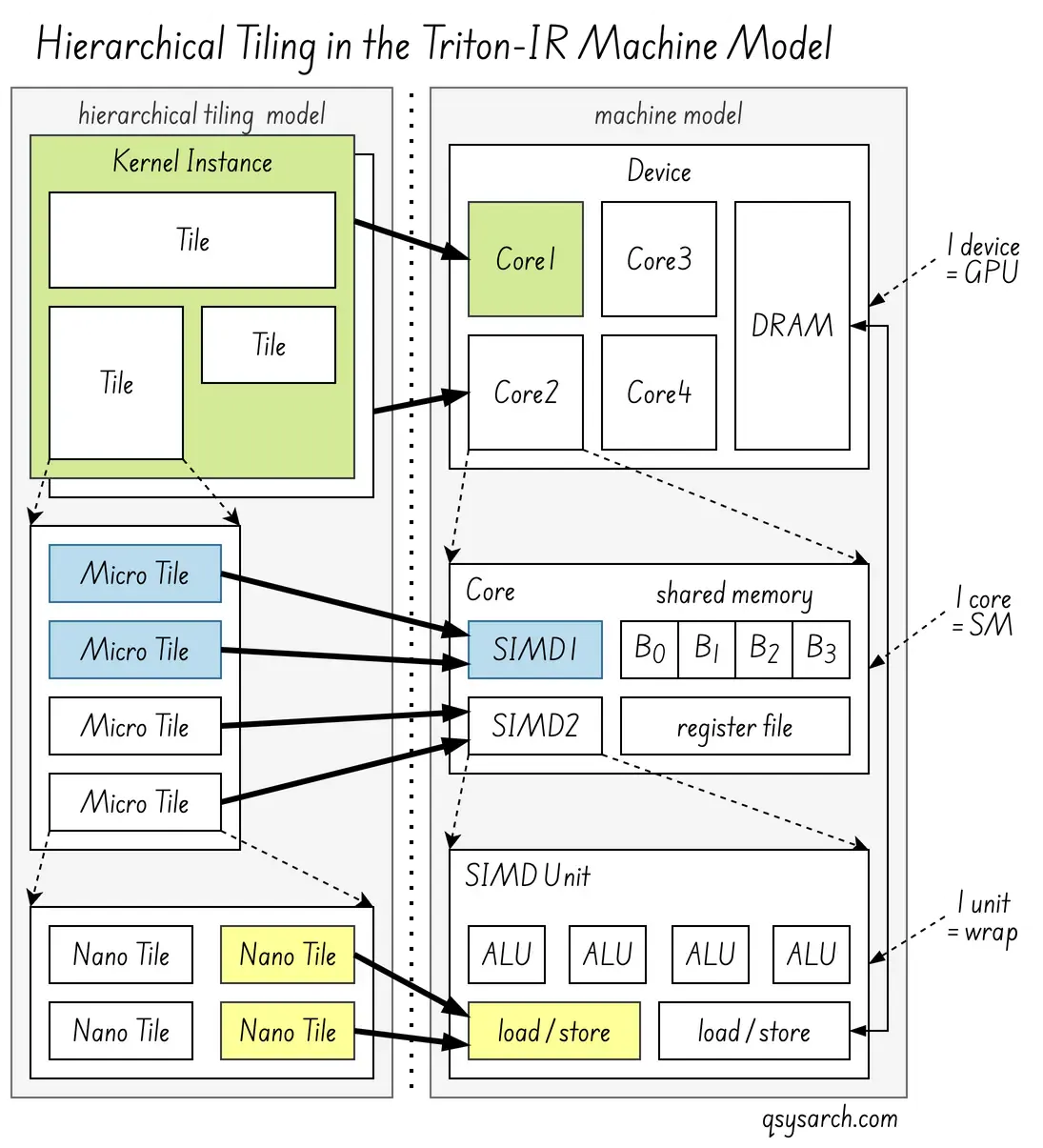
Here's how to interpret this diagram:
-
Kernel Instance ↔ Core (SM): Your Triton kernel code defines one Kernel Instance. This instance is launched on a specific GPU Core, which is a Streaming Multiprocessor (SM). You use
tl.program_idto determine which overall chunk of the problem this instance is solving. -
Tile ↔ Shared Memory: The program instance operates on a large Tile of data. Conceptually, this tile is the primary unit of work. The Triton compiler is smart enough to use the fast on-chip shared memory (SRAM) to stage this data, especially for computationally-intensive operations like
tl.dot, maximizing data reuse. -
Micro/Nano Tile ↔ SIMD Units/ALUs: The compiler further decomposes the main tile into smaller Micro Tiles and Nano Tiles. These are the units of work that get scheduled onto the SIMD Units and individual ALUs within the SM, often corresponding to operations executed by a single warp.
This hierarchical decomposition allows the Triton compiler to manage the complex scheduling and data movement within an SM automatically, which is precisely what makes it so much more productive than writing raw CUDA. You define the work at the Tile level, and the compiler handles the rest of the hierarchy.
To see these concepts brought together, let's watch the creator of Triton, Philippe Tillet, explain a simple vector addition kernel.
THE TRITON LANGUAGE | PHILIPPE TILLET
This segment from a PyTorch talk features Philippe Tillet, the creator of Triton, demonstrating a basic kernel.
Please watch the section from this timestamp. He walks through a complete vector addition example, explaining how pointers are constructed, data is loaded with masks, computation is performed, and results are stored.
The video demonstrates exactly the abstractions we've covered: using program_id to find the start of a large chunk of work, arange to define the offsets for a tile within that chunk, and masked load/store operations to move data.
Conclusion
In this lesson, we have explored the "why" and "what" of Triton. You've learned that it exists to resolve the tension between the high performance of CUDA and the high productivity of standard Python frameworks. We've dissected its core programming model, which shifts the developer's focus from individual threads to blocks of data, simplifying code and automating complex hardware optimizations.
Key Takeaways:
- Block-Centric Model: Triton kernels are written as "program instances" that operate on tiles of data, not as individual threads operating on single elements.
- Core Abstractions: The model is built on
tl.program_idfor indexing blocks,tl.arangefor defining tile shapes, and maskedtl.load/tl.storefor safe, vectorized memory access. - Compiler Automation: The Triton compiler automates challenging tasks like memory coalescing, shared memory management, and intra-SM scheduling, which you would otherwise handle manually in CUDA.
- Hardware Mapping: The Triton model has a clear hierarchical mapping to the GPU architecture, from kernel instances on SMs down to nano-tiles on ALUs.
We have built a strong conceptual foundation. In our next lesson, we will put this knowledge into practice by implementing a more complex and practical AI kernel in Triton. We will then analyze its performance and compare the development experience directly to that of writing an equivalent kernel in raw CUDA.