Introduction
In our previous lesson, we established the foundational concept of the multigroup approximation. We saw that by partitioning the continuous energy domain into discrete groups, we can manage the complex, rapidly-varying nature of cross sections. You learned how to define group fluxes by integrating the continuous angular flux over an energy group, and critically, how to define flux-weighted group cross sections to preserve reaction rates.
This lesson builds directly on that foundation. Our objective is to derive the multigroup transport equations and define group-averaged cross sections, explaining the role of weighting spectra. We will take the continuous-energy Boltzmann transport equation and formally integrate it, term by term, over an arbitrary energy group. This process will transform the single, complex integro-differential equation into a more manageable, coupled system of equations—one for each energy group. The most interesting part of this derivation lies in the scattering term, which will reveal how the different energy groups "communicate" with each other.
Deriving the Multigroup Equations
Let's begin with the familiar steady-state, continuous-energy transport equation:
Our goal is to derive an equation for the group flux, , which we defined as:
To do this, we will integrate every term of the transport equation over the energy interval of group , from its lower bound to its upper bound .
A clear, step-by-step derivation of this process is presented in the following resource.
IntroductionNeutronTransport (2).pdf
This document from HAL archives provides a concise mathematical walkthrough of the derivation of the multigroup equations.
Start from the section titled "Integrating the transport equation (1)". Read through the next two pages to see how each term of the Boltzmann equation is handled. Pay close attention to how the single scattering integral is transformed into a sum over all source groups, g'. Focus on the definitions presented for the multigroup cross section and the multigroup transfer matrix.
Let's break down the integration of each term, as shown in the document.
-
Streaming Term:
Since the spatial gradient operator and the direction vector are independent of energy, we can pull them outside the integral:The streaming term retains its form, but now applies to the group flux .
-
Collision Term:
This is where our definition of the flux-weighted group cross section from the last lesson becomes essential. To preserve the total collision rate in the group, we define the group total cross section as:Therefore, the integrated collision term becomes:
Note that for simplicity, it's often assumed that the energy spectrum shape within a group is independent of angle, so the cross sections are weighted with the scalar flux instead of the angular flux . This makes the group cross section independent of .
-
External Source Term:
Similar to the group flux, we define the group source as the integral of the continuous-energy source over the group's energy range: -
Scattering Source Term: This is the most involved term. We start with the integrated expression:
The key insight is to break the inner integral over the continuous source energy into a sum of integrals over all energy groups .
This expression represents the total rate of particles scattering into group from all possible source groups . We can now define a group-to-group scattering cross section, , which represents the cross section for scattering from group to group . Similar to the total cross section, this is a flux-weighted average:
The denominator is simply the group flux . With this definition, the entire scattering source term simplifies to:
The Final Multigroup Equations
By assembling all the integrated terms, we arrive at the multigroup transport equation for group :
where we have simplified notation by dropping the explicit dependencies on . This is not just one equation; it is a system of coupled equations, one for each group . The equation for group is coupled to all other groups through the scattering source term. It looks much like the original transport equation, but energy is now a discrete index rather than a continuous variable.
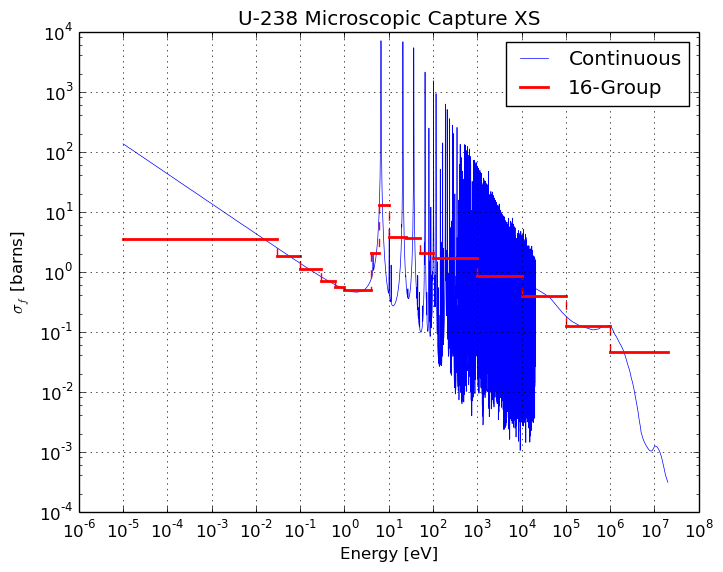
The Role and Challenge of the Weighting Spectrum
There is a subtle but profound circularity in our definitions. Notice that the group constants, like and , are defined using the continuous-energy angular flux as a weighting function or weighting spectrum. However, this flux is the exact solution to the original, continuous-energy problem that we deemed too difficult to solve in the first place!
IntroductionNeutronTransport (2).pdf
This document further explains the crucial dependency of multigroup cross sections on the unknown flux.
Please read the section titled "A second look...". It highlights the key problem: to compute the coefficients for the equation, you need to know the solution. Then, skim the section "Problems with multigroup" to understand the practical implications.
This means that multigroup cross sections are not universal physical constants for a given material; they are problem-dependent. The "correct" group constants for U-238 in a water-moderated thermal reactor core will be different from those for U-238 in a fast-spectrum reactor or a medical accelerator head.
So, how is this paradox resolved in practice?
- Approximation: A reasonable weighting spectrum must be assumed or pre-calculated. This spectrum is chosen to be representative of the type of physics problem being solved. For example, a standard thermal reactor spectrum might be a combination of a slowing-down spectrum and a Maxwell-Boltzmann thermal spectrum.
- Code Systems: Specialized lattice physics codes (like Serpent, DRAGON, or OpenMC in a special mode) are used to solve the continuous-energy transport equation for a simplified, representative geometry (e.g., a single fuel pin cell).
- Generation: The detailed flux solution from this preliminary calculation is then used as the weighting spectrum to condense the vast continuous-energy nuclear data libraries into a set of problem-specific multigroup constants. These constants are then used in the main, large-scale transport code to solve the full problem.
The accuracy of a multigroup calculation is therefore highly dependent on the quality of the weighting spectrum used to generate the group constants.
A Concrete Example: Two-Group Diffusion
To make this abstract system of equations more concrete, let's look at a common, simplified application: the two-group diffusion model. While it uses the diffusion approximation (which we'll study in detail later), it perfectly illustrates the coupled nature of multigroup equations. Here, all neutrons are simplified into just two groups: "fast" and "thermal".
23. Solving the Neutron Diffusion Equation, and Criticality Relations
This MIT OpenCourseWare video demonstrates how to set up and solve the coupled equations for a two-group system. While it focuses on the diffusion equation, the core concept of balancing particle gains and losses between groups is identical to what we've derived.
Watch the following segments: Gains and Losses (Fast Group): The lecturer sets up the balance equation for the fast group. Notice that the gain term is from fission, and a key loss term is scattering out of the fast group. Gains and Losses (Thermal Group): Here, the balance for the thermal group is established. Critically, the only source of neutrons into the thermal group is from particles scattering down from the fast group. This is the coupling term.
In the video, the term represents particles lost from the fast group that become the source for the thermal group. This is a direct, practical example of our general scattering term , where and the sum only has one contributing term, from .
Conclusion
In this lesson, we have taken the critical step from defining the components of the multigroup approximation to formally deriving the multigroup transport equations. You have seen how integrating the continuous-energy Boltzmann equation over discrete energy groups yields a coupled system of equations that are more amenable to numerical solution.
Key Takeaways:
- The multigroup transport equations are derived by integrating the continuous-energy BTE over each energy group.
- This process yields a system of coupled, "one-speed-like" equations, where the group index replaces the continuous energy variable .
- The coupling between groups arises from the group-to-group scattering source term, which describes how particles gain or lose energy and move from a source group to a destination group .
- The multigroup cross sections (, ) are not fundamental constants but are problem-dependent, as their calculation requires a weighting spectrum that approximates the true, unknown flux solution.
Preview of the Next Lesson:
The heart of the multigroup system is the scattering transfer term. In our next lesson, we will focus entirely on the structure and properties of the group-to-group scattering transfer matrix. We will examine the concepts of down-scattering (particles losing energy, e.g., fast to thermal) and up-scattering (particles gaining energy from the medium, important in thermal systems) and see how the structure of this matrix impacts the strategy for solving the multigroup equations.