Introduction
In our last lesson, you learned how to represent sequential games using the extensive form, or game trees. We established the crucial difference between a player's actions (choices at a single node) and their strategy (a complete contingent plan for all their decision nodes). This distinction is the bedrock for what we'll cover today.
While Nash Equilibrium served us well for simultaneous-move games, it has a significant weakness when applied to sequential games. It can sometimes identify "equilibria" that are not entirely rational, as they may rely on threats that a player would never actually carry out if called upon. Your interest in strategy as a tool for "meaningful planning" requires us to be more precise and discard these implausible outcomes.
This lesson addresses that problem by introducing a more refined equilibrium concept. Your learning outcome is to define subgames and Subgame Perfect Nash Equilibrium (SPNE). By the end of this lesson, you will understand how to break a larger game into smaller, self-contained "subgames" and how to use this structure to identify only those equilibria that are credible and rational at every stage of play.
1. The Flaw in Nash Equilibrium: Non-Credible Threats
Let's start by seeing why we need a concept stronger than Nash Equilibrium. Consider the sequential game between Microsoft (Player 1) and Mozilla (Player 2) shown below. Microsoft first chooses a technology platform, '.net' (N) or 'java' (J). Mozilla observes this choice and then decides on its own platform.

If you convert this game tree into its normal form (as shown in the image) and find the pure-strategy Nash Equilibria, you'll find three of them:
- (N, NJ)
- (J, JN)
- (J, JJ)
Now, let's think about the equilibrium (J, JJ). This strategy profile says:
- Microsoft's strategy is to choose Java.
- Mozilla's strategy is: "If Microsoft chooses .net, I'll choose Java. If Microsoft chooses Java, I'll choose Java."
Is this truly a rational outcome? Look at the sub-part of the game that starts after Microsoft chooses '.net'. In this scenario, Mozilla is faced with a choice between N (payoff 2) and J (payoff 1). A rational Mozilla would clearly choose N. The strategy (J, JJ) requires Mozilla to plan to choose J, an irrational move in that part of the game. Microsoft "believes" this threat, and therefore chooses J to get a payoff of 3 instead of 2. But the threat is non-credible. Mozilla would have no incentive to carry it out.
This is the core problem: a Nash Equilibrium only requires strategies to be best responses on the equilibrium path. It doesn't require them to be rational off the equilibrium path. We need a way to enforce rationality everywhere.
18. Imperfect information: information sets and sub-game perfection
Professor Ben Polak from Yale University explains this exact issue. He demonstrates how the standard Nash Equilibrium concept can produce outcomes that are inconsistent with logical, step-by-step reasoning in a sequential game.
Watch the segment from 44:12 to 50:04. Focus on how he identifies certain Nash Equilibria as 'implausible' or 'bogus' because they clash with the logic of backward induction.
2. Formalizing the "Game Within a Game": Subgames
To fix the problem of non-credible threats, we need a way to formally identify all the smaller "games within the game" and check for rational play in each one. These are called subgames.
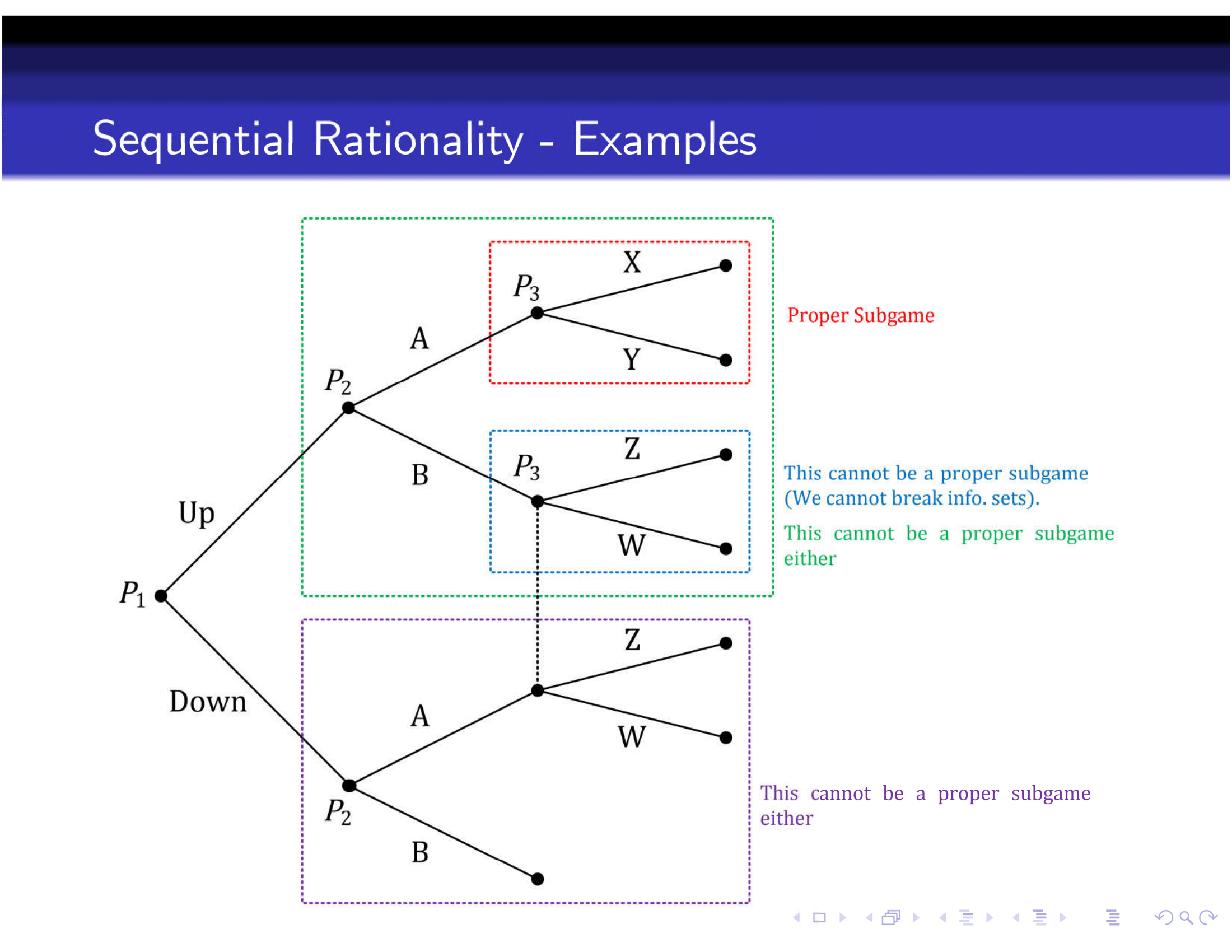
A subgame is a part of the original game that can stand alone as a game in its own right. For a part of a game tree to be a valid subgame, it must satisfy three strict conditions.
18. Imperfect information: information sets and sub-game perfection
Professor Polak provides a formal definition of a subgame, illustrating the three properties it must satisfy. Pay close attention to the examples he gives of what is and what is not a subgame.
Watch the segment from 01:03:44 to 01:10:23. Notice how information sets play a crucial role in determining what constitutes a valid subgame.
The three properties of a subgame are:
- It starts at a single initial node. The subgame must have a unique starting point that is not part of a larger information set.
- It contains all successors of that node. If a node is in the subgame, all the branches and subsequent nodes that follow it must also be in the subgame, all the way to the terminal nodes.
- It does not break up any information sets. If a node is part of an information set containing multiple nodes, you cannot form a subgame that includes some of those nodes but not others. The entire information set must be contained within the subgame.
For your reference, here is the formal mathematical definition of a subgame, which aligns with your interest in a rigorous approach.
Undergraduate Game Theory Lecture Notes
This document from Caltech provides a concise, formal definition of a subgame. This will solidify the concept with the mathematical precision you appreciate.
Read the paragraph that begins 'A subgame of a game G...'. It's the first paragraph in the section titled 'Subgames and subgame perfect equilibria'. Compare this formal definition with the three properties discussed in the video.
In essence, a subgame starts at any decision node that is a "singleton" information set—meaning the player at that node knows with certainty the exact history of moves that led there.
3. Subgame Perfect Nash Equilibrium (SPNE)
Now that we can identify subgames, we can define our refined equilibrium concept. The idea is simple but powerful: a strategy profile is only credible if it prescribes rational behavior (i.e., a Nash Equilibrium) in every single one of these subgames.
Definition: Subgame Perfect Nash Equilibrium (SPNE)
A strategy profile is a Subgame Perfect Nash Equilibrium if it specifies a Nash Equilibrium in every subgame of the original game.
Since the entire game is itself a subgame, an SPNE is, by definition, also a Nash Equilibrium. However, the reverse is not true. SPNE is a refinement of Nash Equilibrium; it is a stricter set of criteria that filters out the "implausible" NE we identified earlier.
18. Imperfect information: information sets and sub-game perfection
Let's return to the Yale lecture, where Professor Polak formally defines Subgame Perfect Equilibrium and applies it to the earlier examples, showing how it isolates the single credible outcome.
Watch from 01:10:27 to 01:15:55. Focus on how the definition of SPNE forces us to check for Nash Equilibria within each subgame, effectively eliminating non-credible threats.
Let's apply this to our Microsoft vs. Mozilla game.
The game has three subgames:
- The entire game itself.
- The subgame starting after Microsoft chooses '.net'.
- The subgame starting after Microsoft chooses 'java'.
Let's test the Nash Equilibrium (J, JJ):
- Is it a NE in the '.net' subgame? In this subgame, Mozilla chooses between N (payoff 2) and J (payoff 1). The NE is for Mozilla to play N. The strategy JJ prescribes playing J. Since J is not a NE in this subgame, (J, JJ) is not an SPNE.
- Is it a NE in the 'java' subgame? Here, Mozilla chooses between N (payoff 0) and J (payoff 1). The NE is for Mozilla to play J. The strategy JJ prescribes J, which is consistent.
- Is it a NE in the whole game? Yes, we already established that.
Because the strategy profile (J, JJ) fails to be a Nash Equilibrium in even one subgame, it is discarded by the SPNE refinement. A similar analysis would rule out (J, JN). The only strategy profile that survives this test is (N, NJ), which is the unique SPNE of this game.
To further solidify your understanding, the following resource provides another excellent walk-through.
Chapter 11 Subgame-Perfect Nash Equilibrium
These notes from an MIT course provide a very clear definition of SPNE and work through another example. This textual explanation will complement what you've seen in the video.
Read the first part of the chapter, from the start up to (and including) Figure 11.4. Pay attention to how they first compute the Nash Equilibrium of the subgame, and then use that outcome to solve the rest of the game.
4. A Practical Note: How to Write an SPNE
Remember from the last lesson that a strategy is a complete contingent plan. This is especially important when writing down an SPNE. You must specify the chosen action for every decision node, not just the ones that are reached on the equilibrium path. This is because the actions specified for off-path nodes are what make the on-path actions rational.
Game Theory 101 (#18): How NOT to Write a Subgame Perfect Equilibrium
This short video from William Spaniel makes this crucial point very clearly. It explains why simply stating the outcome of the game is not enough to define the equilibrium.
Watch the segment from 01:20 to 03:15. The key takeaway is that the off-path actions are the 'threats' that enforce the equilibrium path choices.
For the Microsoft-Mozilla game, the SPNE is (N, NJ).
- For Microsoft: N
- For Mozilla: (N, J) which means "Choose N if Microsoft plays .net, and choose J if Microsoft plays Java."
This is a complete specification of the strategies that constitute the Subgame Perfect Nash Equilibrium.
Conclusion
Today, you've taken a major step in analyzing sequential games. You've seen that the standard Nash Equilibrium concept can be too broad, admitting solutions that rely on empty, non-credible threats. By learning to identify subgames, you can now apply the more powerful and discerning concept of Subgame Perfect Nash Equilibrium.
Key Takeaways:
- Nash Equilibrium in sequential games can be flawed because it doesn't guarantee rational play at decision nodes that are off the equilibrium path.
- A subgame is a self-contained part of a larger game that begins at a single, known decision node and includes all subsequent moves.
- A Subgame Perfect Nash Equilibrium (SPNE) is a strategy profile that constitutes a Nash Equilibrium in every subgame.
- SPNE serves as a refinement of Nash Equilibrium, eliminating outcomes that rely on non-credible threats and ensuring behavior is rational at every possible stage of the game.
You have now defined the solution concept for sequential games. In the next lesson, you will learn the main algorithm used to find it: backward induction. This technique will allow you to systematically solve any finite game of perfect information by starting at the end and reasoning your way back to the beginning.