Introduction
Welcome to a new module that will significantly expand our analytical toolkit. In all the games we've studied so far—from the Prisoner's Dilemma to infinitely repeated games—we've operated under a crucial assumption: complete information. This means every player knows the rules of the game, the possible strategies, and, most importantly, the exact payoffs every other player receives for every possible outcome.
In our last lesson, we saw how the "shadow of the future" in repeated games could lead to a vast array of equilibrium outcomes, as described by the Folk Theorem. However, the real world often presents an even deeper layer of uncertainty. What if you don't know your opponent's true motivations, costs, or capabilities?
This lesson is our first step into this more complex and realistic domain. Our goal is to distinguish between two fundamental types of uncertainty: imperfect information and incomplete information. Mastering this distinction is not just a matter of terminology; it is essential for correctly modeling and analyzing strategic situations where players don't know everything, which aligns perfectly with your interest in using game theory for planning in a complex world.
1. The Information Landscape: A Three-Tiered Distinction
To understand incomplete information, we first need to place it in context with other informational structures we've encountered. Game theorists classify information in games with a high degree of precision.
Let's watch a video that lays out the core definitions clearly.
Game Theory 101 (#63): Incomplete Information
This video by William Spaniel provides an excellent introduction to the key informational structures in game theory. It begins with concepts we've already seen and uses them to introduce the new idea of incomplete information.
Watch the video from 00:15 to 04:09. As you watch, focus on identifying the defining feature of each type of information: Perfect and Complete Information: What two things do players know? Imperfect but Complete Information: What do players not know, and what do they still know? Incomplete Information: What is the new source of uncertainty here? Note the examples given. Finally, pay close attention to the explicit summary of the difference between imperfect and incomplete information.
Let's crystallize the key ideas from the video:
- Perfect Information: Each player, when making a decision, is aware of the full history of the game up to that point. This applies to sequential games like Chess or the extensive-form games we solved using backward induction.
- Imperfect Information: At least one player is not aware of the full history of the game. The most common example is a simultaneous-move game. When you choose your action in the Prisoner's Dilemma, you don't know which action your opponent has chosen. The uncertainty is about another player's action. The term for this is strategic uncertainty.
- Incomplete Information: At least one player is uncertain about some fundamental aspect of the game itself—most commonly, another player's payoffs or preferences. You don't know how much they value a certain outcome. The uncertainty is about another player's type. The term for this is external uncertainty.
The distinction is critical:
- Imperfect Information -> Uncertainty about Actions
- Incomplete Information -> Uncertainty about Payoffs/Types
2. Visualizing Information in Game Trees
These abstract concepts become much clearer when we see how they are represented in the extensive form, or game trees.
Imperfect Information and Information Sets
In a sequential game tree, we represent imperfect information using an information set. This is a collection of decision nodes that a player cannot distinguish between. If two nodes are in the same information set (usually shown by drawing a dotted line or an oval around them), the player at that set does not know which of those nodes they are actually at.
Think about a simultaneous-move Prisoner's Dilemma represented sequentially. We can draw it as Player 1 moving first, then Player 2. However, to make it simultaneous, we put Player 2's two possible decision nodes (the one following Player 1's 'Cooperate' and the one following 'Defect') into a single information set. This visually shows that Player 2 makes their choice without knowing what Player 1 did.
Incomplete Information and "Nature"
To model incomplete information, game theorists introduced a clever device: a fictional, non-strategic player called "Nature". Nature makes a random move at the start of the game that determines a player's "type" (e.g., their payoffs). The other players may not observe Nature's move, which creates the uncertainty about the player's type.
For example, in a negotiation, Nature might "decide" with 50% probability whether your opponent is a "patient" type (low cost of waiting) or an "impatient" type (high cost of waiting). You know the probabilities, but you don't know the actual outcome of Nature's move.
Understanding Incomplete and Imperfect Information in Game Theory
This video illustrates these concepts using game trees, providing a visual grammar for information.
Watch from 00:09 to 03:00. Focus on: How perfect information is represented (each information set is a single node). How imperfect information is represented (an information set with multiple nodes). How incomplete information is modeled using a move by 'Nature' that generates asymmetric information about a player's 'type'.
3. The Harsanyi Transformation: A Unifying Insight
At first glance, imperfect and incomplete information seem like fundamentally different problems requiring different tools. However, the Nobel laureate John Harsanyi provided a profound insight that elegantly connects them. This is a beautiful piece of theory that you, with your interest in the mathematical underpinnings of physics, might appreciate.
Harsanyi showed that any game of incomplete information can be transformed into an equivalent game of complete but imperfect information.
How does this work? Instead of saying "I don't know your payoffs" (incomplete information), we rephrase the problem as "I don't know what type Nature chose for you at the beginning of the game" (imperfect information about Nature's move). By adding Nature as a player, we restore the assumption of complete information—everyone knows the rules and payoffs for all possible "types"—but we introduce imperfect information about Nature's initial move.
[PDF] Games of Incomplete Information
These lecture notes from Stanford University formalize Harsanyi's key insight. This reading will give you the formal economic perspective on this transformation.
Please read the section titled 'Remark 1' on page 2. It's a short but dense paragraph. Focus on this core sentence: 'Games of incomplete information can be thought of as games of complete but imperfect information where nature makes the first move...'. The diagram below it shows exactly this: Nature moves first, creating two possible subgames, but the entrant doesn't know which one they are in.
This transformation is incredibly powerful. It allows us to use a single, unified framework to analyze a much wider class of games. The games we will study in this module, known as Bayesian Games, are built directly on this foundation.
Let's look at a diagram that puts both concepts together in a single game.
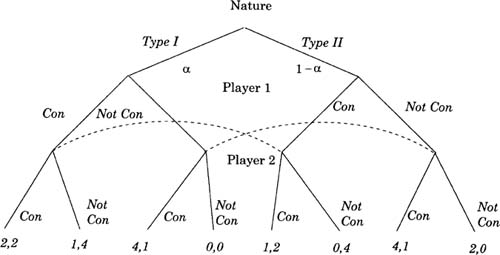
This diagram is a perfect illustration of the Harsanyi transformation in action. We have a game that is technically one of complete information (all rules and payoffs for all types are specified) but imperfect information (Player 2 has two information sets where they are uncertain about the history).
Conclusion
This lesson drew a crucial line between two types of uncertainty that are often confused. Understanding this difference is the necessary first step before we can build models that capture the strategic complexities of the real world.
Key Takeaways:
- Imperfect Information is uncertainty about the actions of other players. It's often called strategic uncertainty and is represented by information sets containing multiple nodes in a game tree.
- Incomplete Information is uncertainty about the fundamental payoffs, preferences, or "types" of other players. It's often called external uncertainty and is modeled using an initial move by a random player, "Nature".
- The Harsanyi Transformation is a foundational insight in game theory: games of incomplete information can be converted into equivalent games of complete but imperfect information. This allows for a unified method of analysis.
In our next lesson, we will use this framework to formally define the components of a Bayesian game: players, types, beliefs, and state-dependent payoffs. We will then be ready to define a new equilibrium concept, the Bayesian Nash Equilibrium, which is the extension of Nash's idea to these more complex informational environments.