Introduction
In our last lesson, you mastered the "how" of mixed strategies by learning the algorithm to calculate a mixed-strategy Nash equilibrium (MSNE). We saw that the calculation hinges on the indifference principle: you select your probabilities to make your opponent indifferent between the actions they are mixing. This might have felt like a clever mathematical trick.
Today, we move from calculation to interpretation. The probabilities we solve for in an MSNE aren't just abstract numbers; they represent fundamental concepts in strategic thinking. This lesson will unpack what these probabilities mean. Your learning outcome is to interpret mixed-strategy equilibria as probability distributions over actions and beliefs about others' play.
We will explore two primary interpretations:
- A mixed strategy as a literal probability distribution over a player's own actions.
- A mixed strategy as a player's belief about their opponent's actions.
We'll also touch on a third interpretation related to large populations, which connects game theory to fields like statistical physics and evolutionary biology.
Mixed Strategies as Probability Distributions
Let's start by formalizing what a mixed strategy is. As you've seen in the calculations, it's a set of probabilities assigned to a player's pure strategies.
This section from Martin Osborne's textbook, "An Introduction to Game Theory", provides the formal definition of a mixed strategy. This rigor will be the foundation for our interpretations.
Please read Section 4.3.1, 'Mixed strategies'. Below the heading, review the formal definition. It's a short but precise definition.
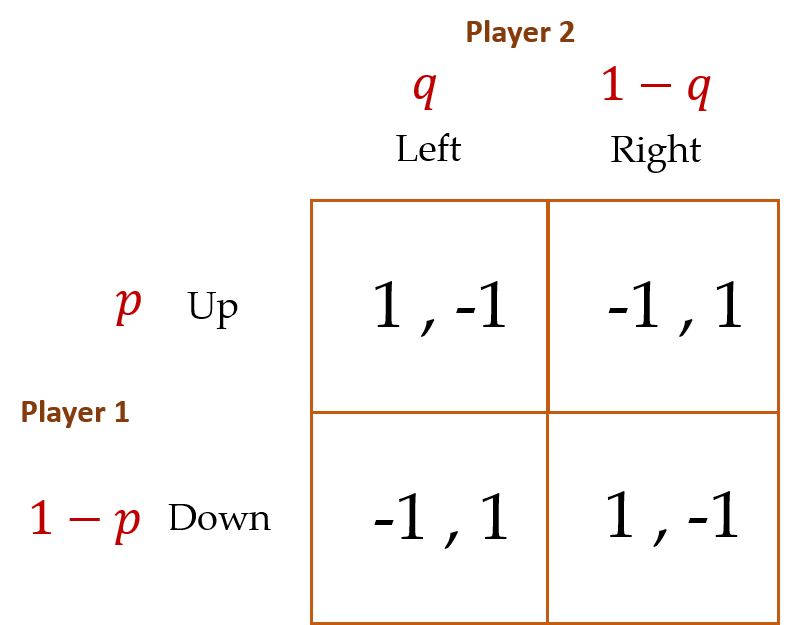
As the text states, a mixed strategy for a player is simply a probability distribution over their set of actions. If Player 1 has actions {Up, Down}, a mixed strategy is a function that assigns a probability to each, for instance, and , where .
The payoffs we've been using are assumed to be Bernoulli payoffs, meaning a player's preference over lotteries (which is what a mixed strategy creates) can be represented by the expected value of these payoffs.
Given this formal definition, we can now explore our first and most direct interpretation.
Interpretation 1: Deliberate Randomization
The most straightforward way to understand a mixed strategy is that players are literally and intentionally randomizing their choices. A player with an equilibrium strategy would, in effect, use a randomizing device—like a weighted coin or a computer program—that selects their first action 70% of the time and their second action 30% of the time.
This interpretation is most natural in purely confrontational, zero-sum games where being predictable is a significant disadvantage.
GTO-2-03: Computing Mixed-Strategy Nash Equilibria
This video from 'Game Theory Online' explains why a player would randomize in a game like Matching Pennies. It frames this interpretation as an attempt to 'confuse' the opponent.
About eight minutes in, watch the randomization segment. Focus on the explanation of why unpredictability is essential in this type of game.
Mixed Strategies as Beliefs
Deliberate randomization makes sense for Matching Pennies, but what about coordination games like the Battle of the Sexes? In such games, the players want to coordinate, so actively trying to "confuse" each other seems counterproductive. This suggests we need a more nuanced interpretation.
Interpretation 2: Mutually Consistent Beliefs
In this view, a mixed strategy doesn't necessarily describe what a player does, but rather what their opponent believes they will do.
- Player 1's mixed strategy, with probability for 'Up', represents Player 2's belief that Player 1 will choose 'Up' with probability .
- Player 2's mixed strategy, with probability for 'Left', represents Player 1's belief that Player 2 will choose 'Left' with probability .
A mixed-strategy Nash equilibrium is then a state of mutually consistent beliefs. My belief about you justifies my actions, and your belief about me justifies your actions.
To formalize this, we can define a belief as a probability measure over the other players' actions.
[PDF] Lecture 3: The Nash Equilibrium and Mixed Strategies 1 ...
These MIT lecture notes offer a formal definition of a 'belief' in game theory, grounding this interpretation in precise mathematical language.
Read the first two paragraphs of Section 4, 'Rationalizability', covering rationalizability and beliefs, up to and including the definition of a belief.
Now, let's see how this "belief" interpretation works in practice.
10. Mixed strategies in baseball, dating and paying your taxes
In this segment of the Yale lecture, Professor Polak applies the 'belief' interpretation to the Battle of the Sexes game, where it provides a much more intuitive explanation for the mixed strategy equilibrium than 'deliberate confusion'.
Watch the segment on interpreting mixed strategies. Pay close attention to how he re-frames the mixed strategy probabilities as statements about each player's belief about the other's actions.
The Unifying Role of the Indifference Principle
How can a mixed strategy be both a distribution of actions and a system of beliefs? The two interpretations are linked by the very indifference principle you used for your calculations.
Let's reason from Player 1's perspective, holding a belief about Player 2's actions.
- If Player 1's belief leads to a higher expected payoff for their 'Up' action (i.e., ), they will play 'Up' with certainty. Their best response is a pure strategy.
- It's only when their belief is precisely the one that makes them indifferent () that they are willing to play a mixed strategy themselves. Any mix becomes a best response.
Therefore, for Player 1 to play a mixed strategy, their belief about Player 2 must be the exact equilibrium strategy . Symmetrically, for Player 2 to play a mixed strategy, their belief about Player 1 must be .
An MSNE is the unique point where Player 1's chosen probability distribution is precisely the belief Player 2 needs to hold to be willing to play , and vice-versa. The beliefs and actions must be consistent.
The following proposition from Osborne's text formalizes this logic. It states that in an MSNE, a player must be indifferent between all pure strategies they play with positive probability. This indifference is induced by their beliefs about the other players' strategies.
This proposition is the formal mathematical statement of the indifference principle. It confirms that for a mixed strategy profile to be a Nash equilibrium, the expected payoffs for all actions in a player's mix must be equal.
Read Section 4.3.4, focusing on the statement of the equilibrium proposition (Proposition 116.2). This proposition is the cornerstone that connects beliefs to actions in a mixed strategy equilibrium.
Interpretation 3: Population Frequencies
A third, powerful interpretation emerges when we think about games played not by two individuals, but by large populations. This viewpoint is central to evolutionary game theory and has strong parallels with concepts like steady states in statistical mechanics.
In this interpretation:
- An equilibrium probability like for 'Up' doesn't mean every individual is randomizing.
- Instead, it could mean that in a large population of 'Player 1s', 70% are of a "type" that always plays 'Up', and 30% are of a "type" that always plays 'Down'.
When a player from the 'Player 2' population is randomly matched with a player from the 'Player 1' population, they face an opponent who will play 'Up' with a 70% probability. The MSNE describes a stable proportion of these deterministic strategies in the population.
10. Mixed strategies in baseball, dating and paying your taxes
The final part of Professor Polak's lecture provides an excellent real-world example of this 'population' interpretation through a tax evasion game. This shows how mixed strategies can model large-scale social or economic phenomena.
Watch the tax game. Notice how he interprets the taxpayer's mixed strategy not as an individual flipping a coin, but as the proportion of people in society who cheat versus pay honestly.
Conclusion
You have now moved beyond the mechanics of mixed strategies to understand their deeper meaning. The probabilities in a mixed-strategy Nash equilibrium are not just numbers; they are a rich concept that can be interpreted in several ways, depending on the context of the game.
Key Takeaways:
- A mixed strategy is formally a probability distribution over a player's pure actions.
- Interpretation 1: Deliberate Randomization. Players literally use randomizing devices to be unpredictable, which is crucial in zero-sum or confrontational games.
- Interpretation 2: Mutually Consistent Beliefs. A player's mixed strategy represents their opponents' beliefs about their actions. An MSNE is a stable state where every player's belief about others makes them willing to behave in a way that confirms those beliefs.
- Interpretation 3: Population Frequencies. In large populations, a mixed strategy can represent the proportion of players who are 'hard-wired' to play each pure strategy. The MSNE is a steady-state distribution of types.
In our next lesson, we will put these concepts into practice by applying the calculation and interpretation of mixed strategies to two classic games: Matching Pennies and Battle of the Sexes. This will solidify your understanding of how the context of a game guides our interpretation of its equilibrium.