Introduction
In our last two lessons, we explored how cooperation could be sustained in infinitely repeated games using specific strategies like the severe grim trigger and the more forgiving tit-for-tat. We saw that both could support cooperation, but each had its own limitations regarding credibility and robustness. This micro-level analysis of individual strategies raises a macro-level question: what is the full spectrum of outcomes we can expect to see in a repeated game?
This lesson shifts our perspective from analyzing single strategies to characterizing the entire landscape of possible and rational outcomes. We will develop the tools to answer two fundamental questions:
- What set of average payoffs is physically possible to achieve in the game?
- Which of these possible payoffs would a rational player ever agree to pursue?
By the end of this lesson, you will be able to define and plot the set of feasible payoffs and the set of individually rational payoffs for a given stage game. These two concepts are the essential building blocks for the famous Folk Theorem, which we will tackle in our next session.
1. The Set of Feasible Payoffs: What is Possible?
The most obvious payoffs a pair of players can achieve are those resulting from the pure strategy profiles of the stage game. Let's use the Prisoner's Dilemma from one of our key resources as a working example.
| Player 1 \ Player 2 | Cooperate | Defect |
|---|---|---|
| Cooperate | 2, 2 | 0, 3 |
| Defect | 3, 0 | 1, 1 |
The pure strategy payoffs are (2,2), (0,3), (3,0), and (1,1). If we plot these on a graph with Player 1's utility () on the x-axis and Player 2's utility () on the y-axis, we get four distinct points.
But can players achieve payoffs between these points? Yes. By using a shared randomizing device (like a virtual coin flip or die roll that they both observe), players can coordinate their strategies. For example, they could agree to play (Defect, Cooperate) if a coin is heads and (Cooperate, Defect) if it's tails. If the coin is fair, the expected payoff would be:
By varying the probabilities, they can trace out the entire line segment between (3,0) and (0,3). By extending this logic, players can achieve any weighted average of the pure strategy payoffs.
This brings us to a core concept: the set of all achievable average payoffs is the convex hull of the pure-strategy payoff vectors. A convex hull is the smallest convex set that contains all the points. Visually, it's like stretching a rubber band around the outermost points.

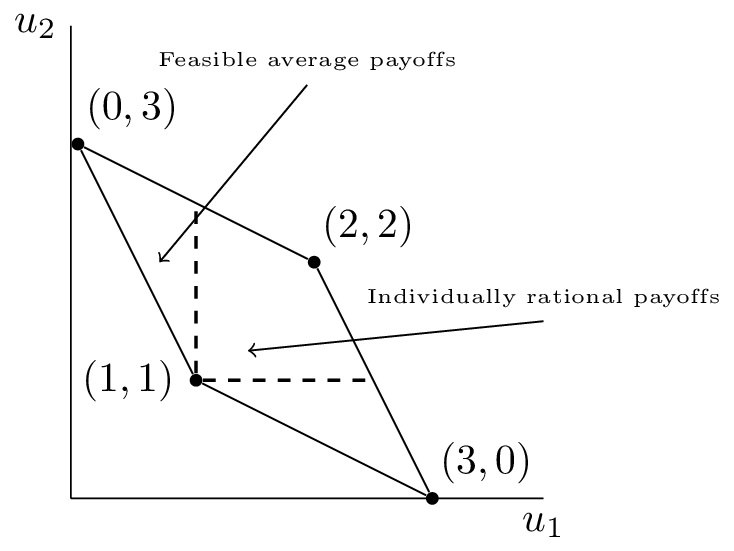
For our Prisoner's Dilemma example, the feasible set is the diamond-shaped area formed by connecting the points (3,0), (2,2), (0,3), and (1,1).
To formalize this and see it illustrated, I recommend two resources. First, a formal definition, and second, a clear graphical explanation.
Repeated games - MIT OpenCourseWare
For a precise, mathematical definition of the feasible payoff set, please review this short section from an MIT OpenCourseWare lecture on repeated games.
Read the section titled 'Feasible Payoffs' on page 19. Notice how it defines the set V as the convex hull (Conv) of all payoff vectors v. This formalizes the intuition we just discussed.
(AGT3E12) [Game Theory] Folk Theorem
Now, let's watch a video that visualizes this concept using the Prisoner's Dilemma.
Watch from 02:22 to 04:09. The presenter defines the set of feasible payoffs and masterfully illustrates how the convex hull is constructed from the four pure strategy outcomes of the Prisoner's Dilemma.
In summary, the feasible set represents every possible average payoff profile the players can engineer through coordinated play, including randomization. Any payoff outside this set is physically impossible to achieve.
2. The Set of Individually Rational Payoffs: What is Acceptable?
Just because a payoff is feasible doesn't mean a rational player would agree to a strategy that yields it. A rational player will not accept an outcome if they can get a better payoff on their own, regardless of what others do. This introduces the idea of a "security level" or a minimum acceptable payoff.
This security level is called the min-max value. For a player , their min-max value, denoted , is the payoff they can guarantee for themselves, even if all other players collude to try and minimize player 's payoff.
Formally, for a two-player game, player 1's min-max value is:
This expression means: we first find player 1's best response () for every possible strategy player 2 might play. Then, we find the worst-case scenario for player 1, where player 2 chooses the strategy () that makes player 1's best-response payoff as low as possible. That minimum possible "best-response" payoff is what player 1 can always guarantee.
A crucial theorem in game theory states that any payoff a player receives in any Nash Equilibrium of the game must be at least their min-max value. A player can't get less than their security level in an equilibrium.
This gives us our second key definition: a payoff vector is individually rational (IR) if every player's payoff is at least their min-max value.
The following resources will help you solidify this concept.
Repeated games - MIT OpenCourseWare
This section from the MIT lecture notes formally defines the min-max payoff and proves that any Nash Equilibrium payoff must be individually rational. This aligns with your preference for mathematical rigor.
Read the sections 'Minmax Payoffs' (page 20) and 'Minmax Payoff Lower Bounds' (page 23). Don't worry about the detailed calculation in the example for now, but focus on the definition of \underline{v}_i and the theorem stating that any equilibrium payoff must be greater than or equal to this value.
(AGT3E12) [Game Theory] Folk Theorem
This video provides a clear, conceptual explanation of what makes a payoff individually rational.
Watch from 01:00 to 02:22. The presenter defines an individually rational payoff as one where each player receives at least their min-max value, which he describes as 'the lowest payoff you can get if you act a little bit smart.'
A common and useful simplification, especially in games with a unique stage-game Nash Equilibrium, is to use the NE payoff as the IR threshold. Since the NE payoff is guaranteed to be the min-max value, it serves as a valid (though sometimes not the tightest) floor for what is considered rational. In our running Prisoner's Dilemma example, the unique NE is (Defect, Defect) with payoff (1,1). The min-max value for each player is also 1 (by playing Defect, you guarantee you get at least 1). Therefore, the set of individually rational payoffs is all pairs such that and .
3. Combining Feasibility and Rationality
We now have the two pieces we need. The interesting outcomes in a repeated game are those that are both possible to achieve and acceptable to all players. This is the set of Feasible and Individually Rational (FIR) payoffs. It is simply the intersection of the feasible set and the individually rational set.
Let's plot this for our Prisoner's Dilemma example:
- Feasible Set: The diamond-shaped convex hull connecting (3,0), (2,2), (0,3), and (1,1).
- Individually Rational Set: The region where and . This is an unbounded area to the "northeast" of the point (1,1).
The FIR set is the part of the diamond that lies within this northeast quadrant.
To see the process of constructing the FIR set from scratch, the following resource is excellent. It walks through the same logic we just did, with clear diagrams for each step.
This document provides a superb graphical walkthrough of finding the Feasible, Individually Rational (FIR) set. It starts with the payoff matrix, plots the feasible set, defines the IR set based on the stage-game NE, and then shows their intersection.
Please study the slides from 'The Folk Theorem' up to 'The Folk Theorem (more formally)'. Follow how the 'Set of feasible payoffs' and the 'Individual rational (IR) set' are constructed and then combined to form the 'Set of feasible, individually rational (FIR) payoffs'.
The key insight here is that the FIR set contains payoffs—like the cooperative outcome (2,2) in our example—that are strictly better for both players than the stage-game Nash Equilibrium (1,1). The possibility of achieving these superior outcomes is the central promise of repeated interaction.
Conclusion
In this lesson, we established the boundaries for cooperation and conflict in repeated games. We moved from analyzing specific strategies to defining the entire space of relevant outcomes.
Key Takeaways:
- Set of Feasible Payoffs: This is the convex hull of the pure strategy payoff vectors from the stage game. It represents all average payoffs that are physically achievable through coordination and randomization.
- Min-max Value (): This is a player's security-level payoff—the minimum they can guarantee themselves regardless of what others do.
- Set of Individually Rational (IR) Payoffs: This set includes all payoff profiles where each player receives at least their min-max value. A rational player will not accept any long-term outcome below this threshold.
- Set of Feasible, Individually Rational (FIR) Payoffs: This is the intersection of the feasible and IR sets. It represents the universe of outcomes that are both achievable and strategically acceptable as long-term results.
You now possess the geometric and conceptual tools to understand one of the most powerful ideas in game theory. The FIR set defines the battleground. In our next lesson, we will introduce the Folk Theorem, a remarkable result which states that, under the right conditions, any point within this FIR set can be sustained as a stable equilibrium outcome.