Introduction
Welcome back! In our last lesson, we established the crucial role of the discount factor () in analyzing infinitely repeated games. You learned how allows us to compare infinite payoff streams and how it represents both a player's patience and the probability of the game continuing. We saw that for cooperation to be possible in the Prisoner's Dilemma, the long-term benefit of mutual cooperation must outweigh the short-term temptation to defect.
This leaves us with a key question: what specific strategies can players adopt to ensure this happens? Today, we will analyze one of the most famous of these: the grim trigger strategy.
Our learning outcome is to analyze the conditions for sustaining cooperation in an infinitely repeated Prisoner's Dilemma using a grim trigger strategy. We will define this strategy, walk through the mathematical derivation to find the minimum level of patience required to sustain cooperation, and explore the credibility of its underlying threat. This lesson will directly connect the abstract concept of the discount factor to a concrete, powerful strategic plan.
1. Defining the Grim Trigger Strategy
The grim trigger strategy is a simple yet severe plan for enforcing cooperation. It can be summarized with one rule:
"I will start by cooperating and will continue to cooperate as long as you have never defected in the past. But if you ever defect, even once, I will defect for all future periods."
It is a "trigger" strategy because a single defection by the opponent triggers a permanent switch in behavior. It is "grim" because the punishment is absolute and everlasting—there is no forgiveness.
The following video provides a clear introduction to the grim trigger strategy and outlines the logic we will use to analyze it.
Game Theory 101 (#58): Grim Trigger in the Repeated Prisoner's Dilemma
In this video, William Spaniel introduces the grim trigger strategy and breaks down the analysis into two key questions we need to answer to see if it constitutes a stable equilibrium.
Please watch from 01:55 to 04:34. Focus on understanding: The precise rule of the grim trigger strategy. The two distinct 'phases' of the game it creates: a cooperative phase and a punishment phase. The two conditions that must be checked for the strategy to be an equilibrium.
As the video explains, to check if mutual adoption of the grim trigger strategy is an equilibrium, we need to verify that no player has an incentive to deviate in either phase of the game:
- The Punishment Phase: If a defection has already occurred, and both players are now defecting forever, does anyone have an incentive to switch back to cooperation?
- The Cooperation Phase: If no defection has occurred, and both players are cooperating, does anyone have an incentive to defect?
The first question is straightforward. If my opponent is defecting forever, my best response in each stage is also to defect (this is the definition of the single-shot Prisoner's Dilemma). Therefore, the mutual punishment of (Defect, Defect) is self-sustaining.
The second question is the interesting one, and it's where our analysis will focus.
2. The Core Analysis: To Cooperate or to Deviate?
Let's analyze the decision of a player in the cooperation phase. Assume both players have adopted the grim trigger strategy. It's the first period of the game. Player 1 asks herself: "Should I follow the strategy and cooperate, or should I deviate and defect just for this one period?"
This is a powerful simplification. Thanks to the one-shot deviation principle, we don't need to check complex, multi-period deviation plans. If no single-period deviation is profitable, then no complex deviation will be either.
Let's use the payoff matrix from the video you just watched:
| Cooperate | Defect | |
|---|---|---|
| Cooperate | 3, 3 | 0, 4 |
| Defect | 4, 0 | 2, 2 |
Here, the payoffs are:
- Reward for mutual cooperation:
- Temptation to defect:
- Punishment for mutual defection:
- Sucker's payoff:
Scenario 1: Stick to Grim Trigger (Cooperate)
If Player 1 cooperates, and Player 2 also follows the strategy (cooperating), they both get a payoff of 3. Since no one defected, they will continue to cooperate in the next period, and the next, and so on. The stream of payoffs for Player 1 is:
The total discounted payoff, using the formula from our last lesson, is:
Scenario 2: One-Shot Deviation (Defect Today)
If Player 1 deviates and defects while Player 2 cooperates, Player 1 gets the temptation payoff of 4 in this period. However, this triggers the punishment phase. From the next period onwards, Player 2 will defect forever. Player 1's best response to perpetual defection is to also defect forever. So, from period 2 onwards, they will both get the mutual defection payoff of 2. The stream of payoffs for Player 1 is:
The total discounted payoff is:
We can rewrite this as:
The Condition for Cooperation
A rational player will stick to cooperation if the payoff from doing so is at least as good as the payoff from deviating.
Now we solve for . Since , the term is positive, so we can multiply both sides by it without changing the inequality direction.
Conclusion: Cooperation can be sustained with the grim trigger strategy if and only if the players are sufficiently patient, which in this specific game means having a discount factor . If , the immediate temptation payoff is too attractive compared to the discounted future of cooperation, and the equilibrium will unravel.
The following video walks through this exact derivation.
Game Theory 101 (#58): Grim Trigger in the Repeated Prisoner's Dilemma
This clip from William Spaniel's video provides the full mathematical derivation we just performed. Watching it will help solidify your understanding of each step.
Watch from 07:18 to 15:43. Pay close attention to how the infinite payoff streams are converted into closed-form expressions and how the resulting inequality is solved for \delta. The video also makes an important point about why this single calculation for period 1 applies to all periods in the cooperative phase.
3. The Role of Payoffs
The threshold is specific to the game we just analyzed. If we change the payoffs, the required level of patience will also change.
Let's watch another analysis with the more "standard" Prisoner's Dilemma payoffs, where mutual defection yields a payoff of 1.
4. Infinitely Repeated Games and Grim Trigger Strategies (Game Theory Playlist 8)
This video from selcuk ozyurt uses a different payoff matrix for the Prisoner's Dilemma and derives the corresponding condition on \delta. This will demonstrate how the calculation changes based on the game's parameters.
Watch from 07:43 to 22:58. The payoff matrix used here is (Cooperate, Cooperate) = (2,2), (Defect, Cooperate) = (4,0), and (Defect, Defect) = (1,1). Follow the derivation and see what the new threshold for \delta becomes.
In the second video, with payoffs R=2, T=4, P=1, the condition for cooperation became . Notice that compared to the first game, the punishment for mutual defection is worse (1 instead of 2) and the reward for cooperation is lower (2 instead of 3). This makes defection more tempting, and therefore players need to be more patient (have a higher ) for cooperation to be sustainable.
4. Practice: A General Derivation
Now, let's generalize this. Your background in mathematics makes you well-equipped to handle this derivation abstractly.
Consider the following general Prisoner's Dilemma matrix presented in this exercise.
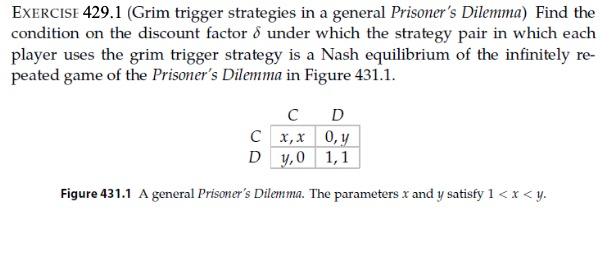
Your task is to derive the condition on for this general game.
-
Write the payoff for cooperating forever.
The payoff stream is . The present value is . -
Write the payoff for deviating today.
The payoff stream is . The present value is . -
Set up the inequality and solve for .
This general formula is very insightful. It shows that the required patience () increases as:
- The term (the temptation to defect minus the reward for cooperating) gets larger.
- The term (the temptation to defect minus the punishment for mutual defection) gets larger.
5. A Deeper Look: Is the Threat Credible?
We've shown that grim trigger is a Nash Equilibrium if is high enough. But is it a Subgame Perfect Nash Equilibrium (SPNE)? This requires the strategy to be optimal in every possible subgame, meaning all threats must be credible.
The threat in grim trigger is: "If you defect, I will punish you forever."
Is this credible? Yes. If you defect, we enter a subgame where you expect me to play D forever. Your best response to me playing D forever is to also play D forever. My best response to you playing D forever is also to play D forever. Since (D, D) is a Nash Equilibrium of the stage game, our prescribed actions in the punishment phase are a Nash Equilibrium of that subgame. Therefore, the threat is credible.
The one-shot deviation principle, which we used earlier, is the formal tool for checking for SPNE. By showing that no single deviation is profitable in any subgame (either the cooperation phase or the punishment phase), we prove that the strategy is an SPNE. The standard grim trigger strategy we've described satisfies this, making it a powerful and robust solution to the repeated dilemma.
Conclusion
Today, you have moved from the abstract concept of discounting to a concrete strategic application. You have rigorously analyzed one of the most fundamental strategies for sustaining cooperation in an infinitely repeated game.
Key Takeaways:
- The Grim Trigger Strategy involves cooperating until an opponent defects, and then defecting forever as punishment.
- Cooperation is sustained if the present value of perpetual cooperation is greater than or equal to the present value of a one-time defection followed by perpetual punishment.
- This condition depends on the discount factor (). Players must be sufficiently patient for the long-term benefits of cooperation to outweigh the short-term temptation to defect.
- The specific threshold for is a function of the stage game's payoffs, as derived in the general formula: , where T is Temptation, R is Reward, and P is Punishment.
- The threat underlying grim trigger is credible because punishing (by playing Defect) is a best response if you believe your opponent will also continue to play Defect. This makes the grim trigger strategy a Subgame Perfect Nash Equilibrium.
The grim trigger is effective, but also extremely harsh. What if a defection was a mistake? Is there a more forgiving strategy that can also sustain cooperation? In our next lesson, we will explore this question by analyzing the famous tit-for-tat strategy.