Hello again! Welcome to your second Korean lesson.
In our last session, we learned how to start and end conversations with essential greetings and farewells like 안녕하세요 (hello) and the all-important distinction between 안녕히 가세요 (goodbye, to someone leaving) and 안녕히 계세요 (goodbye, when you are leaving).
Today, we'll start putting some substance into our future sentences. Our goal is to identify and use essential nouns for everyday objects, places, and people. Nouns are the words we use to name things, and building a solid vocabulary of them is a crucial step toward expressing yourself. Since you're comfortable with Hangul, we can focus on pronunciation and meaning.
Let's start building your Korean lexicon!
1. Nouns for People (사람)
First, let's learn the words for the people you might talk about or interact with in daily life. Knowing these is fundamental for any conversation.
Here are some of the most common nouns for people. The resource below presents them in a clear table.
150 Core Korean Nouns Every Learner Should Know
The article '150 Core Korean Nouns Every Learner Should Know' from FluentU provides a well-organized list of basic nouns. We'll start with the 'People' category.
Please review the tables in the sections titled 'People' and 'Professions'. For now, focus on memorizing the following key words: 사람 (person), 남자 (man), 여자 (woman), 친구 (friend), 학생 (student), 선생님 (teacher), and 의사 (doctor).
Key People Nouns:
- 사람 [sa-ram]: Person
- 남자 [nam-ja]: Man
- 여자 [yeo-ja]: Woman
- 친구 [chin-gu]: Friend
- 학생 [hak-saeng]: Student
- 선생님 [seon-saeng-nim]: Teacher
- 의사 [ui-sa]: Doctor
A Deeper Look: Family (가족)
Family vocabulary in Korean is more specific than in English, especially when it comes to older siblings. The term you use depends on your own gender. This might seem complex at first, but it's a core part of the language and culture.
The following video provides an excellent and clear explanation of these family terms.
[Learn Must Know Korean Words] Family Vocabulary - 가족
Hailey from 'Hailey _Your Korean Friend' breaks down Korean family vocabulary, including the important gender-specific rules for siblings.
Please watch from the beginning to 01:16 to learn the words for 'mother' and 'father'. Then, watch the section from 02:34 to 05:46, which explains the terms for siblings in detail.
As you just saw, here is a summary of the most important terms for parents and siblings:
-
Parents (부모님 [bu-mo-nim]):
- 어머니 [eo-meo-ni] / 엄마 [eom-ma]: Mother / Mom (formal / informal)
- 아버지 [a-beo-ji] / 아빠 [ap-pa]: Father / Dad (formal / informal)
-
Siblings:
- If you are female:
- Older Sister: 언니 [eon-ni]
- Older Brother: 오빠 [op-pa]
- If you are male:
- Older Sister: 누나 [nu-na]
- Older Brother: 형 [hyeong]
- Younger Sibling (regardless of your gender): 동생 [dong-saeng]
- If you are female:
This distinction for older siblings is very important in daily conversation in Korea.
Test your understanding!
You are a male speaker. How would you refer to your older sister?
Show answer
You would call her 누나 (nu-na).
2. Nouns for Places (장소)
Now that we can name people, let's learn the words for the places where we live, work, and visit.
This image provides a great visual start for some common places.
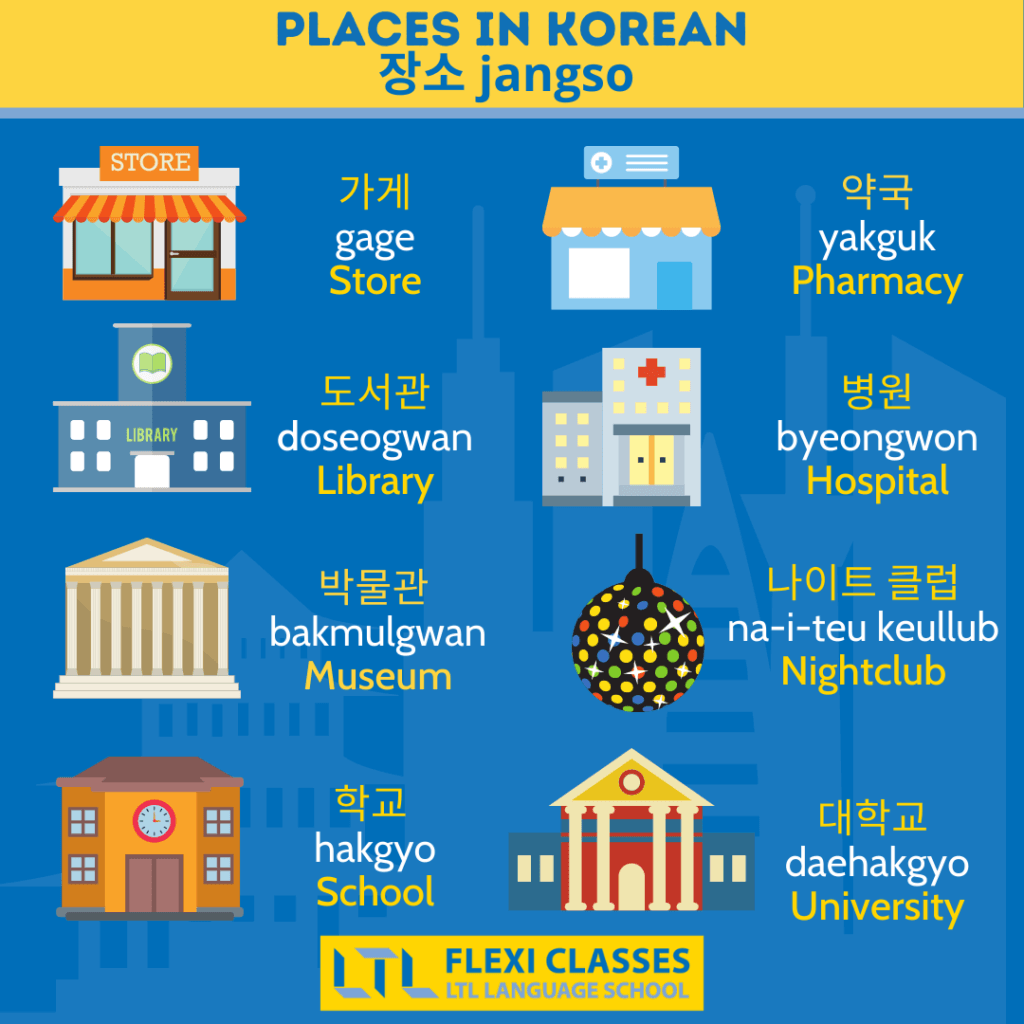
Let's expand on that with a few more essential locations.
- 집 [jip]: House / Home
- 학교 [hak-gyo]: School
- 회사 [hoe-sa]: Company / Office
- 식당 [sik-dang]: Restaurant
- 병원 [byeong-won]: Hospital
- 은행 [eun-haeng]: Bank
- 공원 [gong-won]: Park
- 가게 [ga-ge]: Store / Shop
You can find these and more in the "Places" section of the "150 Core Korean Nouns" article we looked at earlier. Reviewing that list will help solidify your knowledge.
3. Nouns for Everyday Objects (물건)
Finally, let's learn the names for objects we see and use every day. We'll start with some items you might carry with you.

Now, let's cover some more essential vocabulary, focusing on items in a room, food, and drinks.
Korean Words - 100+ Basic Vocabulary For Beginners
The article 'Korean Words - 100+ Basic Vocabulary For Beginners' on 90daykorean.com has helpful lists for food and other basic nouns.
Please read the section 'Food Vocabulary in Korean'. Pay special attention to the words for water, rice, meat, bread, and coffee.
Here is a combined list of high-frequency objects to learn:
General Objects:
- 가방 [ga-bang]: Bag
- 책 [chaek]: Book
- 의자 [ui-ja]: Chair
- 책상 [chaek-sang]: Desk
- 전화 [jeon-hwa]: Telephone
- 컴퓨터 [keom-pyu-teo]: Computer
- 돈 [don]: Money
Food and Drink:
- 물 [mul]: Water
- 밥 [bap]: Cooked rice (also means "meal")
- 빵 [ppang]: Bread
- 고기 [go-gi]: Meat
- 커피 [keo-pi]: Coffee
Try saying each word out loud. Connecting the sound to the meaning is the best way to make it stick.
Test your understanding!
Categorize the following words as a person, place, or object:
- 친구 (chingu)
- 집 (jip)
- 책 (chaek)
Show answer
- 친구 (chingu) is a person (friend).
- 집 (jip) is a place (house).
- 책 (chaek) is an object (book).
Key Takeaways
Excellent work today! You've just added a significant number of essential building blocks to your Korean knowledge.
- Nouns are names: We learned words to name people, places, and objects.
- People: You can now identify basic roles like 학생 (student) and 선생님 (teacher).
- Family Terms: You learned the culturally important and gender-specific words for older siblings (오빠, 언니, 형, 누나).
- Places: You can name key locations like 집 (house), 학교 (school), and 회사 (company).
- Objects: You learned words for common items like 책 (book), 물 (water), and 돈 (money).
I recommend creating your own flashcards (physical or digital) for these words to practice active recall. This is far more effective than just rereading the lists.
Next Lesson Preview
So far, we've learned how to greet people and how to name things. But to make a sentence, we need action! In our next lesson, we will recognize and produce basic Korean verbs and adjectives in their dictionary form. You'll learn words like to go, to eat, to be big, and to be small, which will set the stage for forming your first complete sentences.