Hello! Welcome to your second lesson.
In our last session, we focused on using the present simple tense to describe equipment functions ("The purifier removes impurities") and daily routines ("He checks the gauges every morning"). These are actions that are generally true or happen regularly.
Today, we will learn how to describe actions that are happening right now. This lesson will teach you how to use the present continuous tense to describe ongoing machinery operations. This is essential for communicating what is happening in the engine room at a specific moment, for example, during a watch handover or when reporting an immediate observation.
1. Present Simple vs. Present Continuous
Imagine you are in the engine room.

In the last lesson, we learned to state a fact about a piece of equipment, like a pump:
- Present Simple (Function): "A bilge pump removes water from the bilges."
Now, imagine you see that pump working. To describe this current action, you need a different tense:
- Present Continuous (Ongoing Action): "The bilge pump is removing water from the bilges."
The first sentence is a general truth. The second describes what is happening at this very moment. This distinction is critical for clear technical communication.
2. How to Form the Present Continuous
The present continuous tense (also called the present progressive) is formed with two parts:
- The verb 'to be' in its present form (
am,is,are). - The main verb with an '-ing' ending.
The structure is: Subject + am/is/are + Verb-ing
- I
am checkingthe pressure. - He/She/It (or a single piece of equipment, like 'the engine')
is running. - You/We/They (or multiple people/things, like 'the engineers')
are cleaningthe filters.
For a formal explanation of the rules, please review the following resource.
Maritime Technical English Course
This document, 'Maritime Technical English Course', provides a clear grammar guide. It refers to this tense as the 'present progressive', which is the same as the present continuous.
Please read the section titled 'Present progressive tense: Present progressive'. You will find it on page 17. Focus on the patterns for statements, questions, and the use of the verb 'to be' (is, are, am).
As you can see from the reading, this tense is used for "activities happening at the moment." Let's apply this to your future work environment.
3. Seeing Ongoing Operations in Action
It's one thing to read the rules, but it's much better to see them in a real context. We're going to watch a video that shows a marine engineer performing several tasks. As you watch, pay attention to the actions that are happening in the moment.
Day in the Life of a Mega-ship Marine Engineer
We will watch a clip from the 'Day in the Life of a Mega-ship Marine Engineer' video by JeffHK. This section shows the engineer performing maintenance on a fuel pump. Notice the sequence of actions he is performing.
Watch the clip from 07:54 to 09:20. Observe what the engineer is doing with the pump and the oil.
After watching the video, we can describe the ongoing actions using the present continuous:
- He is taking apart one of the main engine fuel pumps.
- He is draining out all the residual oil.
- An alarm is sounding. (The dead man alarm).
- He is dumping the fuel into the waste oil tank.
- He is cleaning the fuel pump.
All these sentences describe what is happening during that specific period of work.
4. Practice Describing Engine Room Tasks
Now, let's practice using some more examples from the same video and an image.
Practice 1: Watching and Describing
Watch another short clip from the same video. This time, the engineer is checking the fuel levels.
Day in the Life of a Mega-ship Marine Engineer
In this clip, the engineer is 'sounding the fuel tanks'. Watch his actions closely.
Watch the clip from 06:59 to 07:41. Focus on the steps he takes to check the fuel level.
Test your understanding!
Based on the clip you just watched, complete these sentences with the correct present continuous form of the verb in parentheses.
- The engineer ____________ (sound) the fuel tanks.
- He ____________ (clean) the dipstick.
- He ____________ (check) the readings.
Show answer
- The engineer is sounding the fuel tanks.
- He is cleaning the dipstick.
- He is checking the readings.
Practice 2: Describing a Scene
Look at the image below. The text in the image identifies the machinery as an 'Auxiliary engine'. Imagine you are telling your supervisor what is happening in this part of the engine room right now.
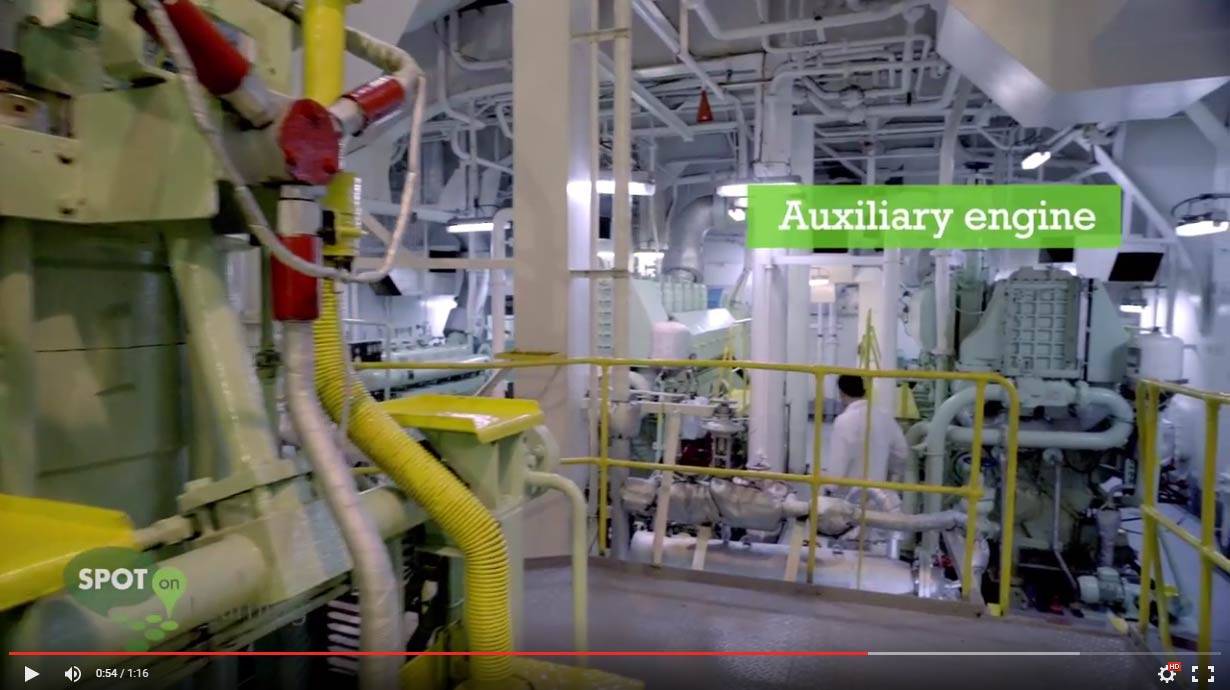
Test your understanding!
Complete the sentences below to describe the scene, choosing the correct tense (present simple or present continuous).
- The auxiliary engine _______ (generate) electrical power for the ship. (Is this a function or an ongoing action?)
- In the picture, the auxiliary engine _______ (run). (Is this a function or an ongoing action?)
- The engineer _______ (inspect) the engine. (Is this a routine or an ongoing action?)
Show answer
- The auxiliary engine generates electrical power for the ship. (This is its function, so we use present simple).
- In the picture, the auxiliary engine is running. (This is an action happening at the moment of the picture).
- The engineer is inspecting the engine. (This is an action happening at the moment of the picture).
This last exercise is very important. Being able to choose correctly between the present simple (for facts/routines) and present continuous (for actions-in-progress) is a key skill for accurate communication.
Conclusion
Let's summarize what we've learned today.
- Key Takeaway: We use the present continuous tense (
am/is/are + verb-ing) to describe actions and operations that are happening at the moment of speaking. - Contrast with Present Simple: The present simple is for facts, functions, and routines (e.g., "The engine uses fuel"), while the present continuous is for what's happening now (e.g., "The engine is using a lot of fuel right now").
- Application: You will use this tense constantly to report what you are doing ("I am cleaning the separator"), what a machine is doing ("The pump is leaking"), or what your team is doing ("We are starting the generator").
Preview of the next lesson:
In the next lesson, we will move on to forming questions using question words (What, Where, When, Why, How). This will allow you to ask for more detailed information about the ongoing actions you can now describe. For example, you will be able to ask, "What are you doing?" or "Why is the alarm sounding?".