Hello! Welcome back to our final lesson in the module on Database Design and Normalization.
In our previous lessons, we've focused on normalization—a process of decomposing tables to eliminate redundancy and prevent data anomalies. We learned to apply 1NF, 2NF, and 3NF to ensure that every attribute in a table depends on "the key, the whole key, and nothing but the key." This process is essential for creating clean, robust schemas.
As we previewed last time, we now turn to a different kind of design challenge. What happens when a complex relationship between two entities is not a result of bad design, but a fundamental part of the business logic? For example, an e-commerce site where a single order can contain multiple products, and a single product can appear in many different orders.
Today, we will learn how to model these "many-to-many" relationships. The learning outcome for this lesson is to design a junction table to model a many-to-many relationship. This is one of the most common and important patterns in database design, forming the backbone of countless real-world applications.
1. Understanding the Many-to-Many Problem
A many-to-many (M:N) relationship exists when multiple records in one table can be associated with multiple records in another table, and vice-versa.
Consider these common scenarios:
- Students and Courses: A student can enroll in many courses, and a course can have many students.
- Blog Posts and Tags: A post can have multiple tags (
#sql,#database,#design), and a tag can be applied to many posts. - Products and Categories: A product can be in multiple categories (a laptop could be in "Electronics" and "Computers"), and a category contains multiple products.
Your background in systems programming might lead you to think about how you'd represent this in memory, perhaps with arrays of pointers. In the relational model, a direct representation is problematic. Let's explore why.
Database Design 18 - Designing Many-to-Many Relationships
This video from Caleb Curry provides an excellent, logical breakdown of why many-to-many relationships can't be modeled directly and the conceptual problems that arise. It aligns well with your preference for understanding the 'why' behind a concept.
Please watch from the beginning until 05:33. The video uses a students and classes example to show why adding multiple columns for relationships (e.g., class1, class2, class3) is a flawed approach that violates normalization principles and wastes space.
As the video demonstrates, attempting to force a many-to-many relationship into one of the existing tables leads to two bad solutions:
- Repeating Columns: Adding columns like
student_id_1,student_id_2, etc., to aCoursestable. This is inflexible (what if a course has more students than you have columns?), leads to manyNULLvalues, and makes querying incredibly difficult. - Comma-Separated Values: Storing a list of IDs in a single text field (e.g., a
student_idscolumn with "1, 5, 23"). This breaks First Normal Form (1NF) because the field is not atomic. It makes it nearly impossible for the database to enforce data integrity, and searching for a specific relationship is slow and inefficient.
These approaches are fundamentally broken. The relational model requires a more structured solution.
2. The Solution: The Junction Table
The correct way to model a many-to-many relationship is to decompose it into two one-to-many (1:N) relationships. We achieve this by creating a third table that sits between the two primary tables. This intermediary table has several names:
- Junction Table
- Linking Table
- Bridge Table
- Association Table
Its sole purpose is to connect the records from the two other tables.
SQL Server Tutorial - One-to-many and many-to-many table relationships
This next video, from LinkedIn Learning, provides a very clear and concise explanation of how a junction table is introduced to solve the many-to-many problem using an Authors and Books example.
First, watch from 03:46 to 05:20 to see the problem set up. Then, skip the 'bad ideas' part and watch from 06:05 to 07:35 to see how the junction table AuthorTitle is created to resolve the issue.
As the video explains, the junction table converts the single M:N relationship into two 1:N relationships:
- One author can be associated with many entries in the junction table.
- One book can be associated with many entries in the junction table.
This creates an elegant bridge between the two entities. Let's look at a diagram to solidify this concept.
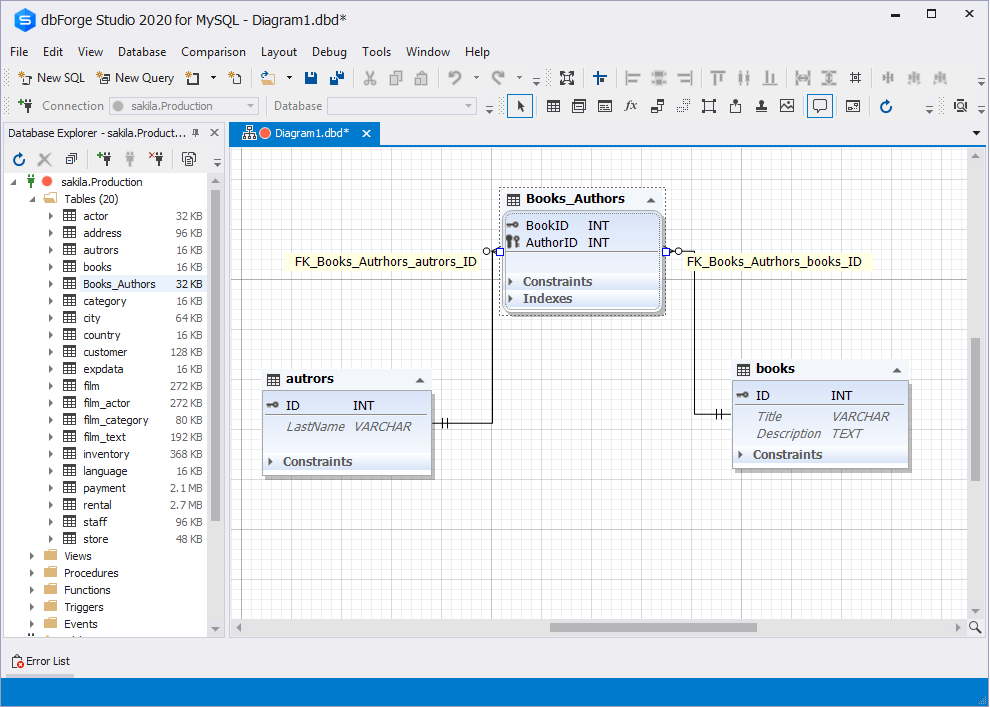
3. How to Design a Junction Table
Now let's get into the specifics of the design. A junction table has a few essential components.
Many-to-Many Database Relationships: Complete ...
The article 'Many-to-Many Database Relationships' from Beekeeper Studio provides an excellent technical overview of a junction table's structure. We'll focus on the core components and the CREATE TABLE syntax.
First, read the section 'Junction Table Fundamentals', focusing on the subsection 'Basic Structure'. Pay close attention to the SQL code and the description of the key components. Then, jump to the 'Best Practices' section and review the code block under 'Technical Implementation', which summarizes the essential elements.
Based on the article, here are the core design elements of a junction table:
-
Foreign Keys: The table must contain at least two columns, each acting as a foreign key that references the primary key of one of the tables being linked. For a
student_coursestable, these would bestudent_idandcourse_id. -
Composite Primary Key: This is a critical feature. The primary key of the junction table is typically a composite key made up of both foreign key columns (e.g.,
PRIMARY KEY (student_id, course_id)). This serves a vital purpose: it guarantees that the same pair of records cannot be linked more than once. You cannot enroll the same student in the exact same course twice. -
Additional Attributes (Optional but common): Often, you need to store information about the relationship itself. For instance:
- In a
student_coursestable, you might want to store theenrollment_dateor the finalgrade. - In an
order_productstable, you'd store thequantityof the product in that specific order.
These attributes belong in the junction table because they don't describe the student or the course alone; they describe the specific instance of the student's enrollment in that course.
- In a
Here is a complete CREATE TABLE statement for an enrollments junction table, combining these principles:
CREATE TABLE enrollments (
    student_id INTEGER NOT NULL,
    course_id INTEGER NOT NULL,
    enrolled_at TIMESTAMP DEFAULT CURRENT_TIMESTAMP,
    grade VARCHAR(2),

    -- Composite primary key prevents duplicate enrollments
    PRIMARY KEY (student_id, course_id),

    -- Foreign keys maintain referential integrity
    FOREIGN KEY (student_id) REFERENCES students(id),
    FOREIGN KEY (course_id) REFERENCES courses(id)
);
You might have also noticed that the order_items table we saw in our 2NF lesson was, in fact, a junction table! It connected orders and books and stored quantity as an attribute of the relationship. This pattern is everywhere once you know what to look for.
Test your understanding!
Imagine you are designing a database for a music streaming service. You have a Playlists table and a Tracks table. A playlist can contain many tracks, and a track can be included in many different playlists.
- What would you name the junction table?
- What are the essential columns this junction table must have? Specify the keys and constraints.
- What is one piece of information (an additional attribute) that might be useful to store in this junction table about the relationship between a track and a playlist?
- Write the basic
CREATE TABLEstatement for your junction table design (including the additional attribute).
Show answer
-
Table Name: A good name would be
playlist_tracks. -
Essential Columns:
playlist_id: A foreign key referencing the primary key of thePlayliststable.track_id: A foreign key referencing the primary key of theTrackstable.- A composite primary key on both columns:
PRIMARY KEY (playlist_id, track_id).
-
Additional Attribute: A very useful attribute would be
track_position(an integer) to define the order of tracks within a specific playlist. You could also adddate_addedto track when a song was added to the playlist. -
CREATE TABLEStatement:CREATE TABLE playlist_tracks ( playlist_id INTEGER NOT NULL, track_id INTEGER NOT NULL, track_position INTEGER, -- Defines the song's order in the playlist date_added TIMESTAMP DEFAULT CURRENT_TIMESTAMP, -- Ensures a track can't be in the same playlist twice PRIMARY KEY (playlist_id, track_id), -- Links to the main tables FOREIGN KEY (playlist_id) REFERENCES playlists(id), FOREIGN KEY (track_id) REFERENCES tracks(id) );
Conclusion
This lesson completes our module on database design and normalization. We've learned that many-to-many relationships are a common and necessary part of modeling the real world, and the junction table is the standard, robust solution for implementing them in a relational database. By breaking a complex M:N relationship into two simpler 1:N relationships, the junction table preserves data integrity and follows normalization principles.
Key Takeaways:
- A many-to-many (M:N) relationship is where multiple records in one table can relate to multiple records in another.
- Directly modeling this is not possible; attempts to do so violate normalization rules and lead to poor design.
- The solution is a junction table that contains foreign keys referencing the two tables it connects.
- A composite primary key on the two foreign keys is crucial to prevent duplicate relationship entries.
- Junction tables can and often should contain additional attributes that store data about the relationship itself (e.g., a grade, a quantity, a timestamp).
Preview of the Next Module:
Now that we have a solid foundation in designing a database schema, our focus will shift from the structure of data to the safety and reliability of data operations. In the next module, "Transactions and Concurrency," we will begin by exploring the fundamental principles that guarantee reliable database transactions, known as the ACID properties. This will be crucial for understanding how a DBMS ensures data remains consistent, even with multiple users and potential system failures.