Hello! Let's continue our exploration of database transactions.
In our last lesson, we identified the common concurrency anomalies that can corrupt data when multiple transactions run in parallel: Dirty Reads, Non-Repeatable Reads, and Phantom Reads. Understanding these problems was the crucial first step.
Today, we'll focus on the solution. The SQL standard provides a powerful mechanism to control how transactions interact with each other, allowing you to prevent these anomalies. This mechanism is known as Transaction Isolation Levels. Our goal is to explain the purpose and function of these levels, such as Read Committed and Serializable. Think of them as a control knob that allows a developer or database administrator to make a deliberate trade-off between data consistency and system performance.
From Chaos to Order: The Isolation Spectrum
Imagine a multi-lane highway. If there are no rules (no isolation), cars can swerve between lanes, causing chaos and accidents (anomalies). If the rules are too strict, forcing every car into a single file line (perfect isolation), the road is safe and predictable, but traffic slows to a crawl.
Database isolation levels work on a similar spectrum. The database designer's job is to pick the "traffic rule" that is strict enough to ensure data correctness for the application's needs, without slowing down the system more than necessary.
To start, let's get a high-level overview of these levels and the read phenomena they are designed to prevent.
Relational Database ACID Transactions (Explained by Example)
The video 'Relational Database ACID Transactions' by Hussein Nasser provides an excellent introduction to isolation levels. It recaps the anomalies we've discussed and then introduces the different levels designed to fix them.
Watch the segment from 18:45 to 27:36. Focus on understanding the names of the four main isolation levels and the core idea that each level prevents certain anomalies at the cost of performance.
Now, let's break down each of these levels in more detail.
The Four Standard Isolation Levels
We'll examine the four isolation levels defined by the SQL standard, moving from the fastest and least safe to the slowest and most correct. For this section, we will rely on a detailed article that uses clear timeline diagrams to illustrate how each level works.
Exploring Database Isolation Levels: A Deep Dive ...
The article 'Exploring Database Isolation Levels: A Deep Dive' from The Coder Cafe provides excellent, visual explanations for each isolation level and the specific anomalies they prevent. We'll use it as our guide through this section.
Keep this article open as we go through each level. You don't need to read it all at once; I will point you to the relevant sections as we proceed. Start by looking at the flowchart in the introduction to get a mental map of the levels.
1. Read Uncommitted
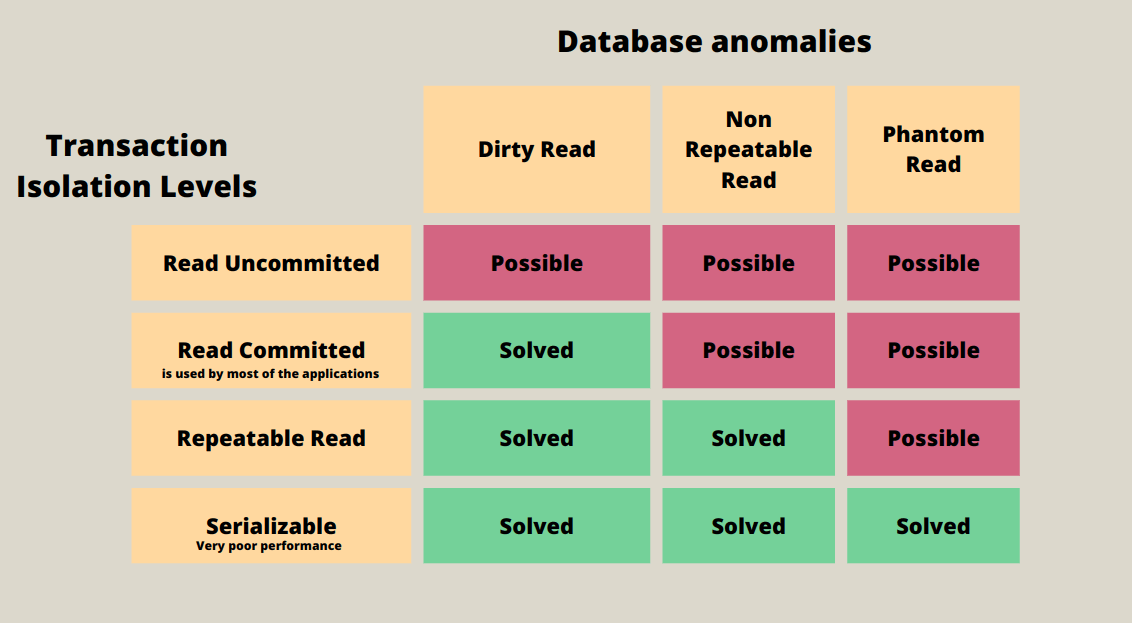
This is the lowest level of isolation. A transaction at this level can see uncommitted ("dirty") changes made by other transactions.
- Anomalies Prevented: None of the ones we discussed. Some databases may prevent an even more severe anomaly called a "dirty write," but that's a finer point.
- Anomalies Possible: Dirty Reads, Non-Repeatable Reads, Phantom Reads.
- Performance: Highest performance, as transactions barely wait for each other.
- Use Case: Very rare. It might be used for statistical queries on very large datasets where approximate results are acceptable and performance is paramount. Many modern databases, including PostgreSQL, don't even implement this level because it offers so few guarantees.
Read the "Read Uncommitted" section of the article to see an example of a related anomaly it prevents (Dirty Writes). Then, review the "Read Committed" section to see a diagram of a Dirty Read, the primary anomaly that this level fails to prevent.
2. Read Committed
This is a significant step up and the default isolation level for many popular databases like PostgreSQL and Oracle. A transaction at this level is guaranteed to only read data that has been committed.
However, each statement within a transaction gets a fresh "snapshot" of the data. If another transaction commits a change between two of your SELECT statements, you will see that change.
- Anomalies Prevented: Dirty Reads.
- Anomalies Possible: Non-Repeatable Reads, Phantom Reads.
- Performance: Good performance and a reasonable level of protection. It's a pragmatic choice for many web applications.
Refer to the "Read Committed" section of the Coder Cafe article. You'll see it prevents the Dirty Read we saw earlier, but as the next section on "Repeatable Reads" explains, it's still vulnerable to a Non-Repeatable (Fuzzy) Read.
3. Repeatable Read
This level provides a stricter guarantee. When a transaction starts, it's as if it takes a snapshot of the entire database. Throughout the transaction, it will only ever see the data from that initial snapshot. Other transactions can change data, but the current transaction will be isolated from those changes.
- Anomalies Prevented: Dirty Reads, Non-Repeatable Reads.
- Anomalies Possible: Phantom Reads (in the standard SQL definition).
- Performance: Slower than Read Committed because the database must maintain the transaction's snapshot, potentially leading to more conflicts.
- Use Case: Ideal for transactions that need to read the same rows multiple times and require the values to be consistent, such as a reporting job that performs multiple calculations on the same set of data.
Review the "Repeatable Reads" section of the article. The timeline diagram clearly shows how it prevents a Fuzzy (Non-Repeatable) Read, as the second read sees the same value as the first.
4. Serializable
This is the "gold standard" of isolation. It guarantees that the end result of running multiple concurrent transactions is the same as if they had been run one at a time, in some sequential order. It completely eliminates the possibility of the concurrency anomalies we've discussed.
- Anomalies Prevented: Dirty Reads, Non-Repeatable Reads, Phantom Reads.
- Anomalies Possible: None.
- Performance: The slowest of all levels. The database has to do significant work (through locking or other strategies) to ensure serializability, which can dramatically reduce throughput in high-concurrency systems.
- Use Case: Mission-critical operations where data integrity is absolute, such as financial transactions, enforcing complex business rules, or preventing a doctor from going off-call if they are the last one available.
Read the "Serializability" section in the article. It shows how this level prevents a Phantom Read by ensuring the result set of a query does not change during the transaction.
Here is a summary of the standard levels and the anomalies they permit.
How Does This Actually Work? The "Low-Level Why"
Given your interest in systems programming, you're likely wondering how a database achieves this isolation, especially for levels like Repeatable Read. The naive approach would be to lock every row a transaction reads, but that would be incredibly slow.
Modern databases like PostgreSQL use a brilliant technique called Multi-Version Concurrency Control (MVCC). The core idea is that the database doesn't just store the current value of a row; it stores multiple older versions of that row.
When your transaction at Repeatable Read begins, the database gives it a "snapshot" identifier. This snapshot tells the database: "Only show this transaction the row versions that were committed before it started." This is how you can read a consistent view of the data without blocking other transactions from writing new versions of those same rows. It's conceptually similar to how a version control system like Git maintains a history of your code.
Transaction Isolation in Postgres, explained
The article 'Transaction Isolation in Postgres, explained' has a fantastic, practical section explaining how MVCC works. This will connect the abstract concept of isolation levels to the underlying implementation.
Read the section titled 'MVCC and isolation in Postgres'. Pay close attention to the explanation of t_xmin and how a transaction's snapshot determines which row versions are visible. This is the low-level mechanism that enables snapshot-based isolation.
Test your understanding!
You are designing the database backend for two different features of an e-commerce platform:
-
Inventory Management: When a customer places an order, the system must read the current stock level of a product, check if it's greater than zero, and then decrement the stock level. This operation must be perfectly accurate to prevent overselling.
-
Dashboard Analytics: A separate internal dashboard runs a long, complex query to generate a daily sales report. The report involves multiple queries that aggregate sales data. It's important that the report is internally consistent, but it's acceptable if it doesn't include sales that happened in the last few seconds while the report was generating.
For each feature, which isolation level (Read Committed, Repeatable Read, or Serializable) would you choose, and why? Explain your choice in terms of the trade-off between correctness and performance.
Show answer
-
Inventory Management:
Serializable. This scenario is a classic "read-modify-write" problem that is vulnerable to anomalies like Write Skew (a more advanced version of a Lost Update). Two concurrent orders could both read a stock level of 1, both decide they can proceed, and both try to decrement the stock, leading to a negative inventory.Serializableis the safest choice because it ensures that concurrent order transactions behave as if they happened one after another, preventing this race condition entirely. The performance cost is acceptable here because data correctness is non-negotiable. -
Dashboard Analytics:
Repeatable Read. The key requirement is that the report must be internally consistent. If the report runs aCOUNTof sales at the beginning and then calculates theSUMof sales revenue at the end, you don't want a new sale to appear mid-report, making the numbers inconsistent (a Phantom Read).Repeatable Readis perfect for this. It gives the entire reporting transaction a single, consistent snapshot of the database, preventing both Non-Repeatable and Phantom Reads (in Postgres's implementation). It's a better choice thanSerializablebecause while it provides the necessary consistency for the report, it has a lower performance overhead. Using the defaultRead Committedwould be risky, as data could change between queries, leading to a confusing and incorrect report.
Conclusion
In this lesson, we demystified the concept of transaction isolation levels. You now understand that they are not arbitrary rules but essential tools for managing the fundamental trade-off between database performance and data correctness.
Key Takeaways:
- Isolation levels define the degree to which a transaction is protected from the actions of other concurrent transactions.
- The four standard levels are Read Uncommitted, Read Committed, Repeatable Read, and Serializable.
- Each level up on the spectrum prevents more concurrency anomalies but typically incurs a greater performance penalty.
- Read Committed is a common default, offering a good balance by preventing dirty reads.
- Serializable offers the strongest guarantee, ensuring transactions act as if they run in series, but at the highest performance cost.
- Modern databases use mechanisms like MVCC to implement these levels efficiently, often by providing transactions with a consistent "snapshot" of the data.
Preview of the Next Lesson:
We've seen how isolation levels help manage the interactions between transactions. However, there's one more concurrency problem to be aware of. What happens when two transactions, each holding a resource the other wants, end up in a standoff, waiting forever? This is known as a deadlock. In our next lesson, we will define what a deadlock is and explore how and why it can occur.