Hello! Welcome to the first lesson of our new module, "Nucleophilic Substitution Reactions."
In the last lesson, we concluded our study of reactive intermediates by examining their likely reaction pathways. We saw that reactions like SN1 and E1 proceed through a discrete, planar carbocation intermediate, which then dictates the final products. Today, we turn our attention to a fundamentally different, yet equally important, substitution pathway: the SN2 reaction. This mechanism cleverly avoids the formation of any high-energy intermediate altogether.
Our goal in this lesson is to describe the detailed mechanism of SN2 reactions, paying close attention to the unique structure of its pentacoordinate transition state. By the end, you'll understand the kinetics, geometry, and fundamental orbital interactions that define this elegant, one-step process.
1. The Concerted SN2 Mechanism
The designation SN2 stands for Substitution Nucleophilic Bimolecular. Let's break down what this means from a mechanistic and kinetic perspective.
- Substitution, Nucleophilic: Just like the SN1 reaction, a nucleophile replaces a leaving group on the substrate.
- Bimolecular: This is the key difference. "Bimolecular" signifies that the rate of the reaction depends on the concentration of two species: the nucleophile and the electrophilic substrate.
The rate law for an SN2 reaction is therefore:
From your knowledge of chemical kinetics, you know that if a reactant appears in the rate law, it must be involved in the rate-determining step (RDS) of the reaction. Since both the substrate and the nucleophile are in the RDS, they must collide and react in a single, elementary step. This is known as a concerted mechanism—bond breaking and bond formation occur simultaneously.
To begin, let's get a clear definition of this process.
The article 'SN2 Reaction Mechanism' from Chemistry Steps provides a concise introduction to the concerted nature of the reaction and its second-order kinetics.
Read the initial part of the article, from the beginning down to the heading 'Reactivity of the Substrate in SN2 Reactions'. Focus on how the term 'bimolecular' relates to the rate law and what it implies about the mechanism.
2. The Pentacoordinate Transition State
Because the SN2 reaction happens in one step, it doesn't have any intermediates. Instead, it passes through a single, high-energy transition state. In this fleeting moment, the central carbon is partially bonded to both the incoming nucleophile and the outgoing leaving group.
This arrangement is called a pentacoordinate transition state. It is crucial to understand that the carbon atom does not form five full bonds (which would violate the octet rule). Rather, it's associated with five atoms through two partial bonds and three full bonds.
Let's examine the structure and energy profile of this transition state.
Substitution Reactions (on Saturated Carbons)
The article 'Substitution Reactions (on Saturated Carbons)' by Making Molecules offers an excellent description and visual representation of the S_N2 transition state and the corresponding reaction energy diagram.
Read the section titled 'SN2 Mechanism'. Pay close attention to the diagram of the reaction profile and the depiction of the transition state with partial bonds. Note how the charge is distributed across the nucleophile, carbon, and leaving group.
As you've read, the geometry of this transition state is very specific. The three non-reacting substituents on the carbon flatten out into a trigonal planar arrangement. The nucleophile and the leaving group are positioned on opposite sides of this plane, 180° apart from each other, along an axis passing through the central carbon.

This specific geometry, with the nucleophile attacking from the side opposite to the leaving group, is known as backside attack. Why is this geometry not just preferred, but required? The answer lies in the quantum mechanical nature of the orbitals involved.
3. The Orbital Basis for Backside Attack
Your interest in the quantum mechanical "why" behind chemical behavior is perfectly suited for understanding the SN2 reaction. The requirement for backside attack is a direct consequence of Frontier Molecular Orbital (FMO) theory.
A chemical reaction can be viewed as an interaction between the highest energy electrons of one molecule and the lowest energy empty orbital of another.
- The nucleophile donates its electron pair. These electrons reside in its Highest Occupied Molecular Orbital (HOMO).
- The electrophile (the substrate) accepts these electrons into its Lowest Unoccupied Molecular Orbital (LUMO).
In our substrate, like methyl bromide (CH₃-Br), the bond between the carbon and the leaving group is a σ bond. This σ bond has a corresponding σ* (sigma-antibonding) orbital, which is empty and serves as the LUMO.
The key insight is the shape and location of this σ* orbital. It has a large lobe located on the carbon atom, but it points 180° away from the C-Br bond axis.
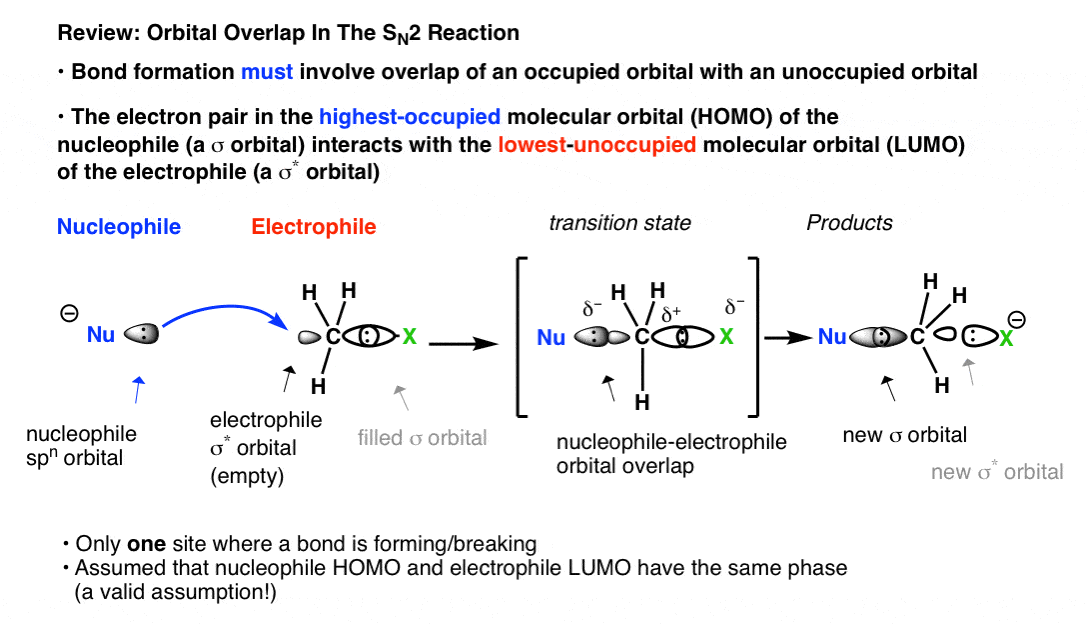
For the nucleophile's HOMO to effectively overlap with the electrophile's LUMO, it must approach the carbon from the backside. Attacking from the front side (the same side as the leaving group) would lead to zero net overlap due to the node in the σ* orbital and electrostatic repulsion from the electron-rich leaving group.
This orbital interaction elegantly explains the entire mechanism:
- As the HOMO of the nucleophile begins to overlap with the σ* LUMO of the substrate, electron density flows into the antibonding orbital.
- Populating the antibonding orbital weakens and eventually breaks the carbon-leaving group bond.
- Simultaneously, the overlap between the nucleophile and carbon forms the new σ bond.
This is the essence of a concerted reaction, all dictated by the geometry of the frontier orbitals.
Substitution Reactions (on Saturated Carbons)
Let's deepen this orbital perspective. The 'Making Molecules' resource provides another excellent section connecting the FMO approach to the necessity of backside attack.
Read the text under the diagram showing the orbital overlap. This section explicitly states how the HOMO-LUMO interaction leads to the trigonal planar transition state and why the nucleophile and leaving group must be 180° apart.
Test your understanding!
Consider the reaction of sodium hydrosulfide (NaSH) with (R)-2-chlorobutane.
- Identify the nucleophile, the electrophilic carbon, and the leaving group.
- Draw the pentacoordinate transition state for this reaction, using dashed lines for partial bonds.
- Based on the requirement for backside attack, predict the stereochemistry (R or S) of the product, 2-butanethiol.
Show answer
- Nucleophile: The hydrosulfide anion, HS⁻.
- Electrophilic Carbon: C2 of the butane chain (the carbon bonded to Cl).
- Leaving Group: The chloride anion, Cl⁻.
The reaction involves the HS⁻ nucleophile attacking the C2 of (R)-2-chlorobutane from the side opposite the C-Cl bond.
Transition State:
The carbon at C2 is trigonal planar with respect to the H, CH₃, and CH₂CH₃ groups. The incoming HS⁻ and outgoing Cl⁻ are positioned axially, 180° from each other. The negative charge is delocalized over the S and Cl atoms.
Product Stereochemistry:
Since the reaction proceeds via backside attack, there is an inversion of configuration. The starting material is (R)-2-chlorobutane. Therefore, the product will be (S)-2-butanethiol. This stereospecific outcome is known as a Walden Inversion.
Conclusion
In this lesson, we have constructed a detailed model of the SN2 reaction mechanism, moving from macroscopic kinetics to the quantum mechanical interactions at its core.
Key Takeaways:
- The SN2 reaction is concerted, with bond-formation and bond-breaking occurring in a single step.
- Its kinetics are bimolecular (second order), as both the nucleophile and substrate are involved in the rate-determining step.
- The reaction proceeds through a high-energy pentacoordinate transition state, not an intermediate. In this state, the central carbon has a trigonal bipyramidal geometry.
- The mechanism requires backside attack, where the nucleophile approaches at 180° to the leaving group.
- This specific geometry is mandated by the need for effective overlap between the nucleophile's HOMO and the σ* orbital (LUMO) of the carbon-leaving group bond.
Preview of the Next Lesson:
The most profound consequence of the backside attack in an SN2 reaction is its effect on stereochemistry. Today, you learned that this leads to an inversion of configuration. In our next lesson, we will focus entirely on this phenomenon. We will formally define and apply the rules for predicting the stereochemical outcome of SN2 reactions on various chiral substrates, ensuring you can masterfully analyze this stereospecific transformation.