Hello! In our previous lessons, we've built a strong foundation for understanding how electrons move within molecules. We've explored resonance and hyperconjugation, both of which are fundamentally "through-bond" phenomena involving the delocalization of electrons in or systems.
Today, we shift our perspective from the bonds to the space between them. Your learning outcome for this lesson is to apply field effects to explain through-space electrostatic interactions in molecules. We will dissect the often-conflated concepts of inductive and field effects, giving you a more precise and physically grounded model for how substituents influence molecular properties like acidity, even from a distance.
1. Untangling the "Inductive Effect"
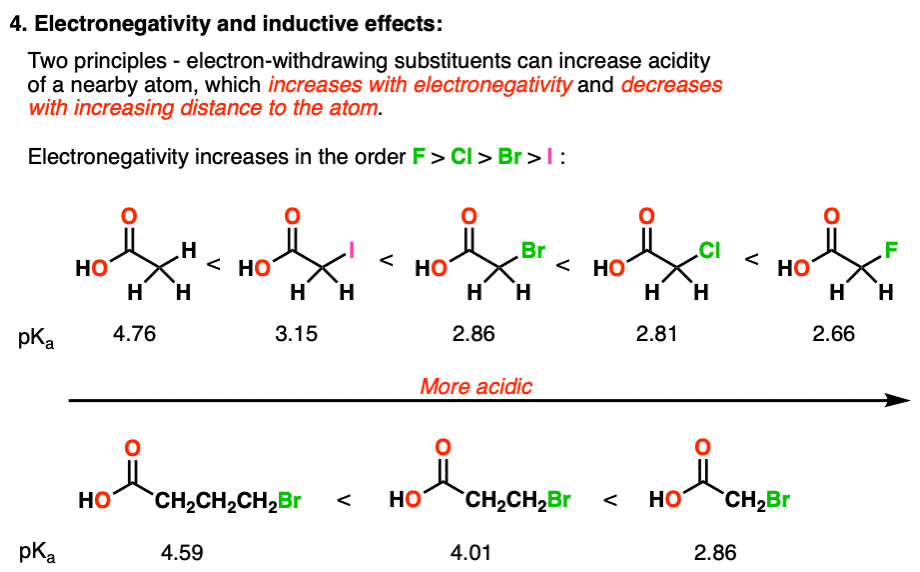
You are likely familiar with the idea that an electronegative atom like chlorine can increase the acidity of a nearby carboxylic acid. This is typically bundled under the term "inductive effect." While this is a useful simplification, it merges two distinct physical phenomena. To truly understand the "why," we must separate them.
Let's start by reviewing the conventional explanation.
Comparing Acidities: Inductive Effects
The video 'Comparing Acidities: Inductive Effects' by Michael Evans provides a clear and standard explanation of how substituent electronegativity and distance impact acidity. This is the model we will deconstruct and refine.
Please watch from 05:19 to 06:29 and from 07:47 to 09:34. Focus on: How the video describes the effect as polarization propagating through the sigma bond network. The two key factors identified: the number of substituents and their distance from the acidic center.
The video correctly identifies that the effect weakens with distance. However, it attributes this entirely to propagation through bonds. The deeper reality is more complex. Let's get a more precise definition.
Chapter 14 Substituent Effects
This excerpt from 'Chapter 14: Substituent Effects' by Professor Neuman provides a formal distinction between the inductive and field effects.
Please read the paragraphs under the heading 'Transmission of Substituent Effects' (page 4). Focus on the definitions provided for 'Inductive effects' and 'Resonance effects'. Notice how the text explicitly includes 'through space' in the definition of the inductive effect, a point we will clarify next.
As the text notes, the term "inductive effect" is often used as an umbrella term. For a more rigorous physical organic chemistry perspective, we make the following distinction:
- Inductive Effect (Strict Definition): The polarization of electron density transmitted successively through the chain of -bonds. This effect attenuates very rapidly, typically becoming negligible after two or three bonds.
- Field Effect: A purely electrostatic interaction that operates through space (and through the solvent medium), not through the bonding framework. It's a classical interaction between the dipole of the substituent group and a charge or another dipole at the reaction center.
This debate between the "through-bond" and "through-space" models has a long history. The through-space model is often called the "field effect," a concept strongly associated with the work of physical organic chemist Michael J.S. Dewar. For many situations, particularly in flexible acyclic molecules, both effects are operative and point in the same direction, making them difficult to separate.
2. The Field Effect in Action
The field effect is governed by the principles of classical electrostatics, akin to Coulomb's Law. Its strength depends on:
- The magnitude of the interacting dipoles/charges.
- The distance between them.
- Their relative orientation.
- The dielectric constant of the medium (solvent) separating them.
Let's examine a case where the field effect is clearly significant.
Chapter 14 Substituent Effects
The same chapter by Neuman provides a perfect illustration using γ-chlorobutyric acid, where the substituent and reactive site are separated by several sigma bonds.
Please read the section 'Location of S Groups (14.2C)' on pages 10-11, paying special attention to the paragraph and diagram under the sub-heading 'Field Effects'.
In -chlorobutyric acid, the C-Cl dipole and the carboxylate group are separated by four -bonds. The purely inductive (through-bond) effect would be almost zero over this distance. However, due to molecular flexibility, the chain can adopt a conformation where the C-Cl dipole is physically close to the negatively charged carboxylate anion. This through-space electrostatic attraction (an ion-dipole interaction) stabilizes the anion, making the parent acid more acidic than it would otherwise be. This is a pure field effect.
Test your understanding!
Consider the two isomers of 4-chlorocyclohexanecarboxylic acid shown below. Which isomer would you predict to be the stronger acid? Explain your reasoning in terms of the field effect.
Show answer
The cis isomer (A) is predicted to be the stronger acid.
Reasoning:
In these rigid chair conformations, the number of bonds separating the chlorine atom and the carboxylic acid group is identical. Therefore, the through-bond inductive effect should be roughly the same for both isomers.
The key difference is the through-space distance. In the cis isomer, both substituents are axial (or both equatorial, depending on the chair flip, but one conformer will place them closer). In the depicted axial-axial conformation of the cis isomer, the C-Cl dipole is spatially closer to the carboxylate group. This leads to a stronger stabilizing ion-dipole interaction (a field effect) for the conjugate base. In the trans isomer, with one substituent axial and one equatorial, the average distance between the C-Cl dipole and the carboxylate group is greater.
Because the conjugate base of the cis isomer is better stabilized by the through-space field effect, it is easier to deprotonate, making it the stronger acid (it has a lower pKa). Experimental data confirms this prediction.
3. Field Effects vs. Orbital Interactions: A Deeper Look
Your interest in quantum mechanics makes it crucial to understand that simple electrostatic models like the field effect are not the whole story. Sometimes, more subtle quantum mechanical orbital interactions, like the hyperconjugation we studied last lesson, can dominate.
Stereoelectronic Effects in Organic Chemistry, Prof. Oliver Reiser, Uni Regensburg, Lecture 1
This advanced lecture by Professor Oliver Reiser at the University of Regensburg provides excellent examples where electrostatic (field) effects compete with stereoelectronic (orbital) effects. This gets to the heart of modern physical organic chemistry.
This is a challenging segment, so take your time. Watch the discussion on the Anomeric Effect (35:34 - 40:00). Note the two proposed explanations: one based on dipole repulsion (a field effect) and one based on orbital overlap (hyperconjugation). Watch the discussion on the Gauche Effect in 1,2-dichloroethane (56:14 - 1:05:54). This is a critical example where the field effect and steric arguments make the wrong prediction.
Let's break down these two key examples:
-
The Anomeric Effect: The preference for an axial substituent on a carbon next to a ring oxygen is a classic stereoelectronic puzzle.
- Field Effect Argument: In the equatorial conformer, the lone pair dipoles on the two oxygens are oriented such that they repel each other, increasing the molecule's overall dipole moment. The axial conformer minimizes this repulsion. This is a "through-space" electrostatic argument.
- Orbital Argument: The axial conformer allows for a perfect anti-periplanar alignment between a lone pair on the ring oxygen (n) and the antibonding orbital of the C-O bond (). This n hyperconjugative interaction is highly stabilizing.
- Conclusion: Here, both the field effect and orbital arguments lead to the same correct prediction.
-
The Gauche Effect: This is a more profound case. For 1,2-dichloroethane, one might expect the anti conformation to be the most stable.
- Steric Argument: The bulky chlorine atoms are furthest apart.
- Field Effect Argument: The dipoles of the two C-Cl bonds point in opposite directions, minimizing dipole-dipole repulsion.
- Experimental Fact: The gauche conformation is slightly more stable in the gas phase and nonpolar solvents.
- Explanation: The simple electrostatic and steric models fail. The correct explanation is stereoelectronic. In the gauche conformation, the filled orbital of a C-H bond is perfectly anti-periplanar to the empty orbital of the adjacent C-Cl bond. This hyperconjugative interaction is stabilizing and outweighs the unfavorable steric and field effects.
This demonstrates a crucial hierarchy: while classical field effects are useful, they can be overridden by more powerful quantum mechanical orbital interactions.
Conclusion
Today, we have added a crucial tool to our analytical toolkit, distinguishing the through-space field effect from its through-bond cousin, the inductive effect.
Key Takeaways:
- The "inductive effect" is commonly used to describe a combination of a true inductive effect (polarization through -bonds) and a field effect (electrostatic interaction through space).
- The field effect's strength depends on the distance and orientation of the interacting groups, as described by classical electrostatics.
- Chemists use rigid molecular systems (like adamantanes or substituted cyclohexanes) to try and isolate field effects from through-bond effects.
- Predicting molecular properties often requires weighing the influence of multiple competing factors, including field effects, steric effects, and quantum mechanical orbital interactions like hyperconjugation. The gauche effect is a prime example where orbital interactions win out over classical electrostatic repulsion.
Preview of the Next Lesson:
We have now examined all the major electronic effects: resonance, hyperconjugation, induction, and field effects. We are now perfectly positioned to tackle one of the most important concepts in organic chemistry: aromaticity. In the next lesson, we will see how these principles culminate in a unique and powerful form of stabilization in certain cyclic, planar, conjugated molecules, using Hückel's rule and molecular orbital theory as our guides.