Welcome to your first lesson in the Foundations of Pure Mathematics. This course is designed to build a rigorous understanding of university-level mathematics from the ground up, with a focus on Real Analysis. This first module will equip you with the essential tools of logic and proof, which form the bedrock of all mathematical reasoning.
Today's lesson addresses the first step in that journey: identifying and using logical connectives to form compound statements. We will define the fundamental units of logical sentences, called propositions, and then explore the five operators used to combine them: AND, OR, NOT, IMPLIES, and IF AND ONLY IF. Your experience in software development has already given you a practical foundation in applied logic, as operations like &&, ||, and ! are direct implementations of these concepts. Here, we will formalize them and expand upon them to build the language of mathematical proof.
What is a Proposition?
In mathematics, we build arguments out of declarative sentences. A proposition is a statement that can be definitively said to be either true or false, but not both. This principle is known as the Law of the Excluded Middle.
For example:
- "The integer 7 is odd." (This is a true proposition).
- "1 + 1 = 3." (This is a false proposition).
- "x > 5." (This is a proposition, but its truth value depends on the value of x).
Statements that are not propositions include questions ("What time is it?"), commands ("Solve for x."), or subjective opinions ("Mathematics is beautiful.").
To learn more about what qualifies as a proposition, please watch the following short video clip.
Propositional Logic: The Complete Crash Course
The video "Propositional Logic: The Complete Crash Course" provides a clear introduction to the concept of a proposition, with helpful examples of what is and isn't a proposition.
Please watch from the beginning until the end of the examples. Note the distinction between declarative sentences (propositions) and questions or commands.
The Five Logical Connectives
Simple propositions can be combined into more complex compound propositions using logical connectives. There are five fundamental connectives that we will use throughout this course.
To begin, let's establish the formal names and symbols for these connectives. The following reading provides a concise summary.
[PDF] Chapter 2 Propositional Logic
This PDF chapter offers a formal introduction to the language of propositional logic. We will focus on two key parts that define the connectives and clarify common phrasing in English.
First, in Section 2.4, "The Language of Propositional Logic," please read the part that introduces the symbols for connectives. Start from the heading "From natural language to logical notation" and focus on the table of symbols. Also read the short paragraph on inclusive vs. exclusive 'or'. Then, jump to the short subsection at the end of Section 2.5 titled "If, Only If, If and Only If." This part clarifies the precise logical meaning of these common English phrases.
Let's summarize these connectives. Let and be two propositions.
-
Negation (NOT)
- Symbol:
- Usage: ("not p")
- Meaning: is true if and only if is false.
-
Conjunction (AND)
- Symbol:
- Usage: ("p and q")
- Meaning: is true if and only if both and are true.
-
Disjunction (OR)
- Symbol:
- Usage: ("p or q")
- Meaning: is true if at least one of or is true. This is an inclusive "or".
-
Conditional (IMPLIES)
- Symbol:
- Usage: ("if p, then q" or "p implies q")
- Meaning: is false only when is true and is false. In all other cases, it is true. The proposition is called the antecedent and is the consequent.
-
Biconditional (IF AND ONLY IF)
- Symbol:
- Usage: ("p if and only if q", often abbreviated "p iff q")
- Meaning: is true if and only if and have the same truth value (both true or both false). It is equivalent to .
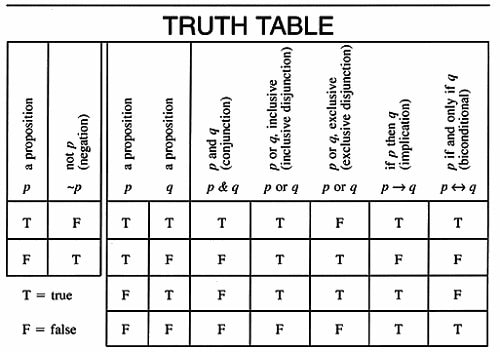
The image below summarizes the behavior of these connectives. We will delve into the construction and use of such "truth tables" in the next lesson, but for now, you can use it as a reference for how each connective operates.
Understanding the Conditional Statement
The conditional connective, , is often the most counter-intuitive, particularly the cases where the antecedent () is false. Why is "if false, then true" and "if false, then false" both considered true implications? The key is to think of it as a promise. The statement only makes a promise about what happens if is true. If is false, the promise is not broken, regardless of the status of .
The following video provides an excellent, multi-faceted explanation to build a solid intuition for the conditional.
The video "How to Read Logic" gives several analogies to help understand why the conditional's truth table is defined the way it is.
Please watch the section explaining the implies connective, from this part. The speaker uses intuitive, mathematical, and visual examples to clarify its meaning.
Forming Compound Statements
Now that we have the building blocks, we can construct more complex statements. Just as in programming, logic has syntactic rules. We use parentheses to group statements and ensure there is no ambiguity in the order of operations. The main connective is the one that connects the largest components of the formula.
For example, in the statement , the main connective is . It connects the compound proposition to the simple proposition .
The following video segment discusses these rules for creating "well-formed formulas."
Propositional Logic: The Complete Crash Course
This clip from "Propositional Logic: The Complete Crash Course" explains the rules for combining propositions and connectives into valid logical expressions.
Watch the part on forming complex formulas. Pay particular attention to the concept of a "main connective," which determines the overall structure of a compound statement.
Practice: Translating from English to Logic
Let's practice translating a few sentences into the language of propositional logic. Define your own proposition letters (e.g., let be "It is raining").
- If the program is running and there are no errors, then the task will complete.
- The system is not in a secure state, or the alarm is not active.
- You can pay with a credit card or with cash, but not both.
Solutions
-
Let be "The program is running," be "There are errors," and be "The task will complete."
The statement translates to: . -
Let be "The system is in a secure state," and be "The alarm is active."
The statement translates to: . -
Let be "You can pay with a credit card," and be "You can pay with cash."
The "or" part is . The "but not both" part means "and not (C and H)", which is .
Putting it all together: . This is the logical structure of an exclusive or.
Conclusion
In this introductory lesson, we have established the fundamental components of propositional logic. You have learned to:
- Identify a proposition as a statement that is either true or false.
- Recognize the five logical connectives: negation (), conjunction (), disjunction (), conditional (), and biconditional ().
- Translate simple English sentences into compound propositions using these connectives and parentheses to ensure clarity.
This is the essential vocabulary and grammar of mathematical language. In our next lesson, we will build upon this foundation by exploring truth tables. This powerful tool will allow us to systematically determine the truth value of any compound statement, no matter how complex, and to establish logical equivalences—a critical skill for constructing rigorous proofs.