Welcome back! In our previous lesson, we introduced the key concepts for this module: the target (a tridiagonal matrix) and the tool (a Householder matrix). We established that a Householder matrix represents a geometric reflection and has the convenient properties of being symmetric and its own inverse.
Today, we will move from the what to the how. You will learn how to build a specific Householder matrix to achieve a precise goal: transforming a given vector into a new vector that has zeros in specific entries. This is the fundamental building block of the Householder tridiagonalization algorithm. By the end of this lesson, you will be able to construct the exact matrix needed to perform this vector transformation.
The Goal: Reflecting a Vector onto an Axis
The core task in tridiagonalization is to introduce zeros into a matrix. We achieve this by targeting columns of the matrix, one vector at a time. The goal is to take a vector and find a Householder matrix that transforms it into a vector that is simpler—specifically, one that points along the first standard basis vector, .
Since Householder transformations are reflections, they are orthogonal transformations, which means they preserve length (the Euclidean norm). Therefore, the target vector must have the same norm as the original vector . This means our target vector must be of the form:
where . This leaves two choices for the target vector: or .
The following video explains this setup beautifully, showing how to determine the reflection needed to map a vector to a multiple of .
3.3.2 Householder transform, part 3
This video from the "Advanced LAFF" series details how to find the specific Householder transformation that maps one vector to another with zeros in desired locations.
First, watch the section that defines the problem of transforming a vector \mathbf{x} into a multiple of \mathbf{e}_0 (equivalent to our \mathbf{e}_1). Next, focus on the geometry of the reflection. The key insight is that the vector defining the reflection plane, \mathbf{v}, is simply the difference between the starting vector \mathbf{x} and the target vector \mathbf{y}. Watch the derivation of this vector from the geometric picture. Finally, the video discusses the two possible choices for the target vector (plus or minus the norm) and provides the final formula. Watch from the discussion on choices to the conclusion.
The Recipe for Construction
As the video established, the vector normal to the reflection hyperplane is the key. Let's formalize the process. Given a vector , we want to find a Householder matrix such that .
- Define the target: Let the target vector be , where .
- Find the reflection vector: The vector that defines the reflection is the difference between the start and end points: .
- Construct the matrix: The Householder matrix is then given by . This form is convenient as you don't need to normalize to a unit vector separately.
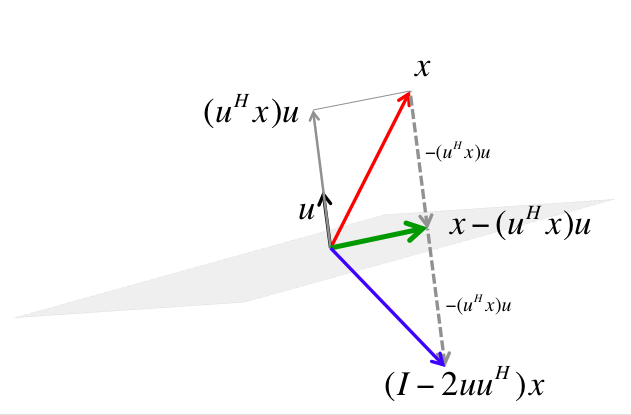
The image below, which you may recognize from your course materials, illustrates this reflection process. The vector is reflected across the hyperplane defined by the normal vector . The component of along is projected and subtracted twice to get the final reflected vector.
The following reading provides a concise summary of the formulas we need.
This web page provides the essential formulas for constructing a Householder transformation to zero out vector components.
Please read the section titled "The typical use", which explicitly states the formula for the vector \mathbf{u} needed to transform \mathbf{x} into a vector of the form \sigma\mathbf{e}_1.
A Note on Choosing the Sign
You have two choices for the target vector: or . While both are mathematically valid, one choice is better for numerical stability. To avoid subtracting two nearly equal numbers (which can lead to a loss of precision in floating-point arithmetic), a standard convention is to choose the sign of to be the same as the sign of the first component of , . This ensures that the first component of is a sum, not a difference, maximizing its magnitude.
So, the robust formula for our reflection vector is:
Or, if you prefer to avoid subtractions, you can define the target vector with the opposite sign, leading to . The resulting Householder matrix will be the same. Let's use this second, addition-based form for our example.
Worked Example
Let's apply this recipe to construct a Householder matrix that transforms the vector into the form .
1. Given Vector
2. Calculate the Norm
3. Determine the Reflection Vector
The first component, , is positive. Following the stability convention, we use the formula .
4. Construct the Householder Matrix
The formula is . First, we need the scalar and the matrix .
Now, substitute these into the formula for :
This is the Householder matrix we sought.
5. Verification (Optional but Recommended)
Let's check if gives the expected result, which should be .
The result is exactly as expected. We have successfully constructed a Householder matrix to zero out the second and third components of our vector.
Conclusion
In this lesson, you've learned the practical mechanics of building a Householder matrix for a specific purpose. This is a crucial skill that transforms the Householder matrix from an abstract concept into a functional numerical tool.
The key takeaways are:
- To zero out elements of a vector , we reflect it to a target vector that lies on a standard basis axis, such as .
- The reflection is defined by the vector .
- A numerically stable choice for the reflection vector is .
- The final Householder matrix is constructed using the formula .
Now that you can transform a single vector, you are ready for the next step. In the upcoming lesson, we will apply this technique to the columns of a symmetric matrix, performing the first full iteration of the Householder method to begin its transformation into tridiagonal form.